
The longevity of the Resident Evil series remains undisputed. Twenty-four years running with eight movies in tow, it was once–until the arrival of The Super Mario Bros Movie and The Super Mario Galaxy Movie, both of which made in excess of one billion dollars at the box office–the most financially successful movie franchise based on a video game and to this day remains at the top of the most profitable zombie horror series. It survived a botched reboot and a cancelled Netflix series. Some would say that it behaves much like its subject matter: a movie zombie that continues advancing regardless of the damage it suffers, so long as its own brain remains unharmed.
But let’s make it clear that this particular zombie must be protected at all costs and whoever wishes to fire a bullet through its zombified cerebrum must learn that there is more than a spark of life left in it. It turns out that, much like many other Hollywood filmmakers in recent years, the Resident Evil franchise has taken a right turn and produced an entry that dwarfs all of its predecessors. In contrast to movies spearheaded by Paul W.S. Anderson and his successors, who were initially more intrigued by the lore of the video game they were adapting and later opted to capitalize on Milla Jovovich’s badassery, Zach Cregger (Barbarian, Weapons) had a different idea in mind. Instead of paying attention to the story and developing a narrative in the way movies tend to do so, Cregger clearly decided to adapt the experience of playing the game and make sure it vibed authentically.
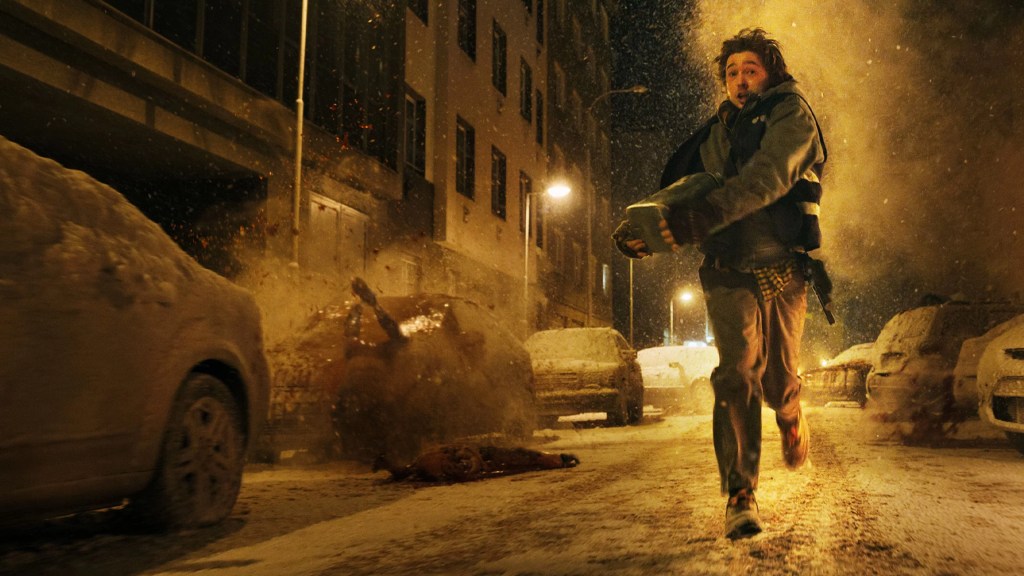
Therefore, it might not be the best idea to view this movie as though it was any other horror film because the convention it follows might not reflect the genre at all times despite borrowing from it somewhat. Much like the game would, we immediately inhabit the perspective of its protagonist Bryan (Austin Abrams), a courier who drives between hospitals delivering organs for transplant surgeries. He takes on a last-minute assignment to drive down to Raccoon City (which we already suspect is going to be a trip into the mouth of horror) and–as he tries to reconcile with his girlfriend over the phone–we tag along as the plot of the movie drags him further in. His car is not suitable to drive in the snow, so he skids more than he drives. Suddenly, a figure appears on the road and Bryan smashes into her. It quickly turns out that she’s not quite normal. We know what’s what even if we haven’t played the games in recent years. The movie just accelerates from there.
You could accuse Cregger’s movie (which he co-wrote together with Shay Hatten known for having written a bunch of movies for Zack Snyder and Chad Stahelski) of absolving the protagonist of any noticeable agency or ability to pause and reflect upon his own character. In many ways, the movie resembles stuff like Army of the Dead and some of the later John Wick sequels which actually behaved as though they were adapted from nonexistent video games. Well, Resident Evil is an adaptation of a video game which makes it proper and expected for it to look as though it was adapted from one. It’s not the 90s anymore and the audiences this movie targets have grown up with video games as their primary entertainment drivers so there’s no need to make them look like movies. In fact, the opposite is true: Cregger understands that the mission is to make the movie look and feel like the game.
And the key part of it is to recreate the feeling of traversing a world that only looks vast but remains mostly out of reach because straying too far from the predicted path will bring the player into contact with an invisible wall. It’s equally crucial to conjure the sensation of stumbling into predicaments and then serendipitously discovering conveniently located solutions to problems. Thus, Bryan will escape the zombie hitchhiker and find a farmhouse. There he will be attacked by a dog and hide in a barn. The barn will have a loft inaccessible to the dog. He will then trap the dog inside the barn and jump out of the window. Then he’ll get to the house and find a shotgun. The shotgun will come in handy when confronting a zombified owner of the house. He’ll then find car keys and escape the farm. He’ll get trapped in a tunnel and we’ll get to experience a bit of first-person horror vibe that will remind you of the game. Bryan will continue making right decisions based on narrative conveniences, set off events by way of walking into locations that otherwise would remain dormant and progress through the world where each encounter seems increasingly more difficult to overcome. He’ll come across people who would drip-feed just about enough exposition to let us all know where we are going but not too much to slow down the pacing. After all, nobody wants to slow down an action video game to listen to people explain stuff for minutes at a time.
Hence, Resident Evil adds up to a wholly satisfying experience that eschews the expectation of a typical action movie and delivers on what the video game series relied on, which is a combination of immersiveness, urgency and suspense, seasoned generously with recognizable iconography. The story, such as it is, remains secondary. Ditto character development. After all, in the context of a video game, you–the player–are the character so character motivations matter only peripherally. Something must be there to retain immersiveness but not too much to overshadow the experience whose primary mission is to entertain through agentic action. Whatever lore, mythology and exposition we encounter along the way is merely window dressing.
And it is all delivered with a sense of self-awareness that Cregger has consistently brought to his recent movies in spades. His take on Resident Evil is not pompous and self-serious. It’s urgent and visceral when it matters and cheeky when it can, so the overall experience registers as effortlessly entertaining and simply fun. Between a good handful of dynamic set pieces that hark back to video game iconography as opposed to unfiltered movie knowledge base and an immersive story structure that leverages convenient urgency that typically registers as cliché in a film context, this new reboot of the franchise is nothing but a breath of fresh air. A well-executed video game playthrough with cinematic narration to hold everything together.
In fact, this 2026 Resident Evil reinvigorates the series and gives it enough momentum to potentially climb to the top of the heap of the current wave of video game adaptations done well. Who knows: we might have to petition the rights holders to change the series name to Resilient Evil to reflect its renewed prowess.





Leave a Reply