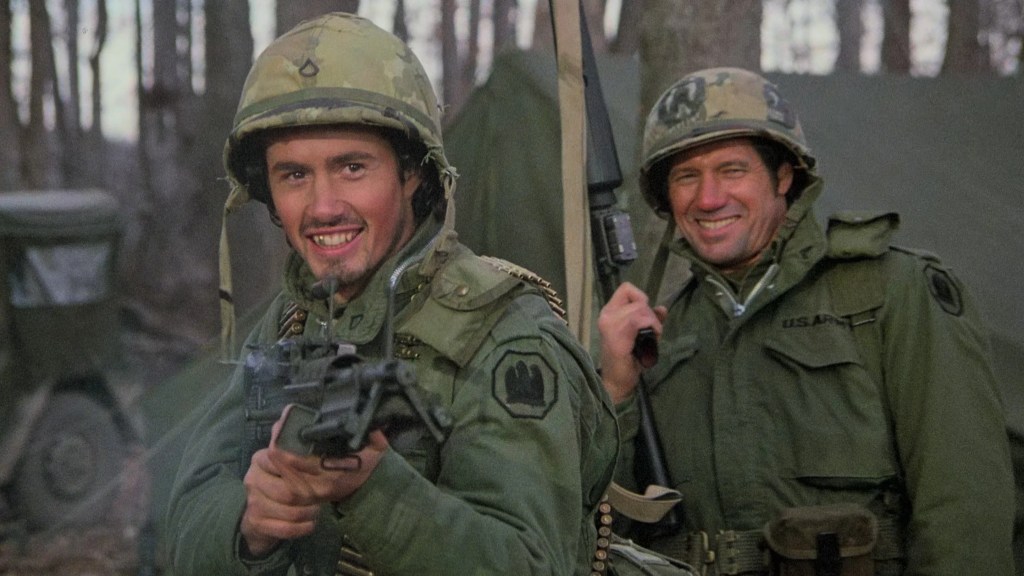
Walter Hill has said that the idea to make what became Southern Comfort originated from two sources: (1) a need to satisfy the conditions of a deal Hill and David Giler had with 20th Century Fox where they would provide the studio with commercially-viable scripts that required only frugal budgeting and (2) the simple drive he had had to make an entire movie set in Louisiana. This latter desire traced back to his experience of shooting parts of his directorial debut Hard Times there.
What Hill and Giler envisioned, together with screenwriter Michael Kane they commissioned to write the first draft of the script, was a lean survival thriller set in the Louisiana bayous where a group of National Guardsmen would end up antagonizing the local Cajun population and have to fight their way out of this predicament to ensure their survival. Many studios scoffed at the pitch of what must have looked like a gloomy thriller mired in moral ambiguity that squarely belonged in the 1970s and the industry had just turned a corner. Movie brats and New Hollywood auteurs were out after a string of financial failures like Sorcerer and Heaven’s Gate, and unabashed escapism spearheaded by George Lucas, Steven Spielberg and others was what made money in Tinseltown.
Nevertheless, Hill and his cohorts found their funding and put together Southern Comfort starring Keith Carradine and Powers Boothe with minor roles from Peter Coyote, Brion James, Fred Ward and a few others. Predictably, the movie didn’t make any money at all. Audiences wanted Indiana Jones, Luke Skywalker and Superman to peer at them from the screen, not a bunch of mud-caked Geronimos with their manly banter and ethically-dubious motivations getting lost in the swamp and picked off methodically by the local population. Some critics saw this as a distant echo of John Boorman’s Deliverance and shelved it as an example of “hicksploitation.” Some others viewed the movie as an attempt at continuing the conversation about the Vietnam War, which they considered closed having experienced The Deer Hunter, Coming Home and Apocalypse Now only a few years earlier. Even Walter Hill wanted to distance his movie from the Vietnam conversation and allegedly prohibited his cast from talking about Southern Comfort as a Vietnam allegory when speaking to the press. Years later, what had been a box office dud in 1981 grew to become a cult classic on video, a piece of gritty and masculine action cinema enjoyed by guys and dudes who’d swipe it off the Blockbuster shelves together with their beloved Stallone and Schwarzenegger mainstays.
But you could say that all those groups–dudes who were after action, Deliverance equators, Vietnam allegorists and even Walter Hill himself–missed the point the movie was making. Their mistake was assuming the wrong point of view even if principally they were right to draw those connections.
The movie greets us with imagery of uniformed soldier-looking men firing their rifles towards the camera. They are not the regular army, though; they are National Guardsmen dispatched to a weekend training. What they are firing are blanks but the hot-blooded resolve recoiling in their minds is as real as it could be. These guardsmen are just regular people plucked out of their blue- and white-collar existences for a weekend away in the Louisiana marshlands to participate in an exercise in territorial defence, survivability under battle-like conditions, fire-and-move tactics and everything else one might expect from a standard training exercise of this sort.
However, the situation in the film is far from standard. It’s 1973 and the country is in the midst of an unpopular war waged overseas. Therefore, the circumstances or the makeup of who would join the National Guard at a time like that might matter more than one would expect. The team we meet in Southern Comfort is a concoction of oldtimers who see participation in territorial defence as an indispensable part of their civic duty, young men trying to avoid being drafted into the regular army and sent into the Vietnam meat grinder, jaded outdoorsmen who enjoy camping in large groups, and a few who relish the hypothetical fantasy of shooting at people who looked nothing like them, dropping napalm on villages and other forms of state-sanctioned murder without having to actually travel into a warzone.
This collection of characters is quite broad and recognizable: it’s got white guys and black guys; old guys and young guys; introverts and extroverts; idiots and intellectuals. Thus, it might be instinctive for us to latch onto them. It’s an American movie about American men and chances are you might see someone from your societal substrata in there. These are the guys we follow. And that’s our first and biggest mistake.
That’s because despite the fact that these characters are wearing army fatigues and the camera insists on following them, they are not the heroes. It takes but a few minutes to understand the group dynamic and single out some of the more volatile characters on the screen. They’re incompetent and insubordinate, the leadership lacks gravitas and some people on the team clearly want to roleplay being in Vietnam with their insistence on firing blanks at random objects or brandishing their knives. They get lost in the swamp almost immediately and instead of heading back to base to seek advice or to regroup and rethink their plans, they double down and elect to solve their problems by way of escalation. They encounter what looks like an encampment of Cajun fishermen and they unilaterally decide to steal their pirogues in order to get through a flooded area that they had originally imagined they’d be able to traverse on foot. They care not one jot about the simple fact that they are about to commandeer someone else’s property, perhaps because they see their needs as superior. After all, they see themselves as an army outfit on a mission. Or maybe they don’t regard the local Cajun population too much and think of them as uneducated swamp hicks who don’t deserve to have the boats that they are about to take. Even though they technically bicker about the practicality of it all, and Hill’s camera remains neutral while letting us hear some opposing opinions on the matter, they simply appropriate what they need and agree to leave a note stating they’d return the boats and asking the owners to trust that they would. American exceptionalism rendered flesh.
Events escalate once again almost immediately when the Cajun fishermen come back to their camp and notice the Guardsmen crossing the swamp in their pirogues. This would probably be a good moment for anyone in the group to communicate or to turn around to speak to them. After all, they could have easily waited for the Cajuns to return to the camp, ask them if they could use their boats to cross and they’d have probably obliged. Failing that, they could have crossed in smaller groups to make sure they wouldn’t need to take all their boats. Instead, one of them, PFC Stuckey played by Lewis Smith, opened fire at the group of Cajuns who emerged from the woods. He knew he was firing blanks and roleplaying. We knew he was doing so because we had seen this behaviour foreshadowed in the opening scene of the film. But the Cajuns didn’t. They ran for cover because they thought they were being fired upon with live ammunition by a hostile force. And the fire they ended up returning was very much real; real enough to give the leader of the group (and the most experienced and put-together character in the group, played by Peter Coyote) what looked like a JFK haircut. At this point both the audience and the group understood that things became real and a game of survival had just begun in earnest. The only way out was through. We sat there with these discombobulated guardsmen and tacitly agreed that they were under attack and the mission was for us to ensure they’d get back to safety. Which is our second mistake. We have imprinted on this group by virtue of social makeup and now we have invested in their plight of survival and eventual escalation.
From that point onward, having witnessed a string of these snowballing events, it’d become progressively easier to either get on board with what the Guardsmen would do in pursuit of survival and retribution, or to at least look away and rationalize their morally compromised behaviour. We saw them happen upon a hut occupied by a one-armed Cajun man whom they immediately accused of killing their leader and we just rolled with it despite the fact we had seen the man who fired back and he had both arms.
But it didn’t matter because in their eyes all Cajuns looked and sounded the same. It made sense to them to escalate events by applying collective responsibility for what they saw as an act of aggression. They conveniently forgot that one of them had fired blanks at the Cajuns first right after they all collectively stole their boats. So, we watched as they berated, abused, imprisoned and eventually tortured the one-armed Cajun, blew up his house and turned all his possessions into a heap of smouldering rubble. And when the Cajun hunters and fishermen, likely the ones whose boats these characters stole, began setting up traps, picking off the Guardsmen one by one under the cover of night, the movie’s perspective didn’t budge even a little. We were fully ensconced in the group’s survival and what Southern Comfort turned into was a close approximation of Wes Craven’s The Hills Have Eyes. For all we knew, these Guardsmen were under attack from a horde of marauding cannibals whom we never saw in close-up and the one we did spoke no English, had only one arm and lived like a primitive hermit.
By the time we were able to wander into a Cajun settlement, bustling with life and music, everyone but the two leads played by Powers Boothe and Keith Carradine had been killed off by what always looked like ghostly apparitions emerging from the fog only to dissipate into the marshes immediately thereafter, or by their savage contraptions. This is where the film does for us what we would never have done for ourselves. It performs the reversal on our behalf: the fog lifts, the apparitions acquire faces, and the people we were taught to fear are shown going about their lives. Both the characters and the audience are forced to unwind the conditioning the preceding two acts of the movie had subjected them to and see the Cajuns for who they really were: not a hive mind of hicks who all looked the same, or an alien hostile force, but a community of real people with lives, dreams, needs and ambitions. As Boothe and Carradine walked through the Cajun village and hid from their pursuers, we could easily see that just because these people spoke a different language and lived very simple lives, they weren’t monsters, unwashed swamp-hicks with atavistic tendencies or shapeless slasher villains sent from hell to torment fatigue-clad weekend warriors for their sins. They were just rural people.
For two acts, the Cajuns are denied faces, and when they speak, they do so in unsubtitled French. Southern Comfort hands the Deliverance-primed viewers exactly the opacity they expect, and lets them supply the menace themselves. However, it is equally a refusal to translate these people for our convenience, the same entitlement the Guardsmen show when they help themselves to the boats. Both readings are true to an extent, and that is the point. The film does not make the Cajuns sympathetic by explaining them. It shows us what it costs to not understand someone, and then presents the bill.
It’s not all black-and-white, though. Hardin (Boothe) and Spencer (Carradine) are the only Guardsmen who most consistently oppose or vocally criticize escalation, and they are the ones we are left with at the end. It is comfortable to attach ourselves to the reasonable men in the group and tell ourselves we were never like the rest. But the film has already shown that being the conscience of a bad expedition does not make you innocent of it. They haven’t done enough to stop their teammates from taking the boats, looked the other way and still got into the pirogues while they could have stayed behind in protest.
If you switch perspectives and watch the film from the point of view of the Cajuns, you’d see a bunch of men getting up to go fishing in preparation for the upcoming village feast. Someone might mention that they’d be out getting hogs from the local pig farm for slaughter; the same hogs we see actually killed on screen in the Cajun village towards the end of the film. They’d head out to their encampment, leave their boats and hear terrifying noises coming from somewhere in the woods. They’d leave and hide to avoid confrontation. They’d come back to their camp not only to notice their boats stolen but to be fired upon in an open act of hostility. This is life or death. What if these bloodthirsty soldiers find their village? Are they going to massacre their families and raze the buildings to the ground? Can they trust that these people wouldn’t do any such thing? Would you?
From the Cajun point of view, Southern Comfort is a siege movie where a brutal horde of marauders emerges from the fog and threatens the Cajun way of life with their reckless and arrogant violence. It’s a movie where a community bands together to defend their families and friends from a seemingly existential threat. However, anyone who immediately tethered this movie thematically to Deliverance would likely fail to notice this subtle distinction. They’d be inclined to stereotypically pattern-match the Cajuns in this movie to the Appalachians in the John Boorman film and disregard a handful of key ingredients that were simply missing from the Walter Hill film. Even though Deliverance carried its own stinging message about the hubris of men venturing into the world they did not understand, it nonetheless characterized the local population as unwashed, uneducated and brutish. And to dispel any ambiguity, the film focused and literalized all those characterizations in the infamous and harrowing scene where Ned Beatty’s character was sexually assaulted by a local hick.
The idea of seeing Southern Comfort as a distant cousin of Deliverance and reviewing it through this lens requires the viewer to see the Cajuns as hostile and animalistic because they’ve seen a similar-looking population behave in similar ways. Simplistic stereotyping at work. From there, it doesn’t take much to assume that just because we haven’t seen any of them rape or violate anyone, it doesn’t mean that they didn’t or wouldn’t do it off-camera. After all, we saw one point his rifle at Peter Coyote’s character–a character we are implicitly more likely to latch onto because he leads the group the camera follows–and blow his brains out. And then we proceed to watch the Cajuns leave ominous-looking taunts and traps behind. The movie undermines this stereotyping very subtly and acknowledging this process requires a nuanced look at the film, something I don’t think many viewers would accommodate. Once tethered to Boorman, hicksploitation is in progress and the movie becomes a slender survival thriller… until we reach the Cajun village and are confronted with reality. Sadly, by the time this happens, we might just want to see the two characters make it out alive so we might overlook the fact that the Cajun settlement does not look one bit like a post-apocalyptic set ripped right out of Mad Max and nobody behaves like the cannibals from The Hills Have Eyes.
The case is similar when, against the wishes of the filmmaker himself, the viewer adopts the lens of seeing Southern Comfort as a Vietnam allegory. On that note, I think it is perfectly understandable that Hill did not want his movie to join the Vietnam conversation because it would be the only conversation anyone would have while discussing the movie, such was the power of this allegory at the time. It is nevertheless inescapable because, whether he liked it or not, Southern Comfort was a movie about the Vietnam War, but not necessarily in the obvious way. In fact, incidentally or otherwise, it denuded something profoundly sinister about the American population that was supposed to head out to the cinemas to see it.
The straightforward way to decode Hill’s movie as a Vietnam parallel doesn’t require much more than looking at the setting and basic characterizations. American soldiers traversing foreign-looking landscapes and attacked by faceless locals who emerge from the fog to pick them off one by one. The invitation to see Southern Comfort as a conversation about how woefully unprepared the US Army was when they entered the Vietnam War and how outmatched it was despite outnumbering and outgunning the Viet Cong was right there in the open, ready to be picked up. It didn’t take a lot of effort to use this movie as evidence of utter nationwide incompetence that coloured the war that claimed nearly sixty thousand American soldiers, not to mention over three hundred thousand wounded. But even still, the perspective was incorrect.
This is because even referring to this movie as an allegory of The Vietnam War betrays the issue. In Vietnamese, this conflict is called “Kháng chiến chống Mỹ cứu nước” which translates to “Resistance War Against America to Save the Nation.” Resistance. War. To Save. The Nation. A war that depending on the assumed perspective looked completely different. From the point of view of the American government, it was a mission to contain what they saw as the worldwide spread of communism. From the point of view of the North Vietnamese and their supporters, it was a war of self-defence against a well-armed and vicious enemy, a war to defend the Vietnamese way of life from invaders trying to impose their worldview upon them by violent means.
That’s why, especially now, when public sympathy in conflicts like Israel-Palestine is shaped so heavily by which side feels familiar to us, it is imperative for us to watch Southern Comfort from the Cajun point of view. In 1981 the world wasn’t ready to contend with the possibility that America, the country that saw itself as the world’s policeman, was morally and ethically compromised. The film’s reception says as much: critics filed it under hicksploitation and considered the Vietnam conversation closed. But the war was a brutal campaign of conquest and geopolitical influence in which the GIs were not simply “the good guys.” So if you want to read Hill’s movie as a Vietnam allegory, you are right to, but the perspective has to change. Reducing it to American boys trying to survive a hostile swamp gives you only half the picture. It obscures the uncomfortable reckoning with the war, and with how readily we side with whichever army looks like us.
Southern Comfort is best seen as a study of the American foreign policy stance and a general cultural stance of assumed superiority. We tend to side with the Guardsmen only because they look like us and talk like us and we should not overlook their arrogance. We ought to recognize how they refuse to backpedal from terrible decisions and how they solve problems by violent escalation. We should also notice how easy it is for us to accept it all because of that implicit sense of affiliation. The National Guardsmen in Southern Comfort are the villains in a horror movie where Cajuns defend their homeland and way of life from extermination. The trick is to realize that the camera follows the villains.







Leave a Reply