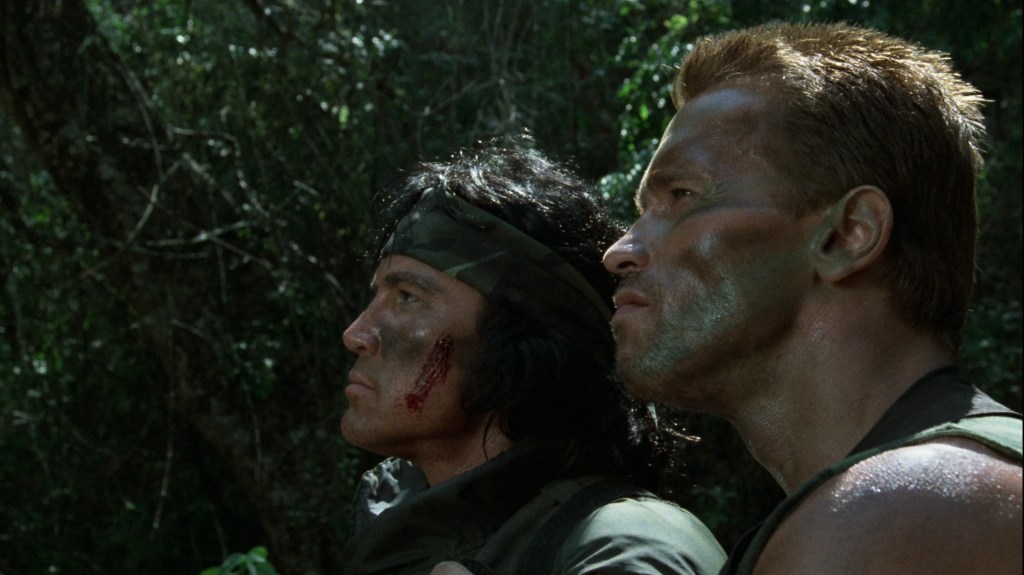
When Predator opened in June 1987, it immediately secured the top spot at the box office. Even though it dropped out of the top 10 in the following weeks squeezed out by tough competition, the “Arnold versus Alien” picture became a mainstay on video and an instant cult item. As per the well-trodden Hollywood logic, greenlighting a sequel was merely a matter of time. But as we all know, the franchise that grew out of the cultural success of Predator went on to live on its own, without Schwarzenegger’s brand propping it up. It became one of the most fertile and most recognizable intellectual properties in the entertainment business with a number of sequels, crossover movies, comic books, video games and an entire universe of fan fiction writing expanding its world beyond what the original script Jim and John Thomas slid under doors of Hollywood executives ever imagined. The question is why that is, and more importantly, what it means.
In fact, the idea of launching a sequel to Predator with Schwarzenegger in the lead was concocted almost immediately. Stephen Hopkins, who ended up directing what eventually became Predator 2, said that original plans for the movie involved Arnold teaming up with Danny Glover in a buddy action format. It all fell apart, though, over a combination of money and priorities: Schwarzenegger allegedly demanded too much upfront and eventually was forced to choose between Predator 2 and Terminator 2. Many would agree that he chose wisely.
This wasn’t the end of the story, though, as in the mid-1990s Robert Rodriguez flirted with the notion of writing a sequel to Predator when he was riding the wave of his early-career success. As a fan of the original movie, he imagined writing what Aliens was to Alien: a bigger, bolder and louder sequel that would open up the universe and weave the story around the character of Dutch in a not too dissimilar way in which Ripley was brought back to her franchise in 1986. What he ended up writing was an everything-cocktail that was too unwieldy and expensive to produce at the time with its alien jungles, multiple predators, extended lore and demanding special effects. Predictably, the project ended up shelved for over a decade before it was dusted off, trimmed down and reworked into what became Predators. Even still, Arnold was approached to appear in a cameo despite serving as the governor of California. He declined.
Similarly, Shane Black–who appeared in the original Predator as the pottymouth Hawkins–made an attempt to bring Schwarzenegger into the fold when he was conceptualizing The Predator. At the time, Arnold was acting again having concluded his frontline political career, but he didn’t want to come back for a mere cameo and attempts to rejig the script around his star appearance amounted to nought. Stars just wouldn’t align for Arnold Schwarzenegger, the name that had drawn audiences to the cinemas in 1987, to come back to the series for anything more than a voice appearance in a video game Predator: Hunting Grounds. So, while it is principally correct to notice that the franchise has done fine without Schwarzenegger’s continuing brand support, it wasn’t for lack of trying.
The original movie which sparked this seemingly evergreen franchise originated as a fluke. It all started with a joke: what if Rocky Balboa fought an alien? At that time, with a number of sequels in the Rocky pipeline, it was fun to jab at the series that looked as though it was going to add seventeen more entries where the underdog slugger would face against progressively preposterous opponents. He had finally defeated Apollo Creed in Rocky II and Clubber Lang, a snarling brute anticipating Mike Tyson, in Rocky III, and a personification of communism in Rocky IV. This idea eventually coalesced into a script–after a number of changes ranging from reducing the scale and number of alien opponents human heroes would have to encounter–where a single action hero would face off against an alien hunter who came to Earth to kill for sport.
When Schwarzenegger was approached to star–being the foremost muscle man of the era–he didn’t want this to be a showdown. He had done one-army-man movies before (Commando, Raw Deal) and felt that he needed to challenge himself. He suggested rewriting the movie around a team of high-performing, testosterone-dripping men with him in the lead. He wanted his The Magnificent Seven, his The Wild Bunch. His own personal The Dirty Dozen. Consequently, Predator was reshaped to become something else that incidentally ended up commenting on the direction of blockbuster entertainment on a meta level.
The movie the world saw in 1987 was not a typical action thriller despite the fact many critics pegged it as such. Janet Maslin called Predator “grisly and dull,” Michael Wilmington derided it as “derivative” and many others saw it as merely an evocation of a Hollywood insistence to mash genres together. They saw Rambo meeting Alien and surmised they had seen it all before… even though they had, in fact, not. What they should have done was zoom out and assume a wider perspective on the matter and maybe lend this movie a little bit of rope instead of dismissing it wholesale as a dumb piece of gun-toting Reaganite exceptionalism. The world of high-octane entertainment was literally changing around them and they couldn’t notice because they were either too close to it or too entrenched in their own worldview.
If you examine Predator a bit more holistically, you will notice that it was not at all derivative but, in retrospect, rather quietly anticipatory of what was coming next. More acutely observant critics of the time remarked that it was by all means a genre mashup, Gene Siskel chiefly among them, even if they intended it as criticism of what they saw as an example of what Hollywood studios had turned to in the 1980s–an elevator pitch movie. A movie that could be explained in thirty seconds or less using nothing but analogy to other successful ideas. Aliens could be boiled down to “Alien meets Vietnam.” Short Circuit was E.T. with a robot in it. And Predator was more than likely distilled to “Rambo meets Alien.” The true value of this proposition lies in the execution and in what this movie hinted was coming next.
The core concept of sending an elite team of action men where Arnold Schwarzenegger didn’t stick out like an overgrown metahuman was already fresh enough. Arnie was leading a group of people like him. Jesse Ventura was just as big as Arnold and he carried a ridiculously huge machine gun that typically was mounted on helicopters. Bill Duke brought menacing stoicism. Carl Weathers came on set with his chiseled post-Rocky physique and solid acting chops. Sonny Landham with his booming laugh and piercing gaze became the group’s emotional barometer. And in a stroke of directorial genius, John McTiernan, who had come from a theatre background and didn’t know what action films were supposed to look like, gave these actors with egos matching their biceps in size enough time to bond so that they’d behave naturally and authentically when the camera was pointing at them. In a movie that audiences and critics had anticipated based on casting alone, the group would have behaved like the A-Team or what we ended up seeing decades later in the nostalgic genre revival The Expendables. What we received in Predator was far more nuanced.
In fact, Predator plays out the abridged narrative of Rambo 2 in the first act. A team of multiple John Rambos arrive at staging grounds, the mission is explained by a CIA operative who joins the squad and off we go in helicopters into the jungle. The music blares from the speakers, Blain peddles chewing tobacco to people and Hawkins tells unfunny dirty jokes. They slide down ropes into the lush forest and proceed with the operation. They quickly reach the hostile village and turn it upside down, much like what John Rambo would have done. Explosions and one-liners. Knock-knock. Stick around. I ain’t got time to bleed. The works.
At this point we are just about thirty minutes into the film and we have essentially dispensed with gun-toting rambology, complete with CIA deception and verbal pissing contests. What next?
This is where the perspective shifts and reminds us of how the movie started. The first images in Predator showed us an alien craft landing on Earth and now after the explosive carnage is over and done with, the movie gives us the point-of-view of the alien. We see our heroes in the iconic heat imaging vision… which is like nothing else people would have seen in 1987, maybe apart from The Terminator with its equally unforgettable red-coloured UI and Westworld with the pixelated Yul Brynner POV.
While the gun-crazy Dirty Dozen on steroids was climaxing in the first act, a whole new movie was slowly gaining momentum in the background, hiding its growing signal underneath the musclebound carnage. Between the hint of an alien craft landing in the opening seconds of the film and a gruesome discovery of Predator’s handiwork that the team assumed had been the work of the rebels they then proceeded to turn into a loose assortment of appendages strewn around the smouldering remains of their makeshift settlement–and the occasional clicking of Predator’s vocal cords filtering into the sound mix–there was enough there to flip Predator into a completely different mode and change the flavour of the film from bombastic apotheosis of muscles and guns to a plight of survival under threat from an infinitely more powerful foe.
On a meta-level, this perspective switch was much more poignant and thematically relevant than it looked. Suddenly, we weren’t watching what the movie had allegedly promised: a bunch of action men doing their thing, brandishing weapons and flexing their muscles. We were watching the action heroes whose exploits had dominated the action genre being picked off by an invisible special effect with remarkable ease. When faced with a threat they could not see, let alone understand, Arnie and his cohorts weren’t in the mood to quip. Their struggle became real and emotionally relevant. While the well-known “stick around” and other one-liners the first act was brimming with all came across as performatively self-aware, once the alien hunter began to stalk the team, their dialogue became astoundingly real. There’s nothing heightened about such iconic lines as “if it bleeds, we can kill it” or Billy’s “there’s something out there waiting for us… and it ain’t no man.” Even the much-parodied “get to the chopper” comes across as wholly authentic and emotionally charged because what we are watching are not action heroes mowing down their enemies while chewing tobacco and smoking cigars, but the same action heroes fighting for their lives, perhaps for the first time ever.
On some level, you could lend Michael Wilmington and Janet Maslin some rope here and agree that Aliens had attempted something similar a year earlier, but what Predator chose to do was much more profound because it literalized the cultural shift taking place in the entertainment space at the time. Hollywood was slowly performing a course adjustment as the era of one-man-army movies had passed its apex by the time 1987 rolled around. Much of the testosterone-laden actioners we identify with the decade were concentrated in the early-to-mid 1980s with the ascendancy of Rocky sequels, and the arrival of other iconic names to the cinematic octagon, like Chuck Norris and Arnold Schwarzenegger. Their peak had come in 1985 when Rocky IV, Rambo 2 and Commando saw the light of day.
However, audiences didn’t collectively develop an allergic reaction to testosterone overnight, even though some critics grew tired of the trend much quicker than others. These action hero movies did not suddenly disappear but ended up slowly fading out of the top of the box office, displaced by the incoming wave of buddy action movies, and a little bit later by IP-driven blockbusters adapting comic book movies. Towards the end of the decade, the archetypal action man ended up humanized and became an action-everyman with Die Hard. This process was not rapid at all; the change of cultural attitudes resembled a slowly closing door. And movies like Predator sat there on the hinge: one foot in the world of old and the other in the future.
What started as an action movie with Schwarzenegger’s name plastered across the top of the poster transformed midway through the story and became a herald of the oncoming tidal change. A whole team of quipping killing machines ended up dispatched by an alien enemy that we didn’t get to see without his invisibility cloak until fifty-three minutes into the movie, and we only got to appreciate Predator’s design in the final act. By that time, Schwarzenegger’s Dutch had been beaten within an inch of his life and escaped death only by accident because he emerged from a river covered from head to toe in mud, which rendered him invisible to the alien hunter with heat-seeking vision. His weapons were gone and his muscles were useless when confronted with the towering Predator presence that made Schwarzenegger look like a helpless child. By that time, Predator could not proceed the same way that Commando did. Schwarzenegger was in no shape to emerge at the end of the film to tell whoever came to evacuate him from the area that he had left “just bodies” for them.
Although it is impossible to observe evolution in motion at a microscopic level and it is only visible from the perspective of time, a keen observer in 1987 would have noticed that the Schwarzenegger who emerged at the end of the movie was not the same Schwarzenegger we saw at the beginning in his red polo shirt bursting at the seams trying to contain his enormous pecs and with a cigar stub lodged between his teeth. When the chopper finally arrived, we saw a different Arnold: covered in dust, caked in mud and (his own) blood, hands on hips. Triumphant and stoic but somehow smaller and deflated. Relieved and happy to see his rescuers. In the course of his iconic encounter with the Predator–who chose to confront this action hero mano-a-mano instead of blasting him to smithereens like the rest of his team–Dutch showed the whole world the fallibility of the action hero. Underneath the thick layer of dense and chiseled musculature Schwarzenegger was still a man. Weaponless and solitary, Dutch needed to engage his brain and fundamental courage to defeat the Predator. He built traps and decoys; he camouflaged his presence and communicated his vulnerability to viewers who–perhaps for the first time–could not be entirely sure if their idol would come out of this ordeal alive.
Interestingly, in the end it was not Dutch’s cunning alone that decided the outcome. As I said, the alien hunter chose to level the playing field out of a visually-telegraphed sense of honour. He stood there in front of Schwarzenegger, removed his mask (thus impairing his ability to see) and revealed his iconic true form, searing this image into the brains of everyone who came to see the movie. What followed was a Herculean skirmish between a man and an alien demigod where the odds were heavily stacked against the man, even though the man in question was an absolute apex combination of perfect genes, outstanding conditioning and unparalleled personal discipline. And he just about barely outwitted the alien opponent only to escape the blast radius of the Predator’s high-tech hara-kiri at the last moment. The fact we saw Schwarzenegger survive this movie was a stroke of luck tilted slightly in his favour by the combination of his wit, resolve and problem-solving: the three traits that elevated homo sapiens to the top of the food chain on Earth, not muscles and raw power.
When the dust settled and the credits rolled accompanied by Alan Silvestri’s slasher-tinged percussive score, the future had arrived. We saw how the action hero evolved in real time and how his authentic humanity was his salvation when all was said and done. Importantly, we saw the mood shift. Even though–as I outlined in the opening paragraphs of this text–there were serious attempts to continue the Predator series with Arnold Schwarzenegger at the helm, he wasn’t indispensable to it. Though the movie started as an Arnold picture, it ended as a Predator picture. You couldn’t go on to make Predator 2 with a story about Dutch fighting different alien monsters or crossing over with the Alien series and co-starring in a movie together with Sigourney Weaver.
It was obvious to everyone involved that the alien had to come back and although it would have been nice to have Arnold back as well, his presence was not required. The era of action hero was entering its Lebensabend and the era of IP-led and VFX-first blockbusters initially ushered in by Star Wars, Superman and Alien was about to spill over into the action genre and overshadow Schwarzenegger and his cohorts, who would have to morph into different kinds of action heroes to ensure their own survival. John McClane in Die Hard bled, and “if it bleeds, we can kill it.” T2 reframed Arnold’s killing machine as a loyal protector.
Evolution is only noticeable in retrospect so you can forgive critics of the time for not seeing the wood for the trees. But it is undeniable now: Predator was a missing evolutionary link. A hinge upon which the door of change slowly swung shut on the era of gun-toting excess.




Leave a comment