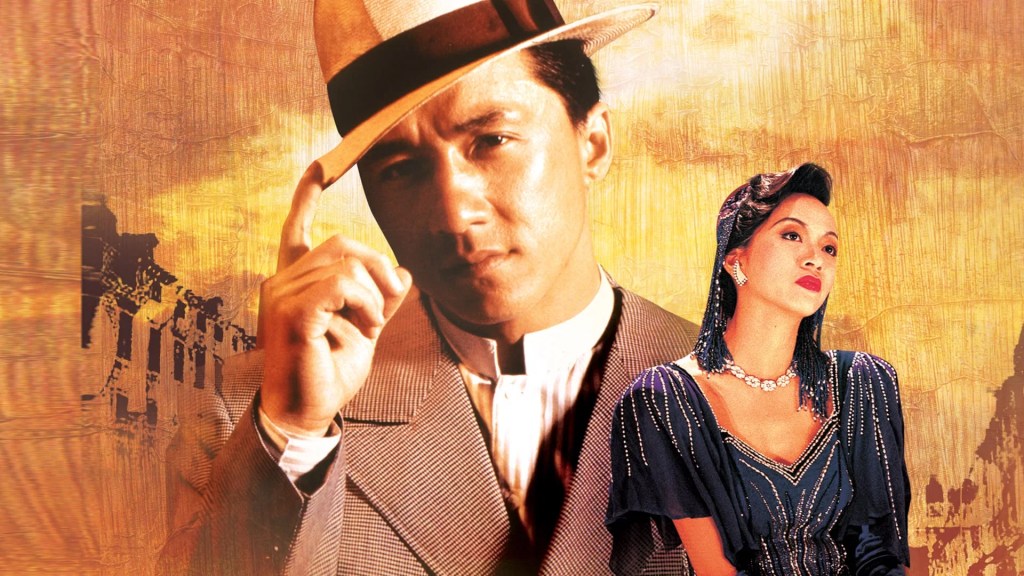
Miracles was released in June 1989 and it was the last movie directed by and starring Jackie Chan to come out in the 1980s. Tucked between Police Story 2 and Armour of God 2: Operation Condor, it remains a lesser-known feature in the catalogue of cinema’s foremost modern daredevil.
Interestingly though, when asked about what his favourite movie was, Chan himself wouldn’t single out any of his most prominent action pieces festooned with the kind of stuntwork that would give Hollywood insurance adjusters heart palpitations like Police Story, where he slid down an electrified pole, Project A where he one-upped Harold Lloyd’s clock tower stunt by falling to the ground, or Armour of God where he base-jumped on top of a hot air balloon. He’d point to Miracles–a period-set gangster epic that loosely remade two Frank Capra movies, Lady for a Day and Pocketful of Miracles and had very little in common with his previous exploits otherwise.
This revelation poses an intriguing question: why? Why would a man who had made a career out of putting himself in harm’s way and who had evolved action cinema with his signature combination of kinetic fight sequences, tactile stunt work and authentic goofiness choose a movie like Miracles as his personal favourite? Admittedly, there must be something about the idea of crafting a period piece with lavish set designs, old-timey cars purring about in the background and numerous extras waltzing in and out of the frame in their zoot suits and wide-brimmed hats that actor-directors find alluring. Working on a set like this must feel as though you were making a capital-M movie harking back to the glitz and glamour of the Golden Age Hollywood.
There seems to be a wider pattern at work here as well, as in many other cases, successful actor-directors would opt to ensconce themselves in potentially perilously expensive passion projects in the aftermath of stunning success. Having written and starred in Rocky, Sylvester Stallone would go on to direct Paradise Alley, a movie he had always wanted to direct. Eddie Murphy would go on to direct Harlem Nights after climbing to the top of the totem pole. Ben Affleck was given a carte blanche after Argo and he chose to adapt Live By Night specifically because he had always wanted to direct a gangster epic. Much like those movies and many others like them, Miracles looked like a product of personal passion enabled by opportunity. After all, despite the fact Jackie Chan’s stardom only penetrated the West a bit later in the 90s, his movies had effectively re-shaped and conquered the box office of Hong Kong, South Korea and Japan. Chan was undoubtedly a superstar of unparalleled magnitude in the region, single-handedly responsible for massively expanding the size of the movie industry.
Undoubtedly, this success came with clout and significant creative capital. Even with a handful of duds under his belt, Golden Harvest moguls saw Chan as a golden egg-laying goose, which meant that–within reason–he was allowed to do whatever the hell he wanted. Which he did. He wanted to make a 1930s-set gangster epic and despite objections from the studio executives who insisted that audiences wouldn’t go for this (and I believe that Chan conceded and included more kung fu in the movie than originally planned), he made one. Not only that, with its budget of sixty-four million Hong Kong dollars, Miracles became the most expensive production in Hong Kong history: partly owing to the lavish production costs and the scope of the spectacle, and partly because the filming ran much longer than intended as a result of a typhoon which devastated a number of sets.
Still, the question remains: what makes Miracles Jackie Chan’s favourite? Is it the fact that he got to wear period suits and design sweeping Scorsese-esque crane shots that roamed opulent sets and made him feel like one of the great Hollywood masters? Is it because it was a movie he made when he was on top of the world? Or was it something else that can only be found when you examine the film itself up close? I believe it’s the latter.
I’d go as far as to say that Miracles is Jackie Chan’s favourite because it resonates closely both with his life story and serves as a metaphorical love letter to his long-held inspirations. In fact, you might be invited to read the movie’s plot as symmetrical to Chan’s own trajectory. In the film, the main character played by Chan, named Kuo Chen Wah aka Charlie, is a nobody who arrives in Hong Kong looking to find success. He encounters a man asking for opportunities and, when asked about his skills, he replies with “kung fu and acrobatics.” It just so happened that Chan himself turned up in Hong Kong with this exact skill set having graduated from the illustrious China Drama Academy, and tried to make it in the vibrant movie industry as a stunt performer and a bit player at first. Kuo ends up swindled out of his money and then stumbles across a flower vendor who convinces him to buy a rose, promising it would bring him good fortune.
Indeed, tables turn when accidentally Kuo finds himself in the middle of a gang war and gives assistance to a dying mob boss. Desperately trying to utter his last words, the gangster confuses his minions into believing that Kuo, who came to his aid in his most vulnerable moment, was to take his place atop a crime syndicate. Immediately, the gangster’s goons put a hat on Kuo’s head and wheel him away into his new life as a crime lord. However, Kuo doesn’t want to take over the reins and engage in smuggling and racketeering; he wants to make a living in legitimate ways and turn the crime empire into something more positive. If he’s to become a local prince of crime, he wants to do things “his way.”
And if it sounds familiar, it is because it is so. Having made a name for himself among stunt performers with his unique willingness to go the extra mile and put himself in danger in ways other stuntmen wouldn’t fathom, Chan was also forced into a position of replacing a position of utmost authority, Bruce Lee himself. After Lee’s abrupt and untimely demise, the Hong Kong movie industry went into a tailspin and immediately a replacement was sought. The movies needed a stoic badass to take over the box office and many people believed that the scrawny-looking Jackie Chan would be a shoo-in. In 1976, he was even cast in a movie titled New Fist of Fury. However, Chan never wanted to replace Bruce Lee. For one, Lee was a legend and Chan instinctively knew that wanting to imitate this man wouldn’t promise a long-term sustainable career and would pigeonhole him as a “lesser” Bruce Lee. And also, Chan felt in his bones that Lee’s on-screen persona and the movies he was in were not in tune with what he wanted to do. Chan was far from stoic and invulnerable and his badassery was of a unique extraction. He wanted to make movies where fights would be kinetic and frazzled, stunts insanely crazy and where action would bleed into comedy while comedy bled into action. He didn’t want to replace Bruce Lee but become a massive box office driver… “his way.”
And the “his way” in question is what matters immensely here. Among the many aspects of Jackie Chan’s movies that separated them from the kind of kung fu movies produced by The Shaw Brothers and Seasonal Films, Chan’s personal love of silent cinema and Old Hollywood was key to their success. By his own admission, Jackie Chan loved to watch old Buster Keaton and Harold Lloyd joints, partly because–as he would explain–you didn’t need to speak English to understand them. The level of storytelling in those early movies was simple and lean enough that movies would cut across cultures and language barriers with remarkable ease. What they also had in spades was unbridled badass energy that permeated early Hollywood.
From that swirling pot of stuntmanlike daredevilry underpinned by unadulterated physical comedy Jackie Chan learned how to make movies that cut through cultures and resonate with audiences the world over. It really doesn’t take a degree in film history to see where his many inspirations hailed from. He would grasp from old movies with both hands and jazz them up accordingly to meet and often exceed his own physical limits. The iconic stunt from Steamboat Bill Jr. in which Buster Keaton seemingly oblivious to the world around him stood like a pillar of salt while a housefront collapsed on top of him, which he escaped unscathed by dint of being perfectly positioned to fit through an open window, was reimagined in Project A Part II. However, Chan didn’t opt to have that meticulously calculated window hole to save him; he just punched through a collapsing housefront with the top of his head. The entire vibe of Wheels on Meals is based on the energy exuded by The Three Stooges classics. Chan’s frequent indulgences in goofy physical comedy–like the scene in Police Story where he answers a number of telephones at the station and ends up completely tangled in cords–hark back to Charlie Chaplin. The screwball nature of romantic relationships written for his leads is tethered to Old Hollywood classics like His Girl Friday, The Philadelphia Story or It Happened One Night; all additionally amplified by Chan’s expressive stage training and perked up with those unmistakably frenetic roundhouse kicks and casual parkour. He took these elements from old movies like good luck charms and redeployed them in his own life with success so stunning that it is easy to imagine divine providence guiding his life choices throughout.
The character he played in the film was Jackie Chan’s own reflection and his life as an accidental mob boss who believed that roses he bought from a street vendor brought him good fortune was symmetrical to his trajectory from a scrappy stuntman to an unlikely replacement for a kung fu legend, to a bona fide action movie legend and a pillar of the Hong Kong movie industry. Therefore, the idea of making a period piece that meshes a gangster epic and a Frank Capra love letter with a helping of martial arts obligatories was quite a bit more inspired than a bout of clout-enabled opportunism. It wasn’t a case of pointlessly squandering the creative capital Chan had accrued over the years, but rather an attempt at consciously spending it in pursuit of repaying what could be seen as karmic debt.
Much like what happens in the movie where Kuo decides to help the poor rose vendor, whose daughter is about to come for a visit thinking that her mother is a well-to-do member of the local establishment and not a haggard beggar, Chan stages an intervention on a meta-level. In the film, the good-natured prince of crime goes to great lengths to make sure that the rose vendor, to whom he owes a debt of gratitude, would come away with her pride untarnished by having to confess the truth to her daughter. One level up, when you look past the production that was as opulent as it was troubled and come to terms with tonal whiplash courtesy of the narrative that packs three movies into a single running time and swerves between a fairy tale, a screwball and a recognizably Chan-esque kung fu joint, the movie is an admission that old movies had always been like those roses bought for good fortune. He had always understood that each and every stunt and idea he’d appropriate from old cinema came with an IOU and a promise that one day, when he had enough money and pull with his financiers to convince them, he’d bring it all out into the open. Thus, what looks like a departure from Chan’s modus operandi begins to make sense because that tonally weird fairy tale is quite possibly meta-autobiographical. It’s Jackie Chan’s way to use the fortune, fame and influence he had earned over the years by drawing inspiration from Old Hollywood movies and the Silent Era to stage its revival in the form of a hybrid remake/love letter to Hollywood’s foremost dreamer, Frank Capra. Furthermore, back on the film level, Kuo uses his own influence and power to essentially stage a movie: a miraculous elaborate illusion to help his friend; when the two levels combine, Miracles transcends even its own ambitious mission and becomes unabashedly self-reflexive while also being incredibly inspired and meticulously engineered.
Sadly, unlike the plot of the movie, the ruse on meta-level did not work as intended. Audiences clocked Miracles as weird and totally incongruent with what they had come to expect from a Jackie Chan picture. Well, relatively speaking. Miracles still became one of the year’s top domestic earners but failed to make a profit due to its staggering production costs. There simply wasn’t enough buy-in even for a star of Chan’s magnitude in the ever-expanding Hong Kong moviegoing market. The scale of its success did not match the level of the film’s ambition, but the ambition in question is what should survive critical scrutiny. It was an easy target for armchair quarterback critics of the time who’d chastise Chan for biting more than he could chew or for indulging and losing sight of what worked and what the audiences demanded from his movies.
Hence, following Miracles, Chan went back to his comfort zone and made a sequel to Armour of God before jaunting to Hollywood once more. Even the movie itself reflects this dynamic as the goofy antics and earnest mythmaking resonant with the true Frank Capra spirit ultimately gave way to an elaborate set piece full of fights and stunts set at a rope factory, as well as a familiar rickshaw chase, during filming of which Chan was, also predictably, injured. Although it was likely a matter of creative compromise between Chan’s own vision for the movie, which was already quite dense with ideas and complex in its own right, and stern recommendations made by Golden Harvest people who worried they might not see their money recovered at all, Miracles looks as though its final act was somehow magnetically drawn to what everyone knew worked well. After all, Jackie Chan was never a wholly indulgent filmmaker and he always remained attuned to the pulse of his audiences.
All he wanted was to show his viewers what made him into the filmmaker and star that they saw before them. He chose to be vulnerable in front of paying audiences in a way many Capra characters would bare their souls while staring into the lens. Chan seems to have felt implicit kinship with Capra and his work, almost as much as he felt that he owed a debt of gratitude to classic cinema tropes he picked up throughout his career like those good fortune roses purchased from a street vendor. Thus, the reason why Miracles remains his favourite is because what you see in the film is Jackie Chan at his most authentic and vulnerable. It’s not a failure to connect or a piece of evidence suggesting that a star bit more than he could chew. Miracles is an admission of love and gratitude and an attempt to bring to audiences in 1989 the kind of filmmaking sensibilities that had since gone almost completely extinct. Which is why this movie ought to be understood and cherished by everyone who wishes to learn more about Jackie Chan as an artist and filmmaker whose provenance extends far beyond his feline physical prowess and earnest camp appeal.




Leave a Reply