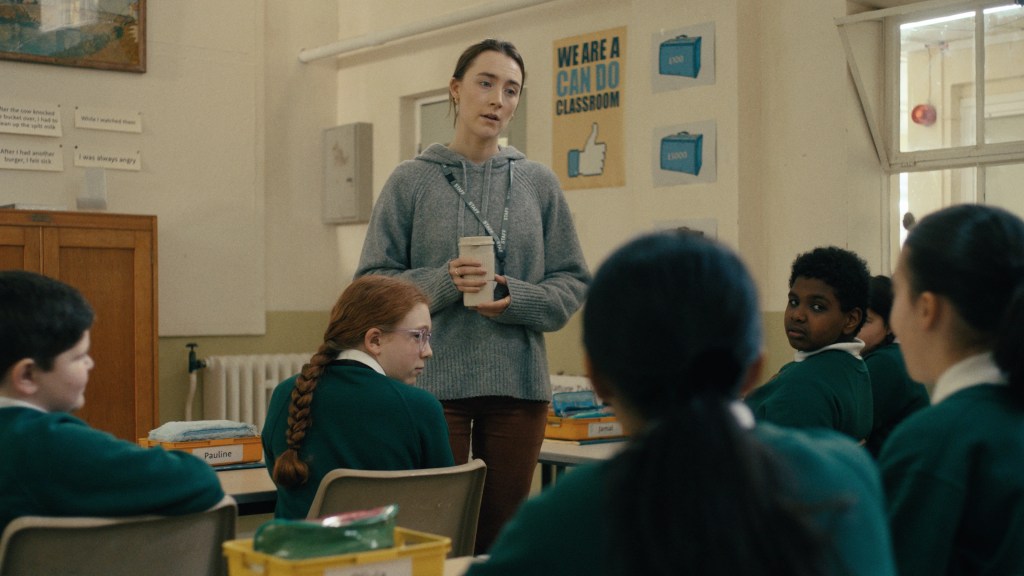

Danny (Eddie Waller) is every teacher’s nightmare: uncontrollable, disruptive, occasionally violent. Maria (Saoirse Ronan) is at her wits’ end. The tools she has at her disposal do not allow her to care for the class and to keep Danny in check. The charitable view of the situation is that the school is understaffed and under-resourced (where are the teaching assistants, you’d ask) as you watch Maria struggle with the increasingly chaotic situation in her classroom that eventually escalates to outright harm when Danny pushes another pupil Pauline (Nia Brown) down the stairs. The more visceral stance you might want to adopt–and I assure you that you will at some point during the first act; such is the way this movie is constructed–would closely resemble the philosophy of Spock: the needs of the many outweigh the needs of the few.
When threatened by the prospect of losing her job as the headteacher (Rakie Ayola) sees the spiralling situation as Maria’s sole responsibility to solve instead of a result of poor leadership and resourcing on her part, Maria heads out to confront Danny’s seemingly absentee father and inform him that Danny has been suspended. What she finds is a single dad who might as well have been plucked out of Ken Loach’s Sorry, We Missed You: overworked and overwhelmed, and also at the brink of sanity because the antisocial behaviour Maria observes at school continues all throughout the day at home and during weekends as well. With an incoming Ofsted inspection looming and pressure on Maria’s shoulders, the story is only left with a handful of avenues to resolve itself and indeed, Bad Apples turns into a wholly satirical dark comedy that resolves its issues by way of escalation to absurdity.
Aided by a handful of narrative leaps of faith that are so convenient they ought to have come in easy-open resealable bags, we find ourselves watching a movie in which a slim and fine-boned female teacher subdues a human equivalent of a juvenile rabid house cat and locks him in her basement that is suspiciously soundproof. The community, initially shocked and appalled by Danny’s disappearance, quickly moves on because the removal of that one particular bad apple from the environment has enabled all other children to flourish. Meanwhile, Maria is left with a leashed prisoner in her house, which is a scenario that cannot realistically be called durable. Hence absurdity ensues and the movie slowly descends down the spiral staircase of caustic entropy and Nordic dry wit.
And that combination is no accident either because Bad Apples is itself replete with that Nordic DNA: adapted from a Swedish novel and directed by Jonatan Etzler, a Swede. Although transplanted into the slumbering West Country setting, the movie could just as well be set in a random small Scandinavian community where everyone minds their own business and where all hard edges are sanded down for that aforementioned Spockian benefit of the many. The entire movie assumes a studied demeanour where the camera always seeks to find that perfect symmetry of the image and where direction and characterization choices make everyone look as though they stepped out of a Richard Ayoade movie.
Therefore, it might take a few minutes to adjust to the movie’s sense of humour and even then some of the audience might not clock Bad Apples as darkly funny or acerbic, but just plain old weird. But the movie isn’t idiosyncratic enough to warrant such dismissal. In fact, it does not go places that a truly weird and out-there film in this space would go. For a counter-example, compare Bad Apples to Jan Komasa’s The Good Boy that took a similar idea of shackling an antisocial youth in the basement to both sequester him from the community he had preyed on and to rehabilitate using some questionable methods and tactics and went full hog into the realm of “what the fuck am I looking at exactly.” Suffice it to say that Komasa’s movie committed decisively to upsetting the audience with its combination of that recognizable Scandinavian coldness and the audacity found in movies directed by Michael Haneke. Meanwhile, Bad Apples registers as shy about doing any such thing. In fact, it is predictably tame in this regard as it repeatedly pulls back from the brink into the warm embrace of awkward normalcy.
Consequently, the film registers as something that narratively wants to go completely nuts and allow its characters to escalate matters to such an extent that the only way out of the stacking absurdity is through a wall of even thicker farce, but nevertheless something holds it back. We follow Maria as she slowly loses grip on things, gets blackmailed by a precocious teacher’s pet and finds increasing kinship with her animalistic hostage, but the story never allows her to completely lose her bearings. Ronan keeps her cool as the camera falls in love with her objectively well-proportioned face and even though towards the end the story wants to make a few choices that hint at weirdness, it all just fizzles into arthouse-adjacent ambiguity, as if the performer wasn’t given the necessary freedom to explore the insanity of her character in a way that could potentially antagonize the audience and have them choose sides. The best-case outcome Bad Apples should have aimed at was to make sure that viewers would take sides and argue between one another on the way home, trying to rationalize or undermine the moral horror show this movie could have explored.
The concept of watching someone imprison a child and following the ramifications of this action was an open invitation to explore the veritable extremity of this predicament in ways that might challenge the viewer. Instead, this rough surface was sanded down and delivered polished well enough that not a single splinter would wedge its way into the audience’s supple little fingers when they chose to place their hands upon it. Which is a real loss because when the credits roll, you might feel something akin to unfulfillment. It is as though the movie left some stones unturned and chose not to upset and discombobulate its viewers with a story that wanted to go ballistic and induce an ethical seizure in at least a handful of patrons who paid to see it.
The upside of it all is that you might consider Bad Apples an accessible alternative to The Good Boy that you could take your mum to see. It won’t send her into a fit, nor will it upset her moral core with visceral visuals. It might instead leave her perfectly content having watched one hundred minutes of mildly idiosyncratic cinema that asks some intriguing questions about the way children are schooled and how we might excuse the notion of excluding a few titular bad apples from the batch to protect the rest from rot. She’ll have a few laughs and one or two scenes will give her a tiny jolt of exhilaration. But the all-encompassing festival-friendly vibe of accessible arthouse will prevail and Bad Apples will register as a nice interlude between lunch and apéro. Though, it’ll be completely forgotten twenty-four hours later because the film’s thematic gentleness will not be able to leave a lasting divot in anyone’s consciousness. Bad Apples is only good for one dinner conversation, not more.




Leave a Reply