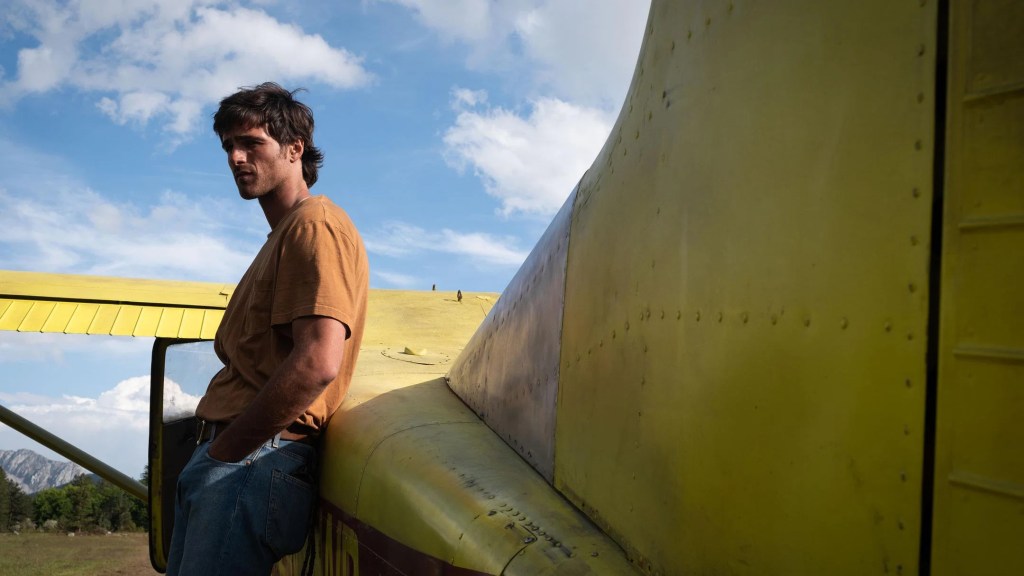

I’m furious and I don’t know where to start. I could go with the tried-and-true “old men don’t make great movies unless they identify as Martin Scorsese” and launch immediately at Ridley Scott’s jugular before I pass out and produce fifteen hundred words of vitriol that I’d have to sanitize somewhat before pressing “publish.” I could equally leave Ridley’s octogenarian backside alone for a second and get my knives out for Mark L. Smith who wrote the movie that boiled my blood because I have a few things to say on the matter. Or I could do both.
Yeah. Both. Both are fine. Let’s do both.
But let’s rewind for just a second because it all begins with the source material. The Dog Stars didn’t come out of nowhere as a movie concept; it was a book first. Not just a book, but a rather successful one. Some critics referred to it as a “crackerjack” while others praised Peter Heller’s craft that didn’t exactly hide its ambitions to sit somewhere in the twilight zone between Ernest Hemingway, Jack London and Cormac McCarthy. Written in a way that is equally sparse as it is precise (which is where Heller’s love for Hemingway protruded through the page), occasionally devastatingly erudite and frighteningly visceral (where McCarthy says hello), The Dog Stars wove a tale of grief and hope situated in the depths of the American interior nearly completely depopulated by a deadly pandemic. Heller made us follow a guy who would stick out as an uber-stoic mute even among the most cowboy-ish of the Montana rangers written for a Taylor Sheridan TV show and painted him as a man of few words but a myriad emotions. A weeping poet hiding in the body of an outdoorsman (which is where a Jack London connection might make an appearance). We sat both on his shoulder and in his head when he interacted with an even more withdrawn survivalist Bangley, with whom he shared his life in the post-apocalyptic hellscape, and when he eventually succumbed to his innate desire to dispense with merely surviving and find someone or something worth living for out there in the seemingly endless expanse of what used to be America.
Heller’s book had it all: a perfect blend of introspective drama, a vivid adventure and a core of humanity grinding against the rough surface of animalistic devolution the human race underwent in a world where survival of the fittest equated dominance of the ruthless. It was unputdownable. And more importantly, it was screaming cinema from its pages. It was merely a matter of time before someone in Hollywood would think it was a good idea to turn it into a movie.
Therefore, it wasn’t really surprising that Mark L. Smith (Twisters) wrote the screenplay for it entirely on spec. For those unfamiliar with the lingo it means that he wasn’t commissioned to adapt this book, let alone paid for it; he wrote it because he felt the need to do so and thought that someone would take interest and develop it into a movie. That’s exactly what I imagine any screenwriter who’s worth their salt and who can recognize greatness when it’s staring at them from the page would do. Hell, I have never written a screenplay in my life and I don’t think I’d be able to put one together without much prep, but I sure had an urge to do so after reading Heller’s novel. The Dog Stars is just written in such a way that it wants to become a movie. It’s incredibly visual and clearly written by someone who was equally versed in the literary craft as he was in the visually-coded language of modern popular culture.
In fact, you don’t have to do anything to this story to turn it into a great film. All you need to do is open the book and follow along while converting chapters into scenes and books (which is how Heller referred to the more fundamental subdivision of the novel into larger parts) into acts and you have a movie. The novel’s architecture already solves problems a typical Hollywood screenplay would have to invent de novo solutions for. A brooding, atmospheric and deliberately paced odyssey that carried Hig to look for hope in a desolate world was geared to become a cinematic evocation of its outward stoicism and inner emotional richness; a counterweight to how Cormac McCarthy’s The Road became a John Hillcoat movie that was as bleak as the novel and ambiguously uneasy in the way it asked the audience to place immense trust in the character of people who picked up the little boy at the end of it as they walked off into the muted post-apocalyptic sunset.
However, the movie that The Dog Stars could and should have been would have been easily dismissed by Hollywood producers as not entertaining enough, slow and simple. For anyone seriously writing a screenplay with an intention to pitch it to people who’d then develop it into an actual movie for general audiences to watch, it would be a tempting proposition to spice things up. It wouldn’t just be enough for us to follow Hig and his dog in what unfolds initially as an episodic narrative painting and only eventually transforms into something more linear when he leaves Bangley and finds Cima and Pops at their perfectly secluded little farm, inaccessible to roving cannibalistic marauders and other post-apocalyptic human pestilence. It would be too vague and literary to imbue the narrative with the same commentary on the world that Heller left in the book, in which he kept reminding us that the pandemic didn’t magically “solve” the problem of climate change and many species of animals continued to die off in the world slowly coming to a boil. It would be too complicated to introduce the viewer to a hereditary blood disease the pandemic survivors would develop after shaking off the deadly influenza virus. And it surely wouldn’t be enough to give characters very basic reasons to put their bodies in motion, like the primal yearning for connection or a desire to escape a descending gloom of depressive thoughts and unresolved grief.
Nope. Hollywood needs more. We can’t just take a scene out of the book in which Hig encounters a small group of ruthless raiders who talk of an incoming wave of barbarians about to descend on the area, and then let them become an afterthought. A movie needs villains and a post-apocalyptic setting invites those Mad Max-esque ideas of homo homini lupus est. A Hollywood movie requires urgency and spectacle and it doesn’t matter that the source material was fine when it was deliberately bereft of it.
So Mark L Smith sat down and turned a great book into an infuriatingly terrible screenplay. I don’t know and cannot possibly corroborate if the first draft looked closer to the book and was subsequently spruced up after a bunch of unwashed Hollywood moguls had a go at it and left scathing notes in red ink on the text. I cannot possibly tell if changes were made in response to Ridley Scott being attached to the project after finishing work on Gladiator II. Apportioning blame is impossible in this scenario so I can only hold everyone involved creatively in putting The Dog Stars adaptation together collectively responsible for butchering a great novel and turning it into nothing more than an ersatz I Am Legend without vampires.
And no, the irony of comparing this movie to I Am Legend didn’t escape me either. Famously, or infamously rather, the Francis Lawrence-directed movie almost completely missed the point of Richard Matheson’s book it was adapted from as well. By dint of removing the novel’s final twist in which the perspectives are reversed and the last man on Earth sees himself as a supernatural threat to a new-born society of night-dwelling vampires, they also turned a great story with a complicated intellectual core into a surface-level spectacle propelled by nothing more than a string of conveniences.
Hence, the movie version of The Dog Stars is a far cry from what it could have been, had it been adapted with required veracity and reverence to the source material. If there’s anything about the movie that truly holds any water, it is confined to the realm of casting; Jacob Elordi as Hig and Josh Brolin as Bangley seem to have carried the right energy that the author intended for their characters and managed to establish believable chemistry between each other. But that’s about it. The rest of the movie plays out as though it was deliberately perked up with genre clichés to make sure the average viewer wouldn’t fall asleep or emerge from the cinema with an urge to tweet about how painfully dull this Ridley Scott blockbuster was, simply because their expectations of being titillated at all times by images projected on the screen were not met.
I cannot possibly opine how this movie would register with someone who didn’t read (let alone adored) Peter Heller’s book, but I can reasonably expect that a seasoned viewer would be able to identify just how painfully workaday this story is. It all unfolds in shorthand using tattered cues, worn themes and hamfistedly explicit characterizations. To tell us that Hig is depressed we must hear him say that he was planning to crash his plane into the side of a mountain. To establish a villain we must fall back on tried imagery of animalistic skinheads with tribal tattoos pillaging in slow motion. To build a sense of urgency, Hig cannot just leave with Cima (Margaret Qualley) and Pops (Guy Pearce) in his plane. They have to narrowly escape capture by what looked like post-apocalyptic Comanches.
Finally–and most egregiously–the last-act trip to Grand Junction could not have been left exactly as it was described in the novel. Not Hollywood enough. Not Ridley Scott enough either. Instead of a trip to an airport that lures planes with friendly banter only to crash them on landing and plunder whatever goods they carried, Grand Junction in the movie is a hellscape that belongs in an offshoot of Blade Runner, not in a terse post-apocalyptic odyssey. Instead of a pair of old people cowering in a control tower when met with a decisive and violent response to their trap-setting behaviour, the film gave us an out-of-the-left-field third act with what looks like a cult of militaristic cannibal weirdos who are into fancy dress parties and disco. And of course let’s not forget about a whole number of micro-conveniences left dangling all throughout the movie to make us feel like everything connects and clicks into place when the story eventually wraps up, because it can’t just be a simple story about people looking for a meaning to their struggle with trying to forgive themselves for abandoning or hurting their loved ones when they needed them the most. It can’t just be a tale of redemption, friendship and survival in a world that continues to tell the human species to respectfully GTFO many years after a deadly pandemic. It has to be a digestible spectacle where stuff is spelled out, foreshadowed relentlessly and sanded down to make sure the average viewer’s stomach wouldn’t churn midway through the screening.
This brings me back to my opening gambit and the idea of apportioning blame. And let’s be clear for just a moment here: in no way am I opposed to meddling with a literary source material in pursuit of an adaptation. Often it is genuinely required because what works on the page might not work on the screen and it is more than possible to craft a masterclass out of a polar opposite of what the book was about and by missing its point completely. Case in point: Starship Troopers by Robert Heinlein. Written as an allegory of the US Pacific War against the Japanese Empire that was replete with racially-charged metaphorical language and an overt apotheosis of militarism and martial traditions, it was turned into a fervent satire thereof. And it cooked. So the point I’m making–in case you didn’t notice–isn’t that I dislike the idea of messing with a book I loved, but rather the idea of abandoning a great story that could have worked as a movie and modifying it to look like a movie that’s as uninspired as it is tedious and heavy-handed.
I expected a guy like Mark L. Smith would write a script that’s geared to resonate with Hollywood moguls rather than a script that conveys the spirit of the novel. Or maybe I could extend an olive branch towards him and expect his financiers to slice and dice a hypothetically faithful treatment to “hollywoodify” it sufficiently to make them less uneasy about spending money on a lavish production on location. But when a guy like Sir Ridley Scott steps behind the camera, the buck stops with him. He’s not a Joe Schmo nobody; he’s a Hollywood icon and what he says, goes. He has enough clout and gravitas within the industry to be able to put his foot down and I expected him to pick up the Heller book, read it and surmise that the script they handed him was calamitous. But he didn’t. Or he did and he didn’t care.
I trusted that Ridley Scott would do right by this phenomenal story and he failed. On all counts. Whether by omission or commission, it is utterly irrelevant because the movie adaptation of The Dog Stars is nothing but a pale imitation of what it could have been because the man at the top either didn’t care or didn’t have the energy to fight to make it right. After all, when you are in your eighties, time is of the essence and he’d rather make a handful of bad-to-mediocre movies (and his recent record of Gladiator II, Napoleon, and House of Gucci only serves to confirm this) rather than commit some extra time to directing a great one. And The Dog Stars had everything it needed to be a soulful masterpiece. Alas…




Leave a Reply