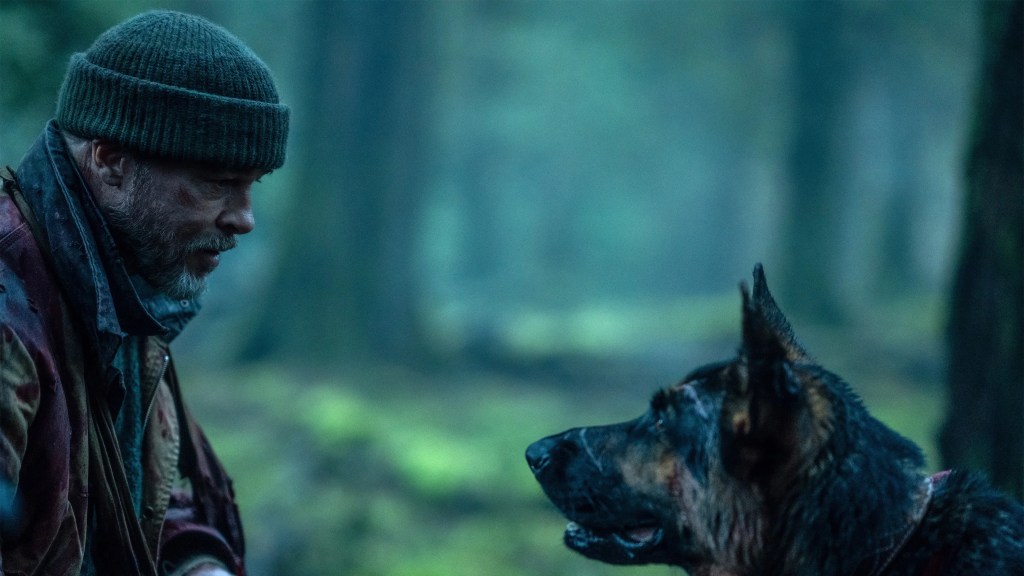

In so many ways, Heart of the Beast extends the long tradition of survivalist cinema that pits humans in direct conflict with the natural world and attempts a psychological test of resolve in the face of overwhelming odds and mounting obstacles; an evocation of the fundamental law of drama that involves following a character and wondering if he would live or die.
David Ayer, one of Hollywood’s foremost practitioners of masculine cinema, scales back down to gritty reality having directed The Beekeeper and A Working Man, and serves what looks like expertly pared-down piece of storytelling that’s sparse in dialogue and rich in experience. Directed from the script penned by Cameron Alexander, Heart of the Beast stars Brad Pitt as James, a retired Special Forces operator who flies in a Cessna to the middle of nowhere in Alaska together with his loyal dog companion Odin. We watch them build a camp, prepare food, play, fish and track big game. We hang on their shoulders when they encounter another mean-looking outdoorsman (J.K. Simmons) whom they greet with a mix of suspicion and reservation. We stay close with them when they decide to pack up to evade an incoming storm. We continue to be strapped to the passenger seat in their aeroplane when James suffers a heart attack while piloting and crashes into a lake… at which point the movie transitions from a mildly stoic exploration of PTSD to a bona fide survival thriller.
James has no time to quaver. He’s trained to move. Identify problems and solve them. Cauterize and continue on his way. Survive. Which is what happens. Heart of the Beast applies the same terse visual language we saw deployed while depicting the protagonist’s isolationist idyll to a prolonged mission of competence-based problem-solving. James tends to Odin’s wounds. Patches himself up. Sets up camp. They regroup, repackage their gear and off they go through the Alaskan wilderness searching for help. On their way they won’t encounter another human soul any more. They will face off against the overpowering menace of nature: natural obstacles, bloodthirsty predators and their own weaknesses. Physical and mental. The strength of the bond between men and beasts will be what decides their fate.
But to appreciate all that you will have to look past a few things. Principally, Heart of the Beast is a lean and simple vehicle aimed squarely at adult male audiences, specifically the fuck-your-feelings-just-go-hard brigade. Admittedly, there is something quietly magical about the concept of following characters who don’t have time for drama and just face whatever adversity life throws at them with the resolve and discipline of David Goggins on crack. Naysayers dismiss it as competence porn; admirers view it as peak male fantasy—the ability to deliver under immense pressure without external help and with nothing but your wits, discipline, presence of mind and preparation. That’s the movie Ayer wants to give us: an experience somewhere between The Grey, All is Lost, The Revenant and Call of the Wild. But this isn’t the only thing he’s serving, unfortunately and it also looks as though the movie he presided over did not trust the viewer enough to connect emotionally with the raw story unfolding on the screen.
In the ideal world Heart of the Beast could have been a nearly silent survivalist procedural that understands the audience it wants to target. Pitt does his job and remains mostly mute and withdrawn unless he’s speaking to or about Odin. Odin on the other hand is his externalized heart and soul and in his canine eyes we can find the depth of emotion these two characters share. The story predictably unfolds in a series of episodes: the plane crash that incites the story proper, Odin’s return to health, an encounter with a CGI grizzly (which I have no qualms with; it’s 2026 and the filmmaker is well within his rights to conjure a digital bear if he wants to), a dangerous crossing, a battle with a pack of wolves, etc. And we should have been able to follow this narrative uninterrupted and otherwise unencumbered by superfluous stimuli.
Sadly, we don’t. We are never trusted enough to match the protagonists’ emotional state with ours without aid, as though the target male audience could not identify escalating drama or mounting stakes on their own. To make sure we feel what we ought to feel when it matters to the story and the filmmaker, anything of note is always predictably scored with the most uninspired and schmaltzy score you could possibly imagine. In fact, I wouldn’t be surprised if Ayer and his colleagues forgot to remove the temp tracks before locking in the final sound edit and shipped the movie with music that wasn’t supposed to be there in the first place. I wished I could experience this movie without any sound at all, much like what I did when I watched Robert Redford battle the elements on his yacht in All Is Lost; it would have easily added a full star to my rating.
Another star Ayer’s film surrendered as a result of meddling with the integrity of the narrative, likely for the same reason the obviously predictable sickly music was installed underneath the image. Apparently, we can’t have nice things and movies just can’t be simple and straightforward specifically when they’d benefit immensely from said simplicity. Instead, Heart of the Beast infrequently cuts to heavily edited flashback footage that literalizes what the story was relaying subtextually and through good old-fashioned character context. What happens is every so often the story will insert a few seconds of what looks like unresolved traumatic memories from the theatre of war James and Odin were deployed to. This is likely to explain visually what sudden attacks of PTSD must feel like for them and these are scenes that simply did not to be in the movie at all. We could have been trusted with figuring out from context alone what likely had happened to them while watching them deal with their present predicament.
Taken together, the score and those edited video inserts downgrade the experience of watching Heart of the Beast considerably. In fact, the movie occasionally veers to territory typically occupied by straight-to-streaming schlock directed by jobbers who do not have the necessary directorial courage to trust that the viewer would get the message without being bludgeoned with it. Thus, watching this latest Ayer vehicle is a rather confusing experience that works surprisingly well only to reset to emotional baseline with these terrible choices and opening the entire movie to being seen as a piece of right-wing propaganda and an emotionally manipulative exercise in championing the veteran cause. Meanwhile, it is mostly All Is Lost with a dog in it and it could have succeeded as that while keeping its emotional vocabulary and social commentary in the layer of subtext where a willing viewer would pick up on it without much effort.





Leave a Reply