
It’s probably not entirely incorrect, though it is based on a hunch corroborated by a cursory scan of a small handful of Wikipedia articles, that the bulk of the raison d’etre of Bad Robot Productions (an outfit founded and led by J.J. Abrams) was to produce or co-finance movies curated and guided to imitate and recapture the unique spirit of Steven Spielberg’s most well-regarded works. Some films hailing from this stable were a bit more forthcoming about signaling this mission (Super 8, Star Trek, or some of the latter Mission: Impossible entries) and drawing a direct line to Spielberg, while others, like Overlord and the Cloverfield series, connected with him in spirit and looked in the same direction as far as their inspirations (like creature features, sci-fi from the 1950s and, crucially, The Twilight Zone) were concerned.
Interestingly, The End of Oak Street directed and written by David Robert Mitchell (It Follows, Under the Silver Lake), attempts to do both. It is equally a piece of homage to the era of high-concept fantasy and science fiction that Steven Spielberg adored and a tip of the hat to the man himself. Most importantly, it succeeds on both of those fronts without transmogrifying into a Where’s Waldo of 80s nostalgia of the Stranger Things variety.
This is achieved thanks to what looks like fundamental understanding of what elevates a spectacle to become deserving of the moniker “Spielbergian:” a finely balanced equation of awe and wonder, a family in crisis at the epicentre of a supernatural event, personalized stakes, believable, lifelike performances and unembarrassed earnestness. Mix them up in right proportions—and this equation, much like a polynomial function, does not have a single solution—and you might end up with E.T. The Extra-Terrestrial, Close Encounters of the Third Kind, War of the Worlds, The Iron Giant, Poltergeist, or Gremlins.
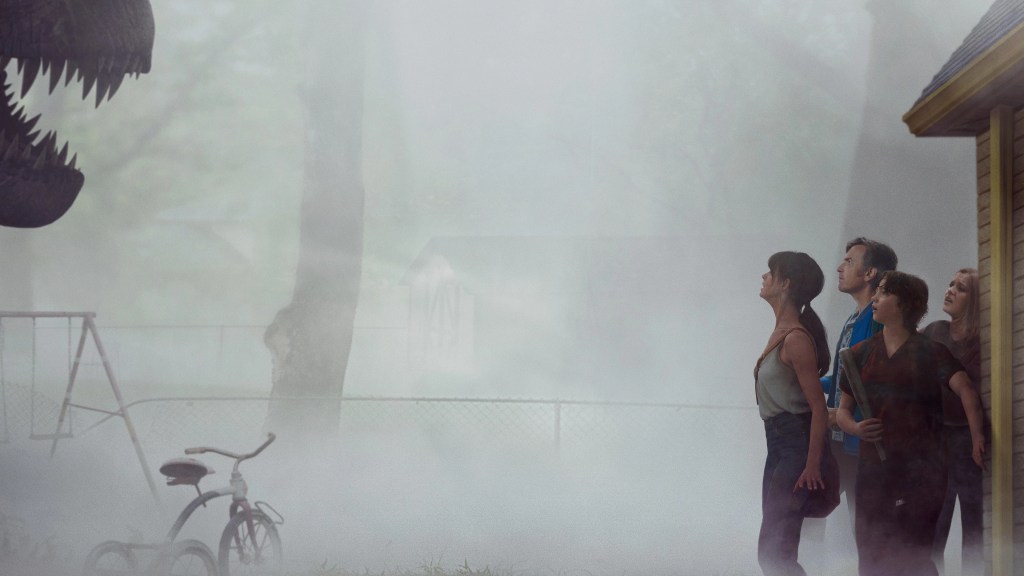
In The End of Oak Street, this Spielbergian effect is arrived at nearly effortlessly. A strained family unit is introduced where the father (Ewan McGregor) and the mother (Anne Hathaway) are inching towards divorce and where their children (Maisy Stella and Christian Convery) must manage their own adolescent dramas in addition to the major familial crisis threatening to tear asunder their fundamental sense of security. The world around them, filtered through a warm hue of subtle 80s nostalgia rooted in appreciation of the vibe of the time as opposed to checking off a whole laundry list of pop cultural references, is introduced through a series of interactions with neighbours and secondary players all of whom feel tactile and fleshed out enough not to stick out like one-dimensional NPC standees. And this already perturbed universe in which a familial foursome is spiraling down into a crisis is additionally thrown into a tailspin by a supernatural occurrence: the entire neighborhood ends up displaced in time.
Thus, a play on what I like to call “suburban fantasy” begins to unfold. Canonically, this concept was particularly well-evidenced throughout the 80s where a number of movies dealt with suburbia-set narratives, in which the seeming idyll was disrupted by an arrival of an outsized external force: an alien visit (E.T.), an invasion of demonic critters (Gremlins), or an assault from vampiric bikers (The Lost Boys), just to name a few. To my mind, this was a cultural outgrowth of middle-class prosperity brought forth by the American post-war economic boon. Boomers and proto-Boomers were able to move out of urban centres and bought houses in leafy neighborhoods, where lives of 80s middle- and (upper)-working-class teenagers were confined; lives of predictable boredom escaping which would then entail imagining these preposterous fantastical scenarios that gave rise to so many classics of the genre.
What makes The End of Oak Street particularly interesting in this context is that it is a movie that willingly and knowingly taps into this tradition of suburban fantasy, but not necessarily to capitalize on its intrinsic nostalgic potential. Much like many successful exemplars of this trend, David Robert Mitchell’s movie uses this concept to both execute the genre template and use it as a galvanizing element for the familial drama unfolding within it. First of all, supernatural forces don’t quite invade the sleepy suburban setting of the movie as much as the suburban setting ends up displaced in time. And it is never of much concern to anyone in the movie to figure out the reasons what happened. There are no shady conspiracies, government experiments gone awry or bogus cosmic events described confidently using pseudo-scientific jargon. What matters is that the family we are following—with its own micro-dramas and an uncertain future—must now face a reality where dinosaurs, appropriately feathered according to most recent scientific findings, roam outside and eat anything that moves.
And this is honestly enough to build that Spielbergian foundation, provided that the story as it unfolds would keep that family drama at the epicentre of its spectacle and disregard those desires to flex with CGI prowess or over-stuff the narrative with action sequences. The End of Oak Street remains simple and focused all the way through and instead of size and scope it opts to craft a handful of well-engineered sequences that still lean on the family dynamic while the spectacle unfolds. In a way that Spielberg himself would find noteworthy, the movie localizes the action and squeezes incredible amounts of tension from surprisingly simple ideas like pointing the camera at a massive predator accelerating from the background while the family fails to notice its presence or by having them evade the teeth of a slithering proto-snake while trapped in the house. Occasionally, Mitchell would flex his blocking muscles and craft a sequence that wouldn’t be out of place in a Spielberg-directed movie, like the standout scene in which the camera tracks McGregor in a continuous shot as he’s chased by a threat, then flips to Hathaway and then reconnects with McGregor again, thus making great use of the set geography and still milking that familial energy because underneath the action both characters come to an instinctive realization that they would lay their lives on the line for one another.
In essence, The End of Oak Street adds up to a surprisingly effective spectacle that harks back to an era when blockbusters where as resplendent as they were personal and focused. A true descendant of Spielbergian tradition, it is a movie that J.J. Abrams wishes he had directed instead: a near-perfect blend of tactile drama and exhilarating action that doesn’t have to rely on low-level dopamine release and saturating the movie with overt pop cultural references. It is by all means a mature perspective on the matter of 80s nostalgia that understands the landscape deeply enough to be able to terraform and sculpt it with ease. Once again, it proves that David Robert Mitchell is a director with real skill and class who’s not about to stop crafting timeless pieces that subvert their respective genres by way of understanding them better than anyone else around.





Leave a comment