John Updike remains one of only four novelists who won the Pulitzer Prize for fiction twice, flanked by Booth Tarkington, William Faulkner and Colson Whitehead. A prolific writer with numerous novels, short stories and poems in his portfolio, Updike once found himself, incidentally perhaps, close to the forefront of the loosening culture at the precipice of the 1960s with his eponymous novel Rabbit, Run.
In it he invented the character of Harry “Rabbit” Angstrom, a man he described as “everything the author was not:” athletic, tall, handsome… as well as reprobate and fiendishly egocentric. He used Rabbit as a cultural barometer of sorts, a character who encapsulated the milieu of the incoming generation of Baby Boomers and through whose lens Updike could paint the picture of America: unvarnished, denuded of its characteristic self-applied exterior of loud exceptionalism. He ended up revisiting this character four more times—in three sequel novels and a novella—and taking the temperature of the world around him by way of imagining how Rabbit’s life would unfold over the years.
And even though he was well-regarded at the time when he was a working novelist, John Updike’s cultural relevance tapered off over time, especially after his death in 2009. Though he remains important to literary critics who continue to hold panel discussions and pursue deeper research of his output—and his works can always be found on shelves at reputable bookstores—there is no question that he has for the most part departed the collective cultural metaverse. It could simply be a result of the culture moving or a natural consequence of writing about specific generational cohorts; it’s not unreasonable to assume that younger readers wouldn’t recognize the world described so meticulously and poetically by Updike in his books. Or it could have something to do with the fact that Rabbit Angstrom—Updike’s most well-known character—was an infuriating excuse of a human being.
In fact, my personal experience of reading Rabbit, Run was similarly dissonant: it’s an amazing book that also happens to be impossible to read for some reason. I wanted to immerse myself in Updike’s command of the English language, the immediacy of his syntax and his incredible mix of metaphorical language and boots-on-the-ground realism; yet I couldn’t despite the magnetic pull of the prose itself. I had to put the book down every so often because the character of Rabbit Angstrom repulsed me so profoundly that I couldn’t guarantee the safety of my Kindle. Reading about Rabbit’s life of a twenty-something guy who had peaked in high school, waltzed around town with a sense of unearned superiority and hurt literally everyone who ever entered his orbit filled me with the kind of explosive mixture of disgust and fury I couldn’t remember other character in any book or film ever instigated. And I have read some seriously dark books in my life. Neither Anton Chigurh nor Patrick Bateman made me want to throw the book out the window in an outburst of impotent frustration as much as Rabbit Angstrom did, despite the fact that both were written as purposefully and incomprehensibly despicable, outrageously ruthless and frighteningly tactile.
This gave me pause. I wanted to understand what exactly made Rabbit so repugnant in my eyes and why I struggled so profoundly to read a book that is in all other respects a masterclass of prose; and after a brief period of internalized pontification I think I found the answer.
Even the most repulsive villains ever conceived to roam the pages of novels or populate the frames of the most iconic movies—from Judge Holden in Blood Meridian, Hannibal Lecter in The Silence of the Lambs, Nurse Ratched in One Flew Over the Cuckoo’s Nest to Norman Bates, Sauron and Darth Vader—rarely would cause the reader to put the book down or look away. In fact, the best villains achieve the opposite and become the magnet that attracts readers or viewers, as though to lend credence to the old screenwriting maxim that “a story is only as good as its villain.” Sure, I may have had to compose myself a few times when reading The Road, Blood Meridian or American Psycho, but it was dictated by the need to give my overstimulated nervous system a brief moment of respite from carnage described in vivid and emotionally manipulative detail on their pages.
Rabbit Angstrom never came close to hurting other people the way Patrick Bateman or Judge Holden would. All he ever did was leave exactly at a time when leaving would cause the most emotional damage to other people. He would come back from work to Janice, his wife and mother to his two-year-old son who was also pregnant with their second, assess the mundanity of their existence as a young family trying to carve out a corner of the world for themselves, and then he’d turn around and leave without a word. We’d hear his inner monologue and see how he rationalized his decision to abandon his partner—whose pathological loneliness he obviously failed to acknowledge—and believed he deserved a better life. After all, he had been a superstar athlete in high school and superstar athletes deserve better than a regular life, a regular job and an ordinary family to take care of. We’d sit in on a number of interventions and conversations with concerned people who tried to bring him back around, while he was living in a town a few miles over with another woman. And we’d witness all this effort fall on deaf ears. We’d see Rabbit undergo what looked like a Damascene conversion and then hang onto his shoulder as he left once more, this time leading to irreparable tragedy. And then we’d see him do it all over again, almost spitefully so.
It is not exactly what Rabbit does to other people that infuriates the most; it’s how he continually rationalizes his decisions and tries to convince you, the reader, and himself that he’s somehow, despite everything in the right. That other people are to blame for his woes. That the world owes him something. That a former star of the basketball court should get a life of splendour and excess, not a mundane existence rooted in service and sacrifice in pursuit of building a family.
The way John Updike describes Rabbit’s internal monologue and how he refuses to take sides in the story he is telling—which could lead some readers to believe that the author somehow endorsed what he depicted—is exactly what makes Rabbit such a compelling villain; not even an antihero—a straight-up villain. And the reason why I found his behaviour so comprehensively atrocious is that Rabbit Angstrom is a guy that probably existed somewhere. You might have someone in your circle of friends who fits this bill as well. You might even see a little bit of yourself in him too.
This is a considerably more frightening prospect than running into Patrick Bateman, Norman Bates or Pazuzu, simply because it’s a realistic prospect. Although violent sociopaths walk among us, the odds of meeting one are slim. And when it comes to supernatural entities, although the world would be infinitely more intriguing with them in it, they remain products of the collective human imagination. But we all know what an interminably selfish person looks like. And the way Updike writes Rabbit—lifelike and organic—is what makes him so insufferable. Specifically, he represents all the bad choices a man could make and he is faced with decisions that you or I might have already faced in our lives. And he continues to choose wrong. He persists in his solipsistic quest with abandon and he cares not one jot for the damage he inflicts, while you—the reader—might instinctively know the right path to take. A path Rabbit sees and willingly ignores. He’s everything you don’t want to be and nothing you want to be. Facing the realization of just how little it might have taken for you personally to make terrible choices in your own life when you were faced with similar problems (if you can even refer to them as such)—supporting your pregnant partner or being there for her when she felt lonely, holding down a job to put food on the table or simply remaining dependable when other people counted on you—and knowing that you made the right decisions when it mattered and it didn’t cost you your life while Rabbit could not rise to this challenge is what irks. And knowing that at times you did not step up to the plate when it mattered and behaved closer to how Rabbit would have behaved stings even more. Which I believe is why reading Rabbit, Run is such a struggle: Rabbit’s villainy is domestic and relatable. Not operatic or elevated.
This is also, perhaps, one of the reasons why Updike’s prose shifted out of the cultural limelight. As the culture progressed and chose to stand in stark opposition to the kinds of values that Rabbit Angstrom espoused, it must have become difficult for many readers to separate the character from the author who concocted him and thus both ended up filed as incompatible with the changing times on account of misogyny. Nevertheless, I believe there is a utility to Rabbit’s character, just as there is value to examining any literary villain in greater detail. I don’t even necessarily think we ought to spend inordinate amounts of time understanding him. As I outlined above, we can intrinsically comprehend him because he’s nothing more than a pathologically self-centered man. Still, we can use him as a reference point of what not to do and who not to become.
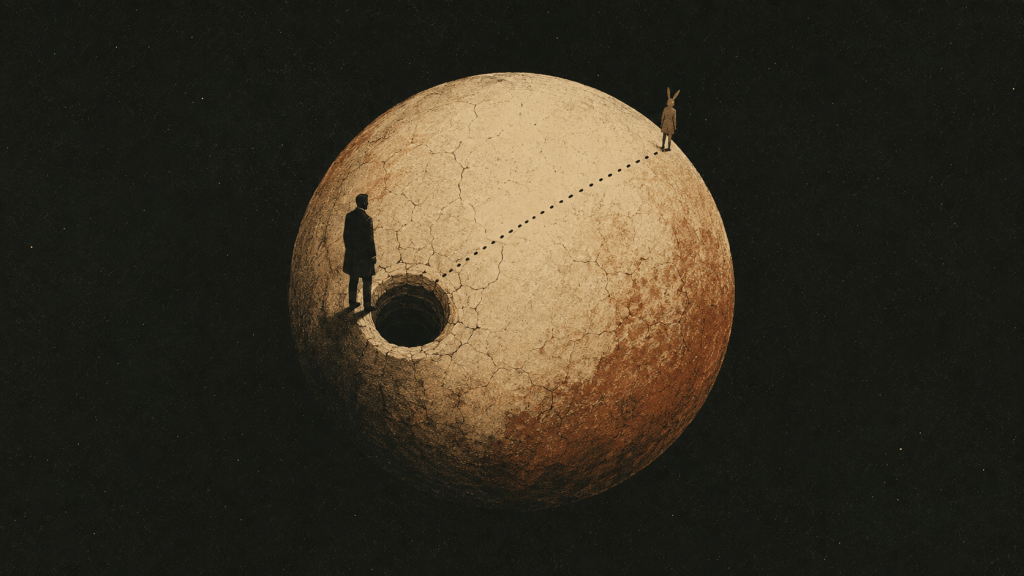
In a similar vein to how some Christians ask themselves in times of strife, “what would Jesus do?” to receive divine guidance regarding decisions they ought to make, any man at any point should be able to ask himself, “what would Rabbit Angstrom do?” And then, he should do the exact opposite. As men, our relationship to Rabbit Angstrom must strive to be completely antipodal. We might want to embark on a brief thought experiment and imagine a planet on which only two people exist: you and Rabbit Angstrom. And the relative positioning between you reflects your own moral standing on the virtue-to-villainy spectrum. In this scenario, a life of moral perfection and untarnished virtue is achieved when you and Rabbit Angstrom will always exist on the opposite poles of the planet. If you want to ask yourself if you’re leading a good life, think about boring a hole directly beneath your feet, through the planet’s core to its antipode; a virtuous man will find Rabbit Angstrom at the end of that tunnel.
Your position relative to Rabbit is not static, though. Every decision you make in life will translate to movement on the surface of this planet and each time you make a decision, Rabbit will make it as well and move. Because no choice in life is truly binary, some decisions will only bring you slightly closer or further away from him, but only decisions which translate to the exact polar opposite of what Rabbit would do will bear the most weight.
Also, Rabbit will never disappear from the face of this planet. Because he is a real man making real-life decisions, the possibility of replicating his choices will always remain for as long as you are alive. Think of Rabbit as a literary equivalent of the Jungian shadow. He’s always there and it’s up to you to position yourself relative to it. It’s also well within your powers to become him if you make enough decisions in your life that he would have made. If you run when he ran, hurt when he did, rationalize when he rationalized. The distance will close and you will be able to shake his hand and it will be the moral nadir of your life. If you can see Rabbit on the horizon, you ought to know that you have strayed from the path of moral virtue. If you can smell his breath, however, you might want to wake up to the realization that you are just as egocentric and casually cruel as he was.
But how do you know where you are relative to Rabbit? You don’t. What determines my initial position? Is it random? No it is not. I believe it is most instructive to rationalize the answer to this question in the following way: you are not born on the surface of this planet because assuming so would imbue you with some moral value from day one. Just as we can’t accuse newborn babies of villainy, we should not assume their virtue either. A baby is pure enough to borrow from John Locke and refer to it as a blank slate. Tabula rasa. Therefore, if any place on the surface of this hypothetical planet has its moral value assigned—the relative distance from Rabbit Angstrom—then the only place without any morality assigned to it is at the planet’s core. This is where you are born and your childhood and adolescence will be spent digging a tunnel to the surface. You will make choices along the way as well. You will be guided by your caregivers, teachers, mentors and other influencers, but depending on how they are equipped to communicate with a young person digging a tunnel underground and whether they wish to help you at all, their guidance might either not reach you at all, become distorted, or otherwise difficult to parse for a young and impressionable mind.
Hence, your journey from birth to adulthood—from the core to the surface—will be a mix of guided choices and stochastic movements, each of which will determine how far away from Rabbit you eventually surface. Which is where your personal voyage will truly begin in earnest because up to that point, Rabbit Angstrom will have waited patiently for you to emerge. He already completed his digging process; it’s predetermined by John Updike’s characterization work. Yours is mutable and everyone’s path is different. However, from the vantage point of adulthood it might seem that our upbringing is a process over which we have only limited control because we are most likely unaware of the importance of the path we are taking. That’s the nature of childhood. We just don’t know because the whole point of that journey is to learn, respond to guidance, such as it is, and develop our own moral core in the process.
Eventually, we all surface and this is the first moment of our lives as young men where Rabbit will begin moving in response to our movement. This is where our decisions begin to matter and the sooner we realize that Rabbit Angstrom is somewhere on this planet with us, the sooner we will be able to maintain a safe distance from him. In fact, we don’t even need to know he’s there. You can derive good advice from elsewhere—mentors, guides, philosophers, friends, religious figures—but I think at this point it might be a good idea to let you know about Rabbit Angstrom and hand you John Updike’s Rabbit, Run as soon as you become an adult; not as a guide but as a diagnostic. I’d go even further and maybe package Rabbit, Run as a bundle together with Marcus Aurelius’s Meditations as a gift every young adult man should receive from another man who’s in a position to guide and mentor their further development.
This is a gift that should be accompanied by a conversation about morals, sacrifice, virtue and the place of a man in the world with appropriate time spent discussing the path towards virtue (Aurelius) and the path leading away from it (Updike). And maybe it should start with that thought experiment about imagining yourself on the surface of a planet where only you and Rabbit Angstrom live.






Leave a comment