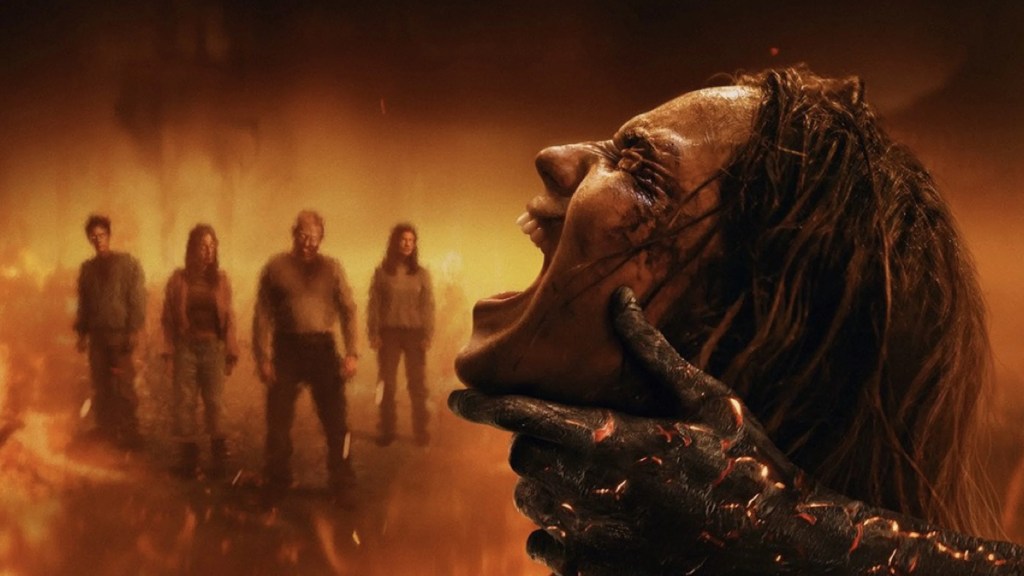

One way of finding out what makes an Evil Dead movie is to play with its elements: remove some of them, introduce replacements, over-express some, downtune some others. This always carries a risk because you will only learn through feedback from audiences who would vote with their wallets one way or another.
Therefore, what the precedence of the entire series teaches us–including Sam Raimi’s original trilogy–is that an Evil Dead movie contains a small handful of non-negotiables that must be included if the movie is to be differentiated from any other nondescript hybrid of demonic possession with zombie horror. We need a confined, secluded location, a forceful and shaky camera work and a characteristic tension between seriously intense gore and a more slapstick splatter horror. I think the exact term is “splatstick.” However, the balance between gore and comedy is finely tuned to skew just a little bit closer to seriousness than, say, Peter Jackson’s Dead Alive, which in all respects is a direct descendant of Raimi’s movies. An Evil Dead movie cannot exist as an outright pastiche but rather something that wants to be taken seriously but happens to be undercut by levity and eventually detaches from its own ambitions on account of its intensity being turned up to ridiculous levels where no viewer would ever continue taking seriously what transpired on the screen towards the end.
Sadly, some filmmakers don’t quite find this balance or when they find it they struggle to maintain it. Interestingly, when Fede Alvarez put together his take on the Evil Dead franchise, he optimized for intensity and lore accuracy. In essence, his movie was a sensory rollercoaster version of the 1981 original that went into such an overdrive towards the end—limbs flying, blood raining from the skies and actors soaked so completely in gore that they melted into the background—that it sufficiently compensated for its choice to eschew levity altogether. Lee Cronin’s Evil Dead Rise mostly successfully abandoned the constraint of a secluded cabin and brought some new ideas to the conversation by setting the movie in an apartment block; though his movie mostly fell back on the tried and true elements of the template in other places.
And now, with Evil Dead Burn, we see what happens when too many levers are being pulled at the same time. In a similar vein to Cronin’s recent effort, Evil Dead Burn opens at a lake and briefly—and unbeknownst to casual viewers who might not know what to look for—sets the tone for what’s about to unfold over the course of the next hundred minutes. Two men are found fishing at a lake before one of them is brutally hogtied by animated fishing lines and dragged underwater by a familiar-looking deadite and the other one winds up cooked until tender in the lake brought magically to a simmer, all to the tune of an actual wall of cacophonous noise we ought to remember from Evil Dead Rise as well.
What this cold-open encapsulates is exactly what the movie will care about and how it’s going to go about achieving its goals. The first five minutes of Evil Dead Burn already display the filmmaker’s penchant for strapping the camera to inanimate objects and elevating Sam Raimi’s forceful POV to new levels (owing to new liberties in this department unlocked by deployment of drones and miniaturized cameras), capturing complex sequences in kinetically roaming single takes and choosing to find respite from movement in close-ups of well-executed gore special effects. At the same time, we are also led to believe that the narrative we are about to follow is not going to be as simple as revisiting the template. We’re not just going to glue ourselves to a cast of characters who are liable to bring literal hell upon their unsuspecting heads by way of either reading passages from a book that looks decidedly as though it was written by and for satanists or by accidentally playing a recording of someone else who did the very same.
At this point, Sébastien Vaniček and his collaborators, must have surely surmised that not adding depth to the Evil Dead lore could increase the risk of their movie falling through the cracks and failing to distinguish itself. Hence, this particular instalment in the series invests quite a lot of its narrative real estate in digging a bit deeper in the lore department than perhaps expected. We’re no longer trapped in a secluded decrepit house together with a spreading demonic disease consuming the characters one after another. We are there in pursuit of a McGuffin because this house isn’t regular and the family we follow is not random either. There’s talk of secret societies, ancient daggers, intergenerational curses, which is perhaps surplus to requirement. None of that is needed to sustain a movie in this series; however, it might also be the case that this completely superfluous lore overload is required to sustain a franchise that’s about to add an instalment reliably every two or three years… which is a development I am here to protest.
We don’t need an Evil Dead universe at all. In fact, we barely require this hopefully just a trilogy to complete either if the main driving force behind it does not extend far beyond wanting to do a movie like Sam Raimi without it being an unsanctioned ripoff. But that’s more or less what we have here as Evil Dead Burn is just a little bit of a mess that’s tuned to operate at a tonal register of a Rob Zombie movie. It’s overtly and wholeheartedly overwhelming in a performative kind of way that is also undercut by moments of levity that struggle to register as anything more than painfully tone-deaf.
Somewhere between the domestic drama of an abusive marriage brought to an end by a car accident involving an undead demon, a domestic scenario that looked at the tone of The House of 1000 Corpses the way that movie looked at The Texas Chain Saw Massacre, and a whole truckload of lore nobody really needed in the first place, Evil Dead Burn is a challenging specimen to sit through and enjoy. Its only saving grace lies in the camera work that plays with gravity much more than any of the previous movies in the series, brings a few inventive moves to the conversation and elevates the violence considerably.
Is this enough, though? The answer is no. Not really. And that’s because Evil Dead Burn in pursuit of trying to saturate its own evildeadness, spoiled the broth irreparably. Sure, the movie has moments where it climbs over the fence of its mundanity and briefly escapes into the neverland of artistic freedom, but they are few and far between. Sébastien Vaniček’s movie is not intense and exhilarating, but rather tiring and irksome. And it surely is not irreverently splatsticky enough to qualify as a bona fide pastiche deserving of an alternative title Evil Dead Alive, despite the possibility it might have been one if its goals had been explicitly stated to this end and followed through. After all, nobody puts a lawnmower in a horror movie willy-nilly.
This one, however, is just too salty. And anyone who has ever ruined a dish by dumping in too much salt would know that you can’t fix it by adding things to neutralize it. Some of the sauce has to be removed instead and something tells me that the filmmakers behind Evil Dead Burn don’t believe that less is more. Their fetish is of the maximalist variety and thus the movie is loud, salty, overwhelming and burdensome. And the funny part is that they let it be known in the first five minutes.




Leave a Reply