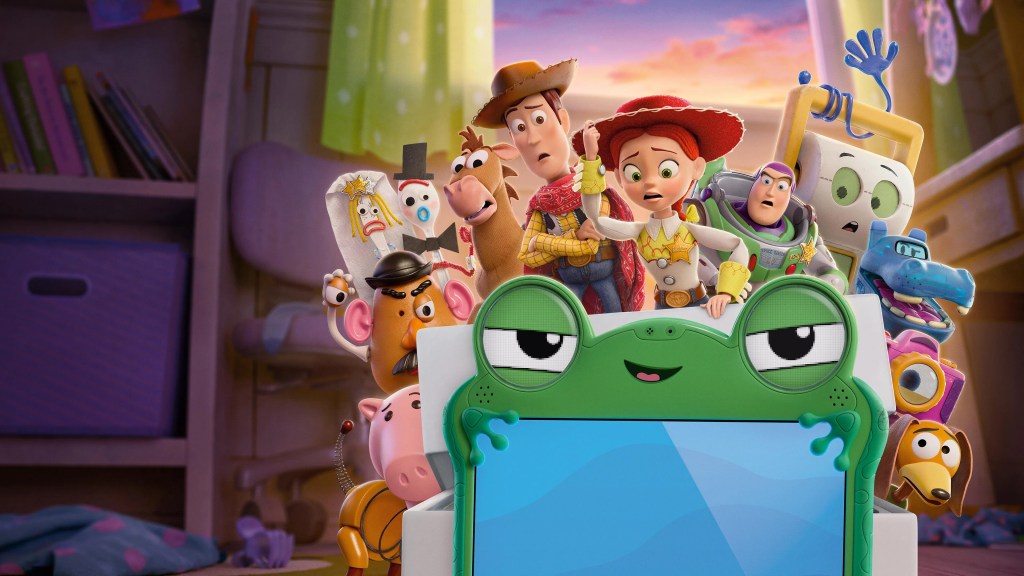

Much like the Paddington movies, the Toy Story franchise has enjoyed what I can only refer to as a free pass from critics and general audiences alike. Held unanimously as a marvel of feelgood vibes, this long-standing series continues to elaborate on that seminal Pixar question “what if toys had feelings” by adding numerous caveats to it. And like those movies about the marmalade-addicted immigrant bear whose cultural staying power being perfectly circular—it’s great because it’s wholesome and it’s wholesome because it’s great—remains a complete mystery to me, I remain baffled at the fact that Toy Story movies are all seen as perfect little vesicles of saccharine goodness and paragons of Pixar blockbuster magic. Among all Pixar properties, they are now the least original, the most predictable and tired and the most profoundly hamstrung by their own self-imposed narrative constraints.
And Toy Story 5 proves it.
Co-directed by the Pixar heavyweight Andrew Stanton and McKenna Harris (who previously worked on Elio, Elemental, and Raya and the Last Dragon), the fifth attempt at looking into the secret lives of toys iterates a tiny bit further on that perennial Pixar question by adding what was clearly designed as a topical angle to it. In 1996 we learned the basics of what happens when kids leave the room while wrestling with the arrival of newcomers upsetting the status quo. In Toy Story 2 we learned about the importance of play while vilifying middle-aged toy collectors with nothing better to do. In the third one we grappled with growing up and leaving toys behind. The fourth one revisited the theme of obsolescence while adding ideas relating to welcoming hand-made creativity. And now we’re once again re-treading that theme of obsolescence, this time told through the lens of technology impacting on play time and sidelining old-fashioned socialization through make-believe play with physical objects by introducing screens as the new kid on the block.
But this time it’s seemingly existential. To repeat the line from the movie: “toys are for play but tech is for everything.” So we follow little Bonnie, who is clearly coded as a shy, socially-awkward kid who might be on the spectrum, as her parents give her an AI-enabled tablet hoping she wouldn’t fall behind other friends who are already permanently locked into an online environment for both socialization and play. And naturally, toys feel threatened by the device. Jessie who has become the new sheriff in town wants to bring back the status quo by getting rid of the wretched device, Buzz wants to help and even Woody makes an emergency appearance. You’ve seen it all before. Almost bit by bit. It’s not an exaggeration to see Toy Story 5 as an execution of the Toy Story template, that is only seasoned with elements of novelty like an army of new-and-improved Wifi-enabled Buzz Lightyear toys coming into the fray, Jessie’s backstory being explored in detail—which isn’t all that original either because how many different character archetypes can you invent for a toy after all—and Woody having to wrestle with his own age… because he’s bald and fat.
That’s about it. It quite frankly plays like a movie made out of an obligation to add another installment to the franchise because Pixar needs money (and judging by how they have handled Elio and Hoppers they lost the institutional confidence in originality) that’s here to do nothing but furnish base-level entertainment aimed at middle-aged parents are either about to introduce their children to screens or have done so already and now regret their decisions. But it’s all delivered with the subtlety of a mildly buzzed Gen-X-er phoning into a morning radio show to rant about technology and social media.
Kids don’t play any more. They just sit there glued to their screens. Oh no. The world is coming to an end. When I was young we used to play outside until street lamps came on. Kids are wimps these days because they have to be chaperoned to play dates and have their time organized by those good-for-nothing Millennial parents who only think about having another avocado toast. That’s the level of subject sensitivity this movie displays while also effectively re-enacting the old Toy Story template for the fifth time with only very minor story adjustments. All is good—newcomer arrives and nothing is good—one of the main characters goes missing and goes on a journey of self-discovery—other toys rush to help—everyone reunites—the newcomer adjusts to their role as a toy—kids and toys live happily ever after—the end. Parents in the audience—at least those who have successfully suppressed the urge to check their phones every three minutes—chuckle at the most obvious stuff or nod in silent approval at those broad comments about tech and AI being introduced to children in an unrestrained public clinical trial second in size only to the one involving social media. They might not even realize that they have chuckled at exactly the same beats four times already. This movie is nothing but a carbon copy. A cookie-cutter product Pixar knows works: made according to the same recipe you have seen a number of times. The only thing that’s different is the colour palette.
And I bet they all feel like it’s the best thing ever, like Toy Story 5 is the movie everyone needs to see. And they either don’t notice or conveniently disregard the cognitively dissonant realization that what they saw was broad, unsubtle and almost completely unoriginal. I don’t expect much from any movie carrying a number “5” after the title, but seeing it as a miraculous work of cinematic wonder and originality—that is nearly indistinguishable from its predecessors—is like praising a new burger at McDonald’s as though it was the best invention in the history of putting food in your mouth because what essentially still is a Big Mac now comes topped with kimchi or sriracha.
So, while I realize it might be tempting to give Toy Story 5 top marks and even shout from the rooftops that the movie comes with its star-rating baked into the title, I simply don’t see it. The movie is tired and repetitive and even the voice cast sounds as though they were ready to retire. But somehow, the cultural free pass remains in place and probably for as long as I live the spell cast on general audiences and critics by Paddington bear and Woody will continue its mission to convince that bland, iteratively constructed conveyor-belt entertainment is interpreted as brilliant and wholesome only because it is culturally expected to see it as such. Above all else, the critical treatment of Toy Story 5 is an unmitigated failure in disentangling the emotional response to what unmistakably is an exercise in more of the same from identifying it for what it is.





Leave a Reply