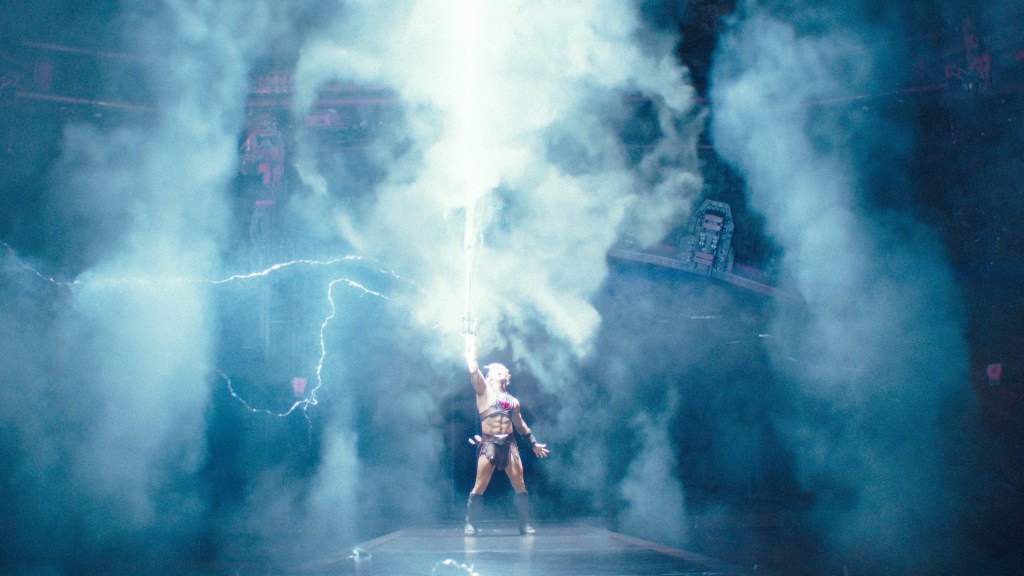

The recently released remake of Masters of the Universe—a 1987 cult item based on a Mattel toy line turned into a morning cartoon that loosely tried to hybridize Conan the Barbarian with Star Wars while looking like a cross between The Beastmaster and Battle Beyond the Stars–was in development as early as 2009. And if you believe Hollywood gossip, the earliest records of this movie’s development could potentially date back to 2007 when John Woo was allegedly in talks to direct it.
Two decades. And honestly–this explains a lot. The first thing you will notice about Masters of the Universe—which at this moment is on the way out of cinemas with its tail tucked between its legs and its box office performance dwarfed by the likes of Backrooms and Obsession—is that its tone and vibe is resoundingly familiar. It looks like a movie that wants to tap into nostalgic reverence for the early days of the MCU, which in the absence of context and supporting evidence presents itself as calculated and shortsighted. After all, the MCU experiment is on its way out and comic book movies are about to cede blockbuster supremacy to the oncoming wave of video game adaptations and here we are witnessing a movie that not only tries to build a shared universe when audiences have already indicated that they might be tired of it all, but they are insisting on doing it in the style of those early Marvel and DC movies from nearly two decades ago.
And the reason for that is simple: when Masters of the Universe was first ideated behind closed doors and the first script ideas were being thrown about—well before the rights began to move between studios and the revolving door of directors entering and exiting the fray started to spin so fast that it emitted a perfectly pitched A at 440 Hz—the MCU was only being conceptualized. Michael Bay’s Transformers movies ruled the roost. And as changes were being made to the script, new ideas added to the bucket were invariably informed by successful movies in this space, hoping that the resulting mishmash would synergize them all into a successful multimedia entity that could sustain its own universe that Gen-X men who grew up watching He-Man and playing with Mattel action figures could get behind and champion.
As a result, the 2026 movie, eventually directed by Travis Knight (presumably on the back of his successful revival of the Transformers franchise with Bumblebee) and starring a relative newcomer to the big boy table in the lead role (Nicholas Galitzine), officially credits four people for screenwriting, additional four for story development and a whopping seventeen more folks with a cryptic-looking “additional literary material” designation that you can find on iMDb (presumably in acknowledgement of all script work performed over the years this movie was in development hell). This in combination with the fact that Travis Knight was reported to initiate rewrites to the already existing screenplay as opposed to starting afresh when he was hired to helm the picture explains quite a lot. If you watch it and emerge thinking that it was a bit of an unfocused mess, that’s because it is. Not by design—by decades of inertia fueled by executive bullheadedness and an outright refusal to accept the phenomenon of sunk cost fallacy. Just because so many people spent years contributing to a script and a number of studios probably spent collectively more money in pre-development efforts than the finished product cost in actual on-set production doesn’t mean it’s worth a damn.
As I said—it shows. The 2026 Masters of the Universe makes the camp 1987 movie look like a work of art in comparison. It is honestly impossible to even begin discussing what does or does not work in this stunning monument to human inability to course-correct in the face of shifting cultural landscapes and data suggesting that the audience this movie was going to attract would be rather niche. Those Gen-X men who grew up watching He-Man might have grown tired and old in the process and some of them might have even left this mortal coil and it just seems that the collective appetite for Joss Whedon-esque quipping and undercutting organic camp with self-aware edgelordism may have simply subsided on the back of market over-saturation. We’ve had nearly two decades of blockbusters that tried to do what Masters of the Universe is attempting to revive. Some of them worked better than others. Some of those successes were amplified by brand awareness and fan appeal. But now most of us are just tired of this horseshit. The idea of staying seated for 140 minutes watching a movie that tries to parody itself while also remaining somewhat serious about setting up a universe, not to mention the requirement to sit through credits with multiple stingers teasing arrival of characters in sequels that are only theoretically forthcoming, is tantamount to torture and I wouldn’t be surprised if CIA adopted it as one of their oft-criticized “enhanced interrogation techniques.”
I know this sounds hyperbolic, but it isn’t. Watching Masters of the Universe was a protracted and painful experience in more ways than one. And at this point I am willing to excuse the silliness of the plotting mechanics or character development because it simply comes with the territory. He-Man has always been corny and camp and I simply expected this intergalactic mesh of Conan and Star Wars to be appropriately divorced from any sort of blockbuster reality by way of introducing its world as though it meant something and as though its archetypal hero’s journey about Adam’s return to Eternia mattered to anyone on a dramatic level. I believe that making sure that Skeletor (voiced by Jared Leto) tried his best to be serious while looking ridiculous and acknowledging without blinking the existence of a talking apex feline with a demeanour of Eeyore as well as characters like Ram-Man and Fisto would have conveyed the right message—that we’re taking this nonsense seriously.
After all, kids who did watch these morning cartoons way back in the day and played with those action figures took it seriously at the time. So why not play into this? The 1987 movie did. In fact, taking a ridiculous-looking material seriously would have been one of the two ways Masters of the Universe could work in the current climate, even though each of them is clearly a gamble of its own making. The movie had an opportunity to take its entire narrative structure complete with ludicrous characterizations and familiar plotting and delivered it verbatim, knowing it’s ridiculous and stupid and behaving as though it wasn’t. That’s camp that actually accounts for the nostalgic connection the middle-aged viewers would have had with the source material. We don’t need to hear snickers and giggles at the fact one of the guys is called Fisto because we’d assume it’s OK to be called Fisto in this bonkers universe and the success of the movie would have rested on its innate likeability.
The other, more self-aware and meta-inclined way out of this predicament would have been to introduce a framing device speaking to that nostalgic connection directly. Imagine a movie in which all these ridiculous characters engage in their over-the-top battles, quip the most childish and corny one-liners you can think of and introduce deus ex machina magic whenever convenient only to unveil at the end of the film that the story we’re watching is make believe. That what we’ve been looking at all along is a dramatization of children playing with action figures. In fact, be bold: start the movie this way and then go into the story proper. You’d probably have a chance to endear both younger audiences who might not be immediately aware of He-Man, as well as their dads who’d be reminded of how they used to play with their own action figures themselves when they were kids. But both approaches carry the risk of rejection if the material isn’t handled with an appropriate mix of reverence and bravura, which is harder to find in Hollywood than you might imagine.
Unfortunately, Masters of the Universe is a movie made by people who were embarrassed about making it and didn’t have a single original idea between them. All they wanted—and it’s just what happens in Tinseltown—was to build a Marvel-like cash cow because they looked at the success of the MCU and their own IP bank and thought that they could also build a billion-dollar franchise. But it is like looking at a viral tweet made by someone else and then looking at your diary filled with quips and quirky thoughts and thinking that you could become a viral sensation too because you have all the ingredients available to you that the viral tweeter had.
The most important thing about creating cultural phenomena is timing: a combination of boldness, material strength and its appropriate treatment that respects the target audience while challenging it sufficiently, and the insight or dumb luck to do it when an opportunity presents itself. Pasteur’s principle works in all fields—luck is when preparation meets opportunity.
Sadly, Travis Knight and his many cohorts were not prepared because they clearly felt the need to distance themselves from their own joke and didn’t have the requisite mettle to put themselves in a vulnerable position of being the butt of their own parody. And because it took them so many years to deliver this movie without adapting its tone to the changing cultural climate, they missed their opportunity by at least a decade.
Honestly, this is where I’d place a crass comparison to Roger Corman or Uwe Boll and imply that this is what would have happened if you handed them a blockbuster budget and asked them to remake Masters of the Universe, but it would be unfair to both of them. They would have never been embarrassed about making a camp movie that this thing needed to be and would have committed to the bit.
Unfortunately, Travis Knight’s Masters of the Universe is only performatively silly and camp, a movie made by and for people who are awkward about their childhood memories of playing with toys. A wasted opportunity to celebrate something silly in a silly way, or at least to spoof the MCU without trying to set up its clone as a money-generating slop machine. What they made was ersatz Thor that is late to the party by fifteen years, doesn’t endear anyone and behaves as though it had a franchise hiding in its pocket.





Leave a Reply