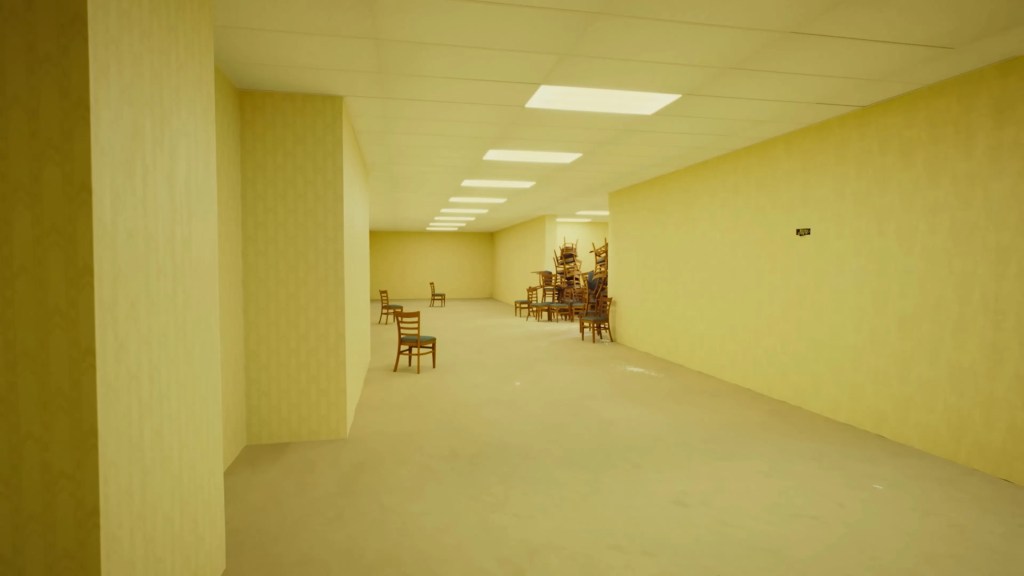

The camera is shaking. You can hear the man in the suit breathe heavily as he wanders around a strange-looking locale. Everything is post-it yellow. Some walls are crooked. Some doors lead nowhere. Some corridors narrow to a slit. And then we hear a noise. Someone else is present. A threat of some kind. The grainy POV footage shakes even more, panic is detectable in the man’s voice. And then the footage cuts to black.
We can only assume what transpired. Which we do because we have seen enough horror movies to make assumptions of this extraction. So, when the movie eventually settles on what looks like a conventional-looking narrative after a brief sequence of insert shots with a young girl looking at an apartment block being demolished, we can safely anticipate that the strange-looking location is going to make an appearance at some point; and it does. But not before we spend some time with Clark (Chiwetel Ejiofor), a visibly distraught man. He’s seeing a therapist (Renate Reinsve) and from their conversations we learn that Clark’s marriage has just fallen apart. That he has been kicked out of his house. That he resents his ex for not being able to pursue his career and that he works (and sleeps) at a barely attended furniture store. Does it matter to the story? Probably. Maybe. I don’t know. Depends who you ask.
What matters though is that Clark finds a secret (some would say supernatural) entrance to this strange space one night, the titular backroom, a seemingly liminal space. A never-ending micro-universe where everything looks as though it had been rendered from memory by a slumbering teenager on LSD. He becomes obsessed with mapping it out and understanding why it exists and what it’s for. Which is what I think the filmmaker (Kane Parsons) wants us—the viewers—to get obsessed about as well.
However, as we follow Clark and a pair of his co-workers (Lukita Maxwell and Finn Bennett) down that rabbit hole of dadaistic set design, abstract constructions and pop-surrealist storytelling, we might not necessarily conjure the same excitement for finding out what Backrooms is trying to achieve. Or maybe more precisely, our willingness to get on board with the program and invest some cognitive horsepower in the process of ideating about that this space and the movie as a whole wants to leave the viewer with depends strongly on (1) the viewer’s age and (2) their familiarity with other works of art and entertainment that also happen to place similar demands on them.
And this is where the real problem is because Backrooms—while superficially effective as a creepy horror film with a strong found footage element—betrays its provenance almost immediately. Based on a web series and inspired by an online phenomenon referred to in the biz for some reason as “creepypasta,” Backrooms is a great example of a movie that desperately wants to project an image of inspired artistry to distract from its innate shallowness. If it looks like a movie made by a teenager, it is because it is one. And I don’t want to come across as fundamentally disparaging here. Kudos to Kane Parsons who put this movie together, got the project financed and attracted an Oscar-winning actor to perform for him at a very young age. Good on him. It’ll be interesting to see what he does next, especially since Backrooms has become a bit of a sensation with its insane box office numbers.
But it is equally inescapable that the movie comes across as pervasively pretentious, unnecessarily cryptic and ultimately unsatisfying to anyone who has already outgrown that college phase of getting unreasonably excited about surface-level aspects of dream logic or the simulation theory and other philosophy-adjacent obscurities. Call me a cynic but Backrooms is the movie you make when you’re nineteen or twenty after falling in love with Donnie Darko and Mullholland Drive or Inland Empire. It’s all about injecting the narrative with concepts that sound cool when described vaguely to a room of stoned party-goers and not at all about either allowing the viewer the necessary space to explore those ideas on their own terms (which is what David Lynch did rather respectably) or about guiding the viewer through a diorama of nested symbolism and metaphorical interpretations (which is, for instance, what Richard Kelly would be expected to attempt). Consequently, the resultant movie looks cool from afar and seemingly promises an intriguing journey, but it fails to inspire a conversation that is worth having.
Arguably, this is the most difficult aspect of making a movie that dabbles with dream logic and surrealist ideas, whether its mission is to leave a lot of open-ended questions to ponder on your own time or to build an intricate puzzle with one or more built-in solutions the viewer is supposed to find if they don’t feel at home with mapping their own thoughts onto the narrative. It’s not enough to throw ideas around and build something that’s tonally creepy and occasionally viscerally effective. What a movie like Backrooms needs to do in order to ensure its own longevity that extends beyond viral popularity baked into the filmmaker’s own Internet provenance (which is way more energetic than it is sustained) is to inspire multiple rewatches and dig itself into the viewer’s brain and resurface in conversations. It needs to force you to want to find out more. To think and ideate on your own time.
Unfortunately, Backrooms is the kind of movie that wants to be counted among the likes of Stalker and Eraserhead but it just doesn’t have that magical spark in it, or the instinctively detected whiff of intellectual prowess. It’s a competently-engineered student film that functions as nothing more than a parlor trick that purposefully discombobulates with arcane terminology and visual concepts while having little to say about them. Backrooms wants to have the magnetism of Enemy, Annihilation or mother! but just doesn’t click.
And I know it’s difficult to articulate why this movie feels a bit fake and blowhardy because it’s just a feeling that is inherently ineffable. It’s in the way scenes are staged that either look as though they were built by people who haven’t really experienced a lot yet. It’s in those insufferable insert shots that look as though they wanted to tell me something that sounds inspired only if this is the first film you watched in your life that ever demanded anything more than looking at the screen, remembering names and following the plot.
As I said: Backrooms might trick you into believing you are a witness to something inspired and elevated, but in reality it is merely a creepy postcard on the subject. Shallow and disposable.







Leave a Reply