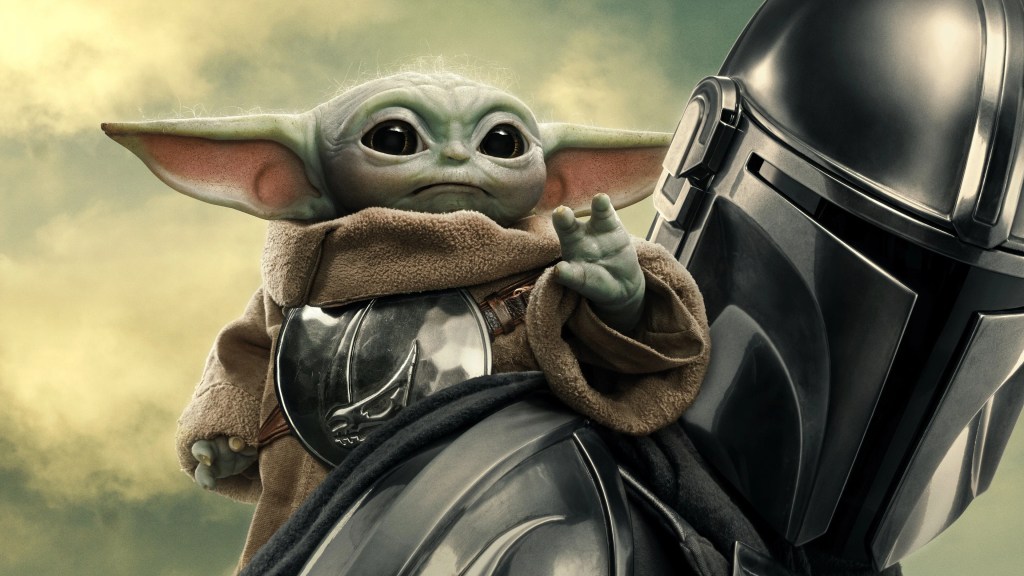

The Mandalorian was seen by many as an antidote to the messy and uneven Star Wars Sequel Trilogy, and in fact it became a refuge for fans disappointed with how the Skywalker Saga concluded with The Rise of Skywalker. The Mandalorian offered stability with its episodic format and hinted at a possibility that the filmmakers in charge, Dave Filoni and Jon Favreau, understood the Star Wars fanbase by appealing to beloved iconography and western vibes detectable in the Original Trilogy.
It was a matter of time before the adventures of Mando and Grogu (christened as Baby Yoda by uninformed online consensus) would make their way to the big screen. But it wasn’t anywhere near as natural as you’d might imagine. Following three successful seasons of The Mandalorian and a handful of crossover appearances on a few other Disney Plus shows, Favreau and Filoni weren’t exactly gunning to make a movie follow-up. Instead, they were fully committed to developing the fourth season of the show (which they wrote), but owing to external factors like the infamous 2023 Hollywood labour disputes, Lucasfilm prioritized the development of a movie.
However, judging by the budget allotted to the production of what became The Mandalorian and Grogu—a relatively measly 165 million dollars, one-third of the reported net budget of The Rise of Skywalker—Lucasfilm exercised much more caution. Perhaps they absorbed the lessons of The Rise of Skywalker and Solo: A Star Wars Story, or simply came to terms with the reality of the visibly shrunken post-pandemic movie exhibition market. Or maybe they didn’t quite trust the notion that a Star Wars movie disconnected from the Skywalker canon could command a significant chunk of the box office revenue.
After all, the memetic connectivity of The Mandalorian to the greater Star Wars universe was shallow at best, as it was rooted predominantly in iconography rather than anything more substantial. The success of the show was largely driven by the cultural cachet of the bounty hunter lore, which had sprung to existence out of nothing else than the acknowledgment that Boba Fett’s character looked cool and carried a certain degree of mystique. That and the fact that Grogu was adopted by the online community as a bit of a sweetheart because he looked like what if Master Yoda looked and behaved like Gizmo from Gremlins when he was young. You can argue all day but this is how shallow the phenomenon of The Mandalorian really was: two visual memes hybridized into an unlikely buddy setup plopped against the backdrop of a western-esque anthology with a wider arc building in the background.
And you might imagine that the opportunity to make a movie follow-up to three seasons of this experiment—abetted further by a handful of crossovers loosely sketching what looks like a framework of a Marvel-style shared universe—could be seen as a platform to elevate what worked on the small screen and use the bigger canvas to tell a more epic, self-contained story that drives the character arcs of both Mando (Pedro Pascal) and Grogu/Baby Yoda much further than the show could do, amplifies the stakes and even sets the stage (and primes the audience too) for what’s to come in the potentially forthcoming fourth season of the show. That’s at least what I’d consider standard Hollywood practice that many longstanding franchises stretching between TV and cinema would typically attempt. You build slowly on the small screen and capitalize on the big screen.
No such luck here, though. The Mandalorian and Grogu does not look at all as though it was conceived to carry out a mission of utilizing the big screen format to further the ambition of the show and do stuff that the TV screen was simply too narrow for. In fact, it looks like a movie that was put together “on the quick” in response to a political decision to halt the production of the show, born out of the very same narrative momentum that carried The Mandalorian through three seasons of serialized production. It is less a fully functional movie than an extended TV special or even a stitch-up of what would effectively work as a three-episode miniarc within a season of the show. The only feature distinguishing it from what has become familiar on the show is the James Bond-esque cold-open where Mando and Grogu are found on a mission to retrieve an ex-Imperial warlord in exchange for moolah. We get to see Mando infiltrate the guy’s base, AT-ATs falling off mountain ridges, a brief airborne shootout and then we’re back at base camp where the baddies is put away in chains while Mando collects another quest from his Rebel handler Ward (Sigourney Weaver).
Structured a bit like something out of an MMORPG—where a mission nests a handful of sub-quests casually leading the character along the predestined plot trajectory while giving us an illusion of domino-esque momentum—The Mandalorian and Grogu simply fails to escape the confines of its own comfort zone and gives us exactly the kind of entertainment we’d have come to expect from the TV show. Nothing more, nothing less. We see Mando go on what essentially is a three-episode quest, Grogu is cute at all times and uses the Force to casually rescue the story that keeps painting itself into corners and—crucially—nothing of consequence truly takes place in the movie. Because it is not a movie after all, only a longer episode of the show.
Which is a total waste of everyone’s time, effort and money. Quite frankly, The Mandalorian and Grogu was a perfect opportunity to push the narrative and make irreversible decisions that would ripple through the show, thus making the movie an indispensable part of the journey. But all we get are surface-level fan service and the kind of spectacle that is two sizes too small for the screen it was projected onto.
I find it quite ironic, to be perfectly honest, because from the onset it looked as though The Mandalorian was a genuine attempt by Lucasfilm to build a self-sustaining shared universe that’s not tethered to the Skywalker storyline inspired to a great extent by the example of the MCU. They wanted to truly capitalize on the vast lore and the extended Star Wars canon available to be mined for filmmaking purposes much in the same way as the volumes of comic book lore were used to bring The Avengers to the screen and assemble a multilevel, intricate web of interconnections between seemingly disparate narratives all converging at massive tent pole events of cinematic scale and ambition. What they seem to be on the way to achieve looks inspired by the late-game MCU: tired, out of ideas worthy of cinematic treatment and tied together by mere convenience and obligation.
Incidentally, The Mandalorian and Grogu shows that Lucasfilm, while desiring to apply the strengths of the MCU experiment, has inherited its innate vulnerabilities. While it is clearly possible to depart the long-standing Skywalker canon especially on the small screen, which other TV series have shown, generating sufficient interest to successfully deploy a blockbuster becomes an insurmountable challenge without the drawing power of well-established icons. It looked from the outside as though Mando and Grogu had the necessary staying power, but it clearly turns out that their cultural rooting was much more shallow than anticipated. They just don’t have the same organic connection with the fanbase and their tether to the culture is as shallow and fleeting as their combined visual meme.
Sadly, the fate of the currently paused The Mandalorian series was mishandled by people who clearly didn’t appreciate the gravity of the undertaking. What they needed The Mandalorian and Grogu to be was a load-bearing wall for their shared multimedia universe to rest on and what they handed Lucasfilm executives was a cudgel to pummel them with and a reason to believe that the only successful Star Wars movies are the ones that—even if indirectly, distantly and vaguely—orbit the Skywalker lore.



Leave a Reply