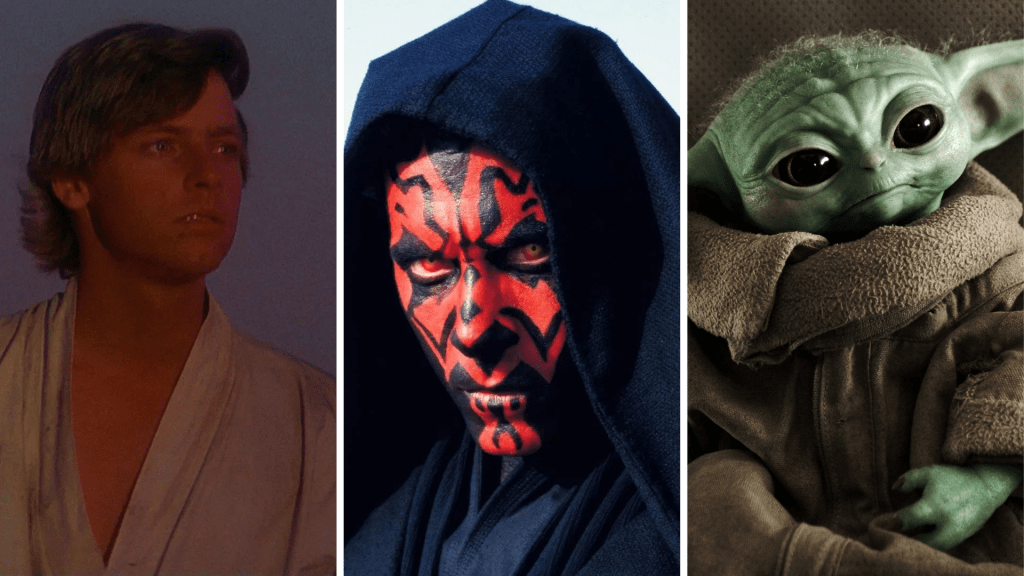
I remember vividly the excitement accompanying the months leading to the release of Star Wars Episode I: The Phantom Menace. Fifteen at the time, I was buzzing with anticipation even though the 1997 re-release of the Original Trilogy in its now vilified Special Edition format was still fresh in my memory. For anyone immatriculated into the cult of Star Wars, especially at a young age, the idea of witnessing the arrival of a brand new movie in this space was a religious experience.
And then it happened. The lights went down, the squeals coming from the auditorium filled with young fans of the series, some of them shushed by their caregiver companions, extinguished. The cinema filled with the magnificent roar of John Williams’s iconic theme. My heart skipped a bit. But it was all downhill from there because even the opening crawl foretold an impending tsunami of disappointment. Between the mentions of blockades, trade disputes and galactic taxation, it was easy to see that the magic of the original movies was nowhere to be found. And whatever excitement I had left in the tank was completely diffused by the time George Lucas introduced me to the character of Jar-Jar Binks.
Therefore, dual lightsaber battles with an epic choral accompaniment notwithstanding, my cohorts and I wholeheartedly rejected what The Phantom Menace brought to the Skywalker saga. It was too infantile and wooden and void of that practical plasticity the older movies in the series had in spades. Young Gen-X dads were also shaking their heads in disbelief on their way out. But their eight-year-old kids were positively buzzed, their synapses firing on that extra dopamine. After all, it seemed that George Lucas targeted them specifically with this movie.
The massive hype built up before the release of The Phantom Menace quickly turned into ire because the myth-making and magic of the originals was missing in action. The entire run of the Prequel Trilogy was therefore an emotional roller coaster for those who had imprinted on the originals. Respite was only found at the time when Episode III came along, specifically because it finally closed that narrative gap and reminded us of what we had all been promised: the story of how Anakin turned to the Dark Side and became the most iconic villain of all time. Meanwhile, those younger fans for whom The Phantom Menace likely was their first meaningful interaction with the series never held such potent reservations. They ingested those highly choreographed sword fights and normalized their cultural imprinting against the baseline of full CG-backgrounds and animated characters, not practical sets and puppets.
Thus, the cohort of youngsters who grew up alongside The Prequel Trilogy and frequently sat down to eat their morning cereal while watching The Clone Wars on TV was much more open to adopting these ill-fated movies that people my age and older saw as complete betrayal. For those latter-day Millennials and Gen-Z-ers, The Phantom Menace, Attack of the Clones and Revenge of the Sith were constituent parts of the Star Wars lore, which serves to explain why over the years the once staunch criticism towards these movies eventually subsided. It wasn’t just a case of the initially ironic memes, which sprouted on the outer rims of the blossoming online culture, driving this adoption; it was generational.
Moreover, it is a systemic phenomenon that isn’t unique to that strange case of the Star Wars prequels. It is rather an implementation of a widespread pattern of cultural imprinting that—whether we like it or not—plays a crucial role in guiding our likes and dislikes. We are more likely to be inculcated with appreciation for what came before us; also, cultural items we are exposed to during our formative period we can easily adopt as natural. You can notice the same pattern in other longstanding series stretched across multiple generations. If asked which of the many Saturday Night Live casts reigns supreme, chances are that it is the one that was current when you got invested in this show. Similarly, the perennial question of who is the best James Bond almost always falls along generational lines: Boomers stood by Sean Connery, Gen-X-ers were more leaning towards Roger Moore and Millennials adored Pierce Brosnan. Meanwhile, being what’s called a Xennial myself, I bat both for Brosnan and the often-overlooked Timothy Dalton.
Thus, the cultural normalization of the Star Wars prequels was a product of early-life imprinting bolstered by the impact of The Clone Wars as a morning cartoon companion for many younger adepts of the series. So, is it then right to expect that the Sequel Trilogy comprising of The Force Awakens, The Last Jedi and The Rise of Skywalker could eventually warm the hearts of the core fan base and become adopted as the text using the same mechanism?
This is where I think complications arise because the cultural standing of the Star Wars series is governed by additional factors, some of which gained in prominence and sway in recent years. Fans have changed over time and some divisions and gripes have now calcified beyond repair. For instance, when I was young, the idea of Special Editions with additional footage and changes made to the original movies was mostly received positively. There was some opposition from franchise purists who truly cared about who shot first in that iconic exchange between Greedo and Han and who insisted that Jabba the Hutt was never supposed to feature in the original movie. In fact, some still pressed that the 1977 movie be referred to simply as Star Wars instead of Episode IV, a change made during the theatrical re-release ahead of the global premiere of Empire Strikes Back.
Over time however, things changed. Although I grew up having adopted both the “OG” versions of the trilogy and its Special Editions, which I watched on a loop as a youngling, my view has shifted in the aftermath of the numerous changes made by Lucas to all Star Wars movies coupled with the fact that unmodified versions were allowed to go out of print and thus were made completely unavailable. Simply put, it’s not that easy. Even though many fans in my age bracket had held these re-releases in high regard initially, now the mood is different and this shift has been vastly accelerated by the online experience allowing all fans to exchange their views on the matter, gripe and complain in public fora in an atmosphere of feeling seen, and develop an unhealthy attachment to these movies too. And although these online spaces have been predominantly driven by voices of older fans who “remember the good old days,” younger adepts grew up surrounded by it too.
Therefore, assuming that younger Gen-Z-ers and Gen-Alpha kids—for whom the experience of going to see The Force Awakens with their dads at a young age will be additionally tainted by these online influences—would imprint on the movie with ease is for the birds. Moreover, the J.J. Abrams-directed revival of the saga—in contrast to the prequels—was not directly aimed at co-opting new demographics into the fandom at all. It was nostalgically targeting those disgruntled older fans who demanded the series go back to its roots. Which it did—The Force Awakens was a de facto remake of the 1977 original with a handful of modifications. Hence, expecting that new viewers would form long-lasting bonds to movies that were vibing on frequencies that they had no business resonating at might be a bit optimistic. And let’s not forget that kids in 2015 were still watching The Clone Wars and Star Wars Rebels, reinforcing their imprinting of the Prequel canon.
Consequently, what I think is likely going to happen over the coming years is that the Sequel Trilogy will remain seen as a bit of an oddball, a trio of movies nobody really wants to talk about at great length out of risk of revivifying all those numerous cultural conflicts pertaining to Daisy Ridley’s character being reduced to a “Mary Sue” archetype, the whole debacle surrounding The Last Jedi split in the fandom and the massive U-turn summarized memetically as “somehow, Palpatine returned.” And in contrast to those older generations who had no other choice but to accept prequels as canon, the world of Star Wars has become completely saturated with other content that viewers can choose to normalize and get behind instead. They have options.
Fans don’t really have to fret over the possibility that they would have to wean themselves on to The Rise of Skywalker in the coming years because they have access to other, less problematic properties in this space, like Rogue One or The Mandalorian, let alone the multitude of other miniseries, series and and animated shows that have populated Disney Plus in recent years. In fact, younger fans have found their memetic companion in Grogu, better known as Baby Yoda, which immediately afforded The Mandalorian a place in the established and fan-accepted canon. It was a much safer option than having to demilitarize the cultural minefield that the Sequel Trilogy has become in the eyes of the Star Wars fandom.
The mechanism of cultural imprinting is still at work in the current climate, but it is a bit more nuanced and non-linear out of necessity to circumnavigate issues influenced by online feuds and culture wars, frequently exacerbated by politically-motivated bad faith actors. It is still true that what we are exposed to at a young age is more likely to be adopted as canon as the makeup of the fanbase shifts with ageing demographics, but we are on the whole more selective and purposeful in what we normalize and adopt. Even though the Prequel Trilogy has now been for the most part adopted as canon, the character of Jar-Jar Binks is rarely mentioned in polite conversation despite being a central figure in The Phantom Menace. We reminisce only about what brings us warmth while consciously pushing controversial elements to the side.
We’ll still chuckle at the fact that Anakin hated sand, but we’re more likely to hear about the numerous epic lightsaber fights the Prequel Trilogy was littered with, even if occasionally underpinned by a seriously so-bad-it’s-good energy. Analogously, it’s just way easier to pretend the Sequels don’t exist—despite the fact that The Force Awakens remains one of the highest-grossing films of all time—because audiences can just attach themselves to The Mandalorian, Andor, Rogue One and the like. Imprinting is real, but it’s also intelligently selective, it turns out.



Leave a Reply