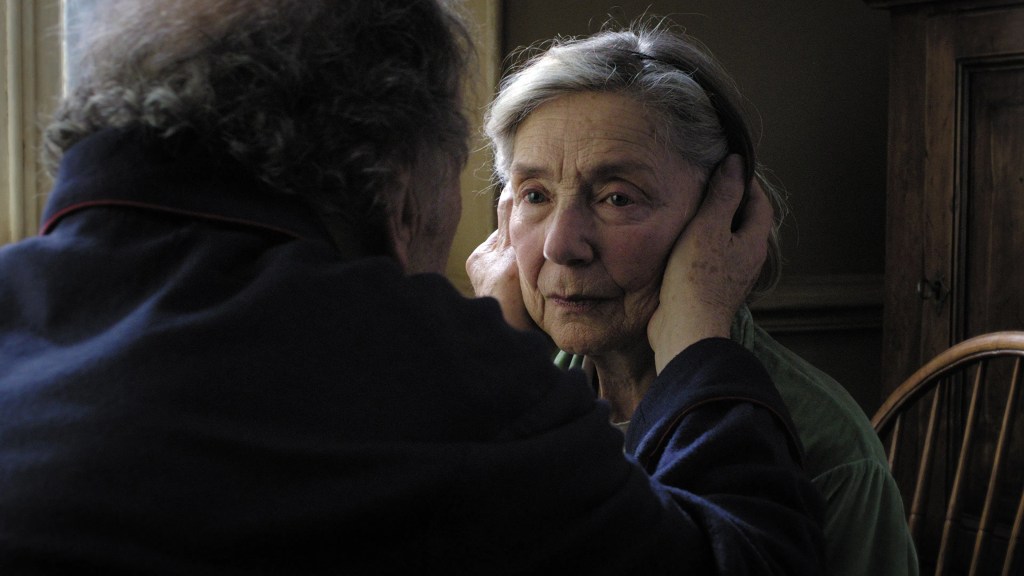

Having secured his place in the pantheon with his Palme d’Or for The White Ribbon, Michael Haneke came back in 2012 to reprise his critical success with Amour, a movie that perhaps could be seen as a thematic outlier against the backdrop of his entire filmography, in which he persistently acted as a stern teacher keen to educate the upper classes about the perils of disengaging from the world at large and hiding behind the armour of financial wealth the way one would be inclined to teach a puppy not to defecate indoors—by stuffing their noses into the freshly produced droppings hoping to establish a negative feedback in their synaptic circuitry. It would seem that by committing to telling what looked like a tender love story, Haneke’s cold didactic touch was warming up and he was slowly letting his innate humanism triumph.
Well, not exactly. Haneke’s Oscar-winning tender exploration of love in times of hardship has a toggle switch hidden within its confines that allows the viewer to change perspective in real time and reveals that the filmmaker is still just as interested in scorning the haves from the elevation of his preacher pulpit as he is in exploring their own humanity. In fact, if you position the switch correctly, in that middle position of sorts, you might even see the film as a blend of both modes of thinking—a hybrid of didactic scolding and emotional reassurance. To achieve that, however, preparation must need opportunity and the viewer needs to attune themselves to the peculiar frequency at which Amour seems to resonate most profoundly.
Nevertheless, it is true that you do not have to do any intellectual heavy lifting at all, and you shall still most likely emerge from viewing Haneke’s film enriched in some fashion and perhaps moved by the humanist drama the movie asks you to invest in. It is more than enough to see Amour for what it is on face value, which is a simple story of love, devotion and perseverance where Georges (Jean-Louis Trintignant) must face against the frightening prospect of seeing his wife Anne (Emmanuelle Riva) slowly wither away having suffered a stroke. Haneke spares no expense in relaying the utter horror of having to watch your loved one’s mind and identity slowly become entombed in a malfunctioning body, unable to communicate or experience the world the way she was used to. In his typically unrelenting fashion, Haneke commits to upsetting the viewer with the stark reality of what it must be like to both suffer from suddenly seeing your own body refuse to perform even the simplest tasks and to have to care for a someone afflicted in this way. You are well within your rights to choose to see Amour as nothing more than a treatise on this predicament and an exploration of the plethora of emotions associated with the very idea of having to let go of someone who may have been your entire world, as well as being fully aware of the fact they are suffering immensely without even a remote ability to communicate their pain, let alone fend for themselves. It is a horror of dependence woven into a story of undying love.
But that’s not all. If you flick that switch, you will see that Amour is also a treatise on exactly what you’d come to expect from Michael Haneke, who had spent his entire life taking his surgical instruments to brutally invade the lives of privileged people who are so thoroughly encased in wealth that they can afford not to interact with the outside world at all. He did it in Funny Games, Caché and many other films, and Amour is not an exception in this regard either. Perhaps you can’t teach an old dog new tricks, but as far as I am concerned, his superficially tender love story is a fascinating template upon which to map his more familiar proclivities.
That’s because you—the viewer— are in control. You get to choose to look at Georges and Anne and see a tragic story of love or to see past this relationship and notice where this love is nested and how they interact with the world around them, how they distance themselves from it and how they treat those who enter their inner sanctum. They live in an ivory tower, a massive apartment where they dwell sequestered from the woes of the outside world. They insulate themselves from any form of tangible reality by indulging in classical music and literature and their only exposure to the world comes from reading a curated digest of the news in a ritual of becoming informed, but not necessarily invested, in the various global crises unfolding elsewhere. They do not need to care one bit about other people as long as they get to be self-sufficient enough to get their shopping done and head out to the opera or a concert once or twice a week.
However, once Anne is struck down with the horrifying and debilitating illness, things must change. They can no longer afford to live as they used to, and they become reliant on other people. Furthermore, they become reliant on people positioned well beneath them in the societal hierarchy. Haneke pays familiarly close attention to these frequent yet fleeting moments when he shows us that more and more people invade the characters’ space after Anne’s stroke. Nevertheless, these are never just concerned friends or neighbours. These are people Georges ends up paying even when their encounter involves a courteous exchange signifying friendly concern. Georges does not have friends. He has contractors and subordinates. And even in times of strife he continues to view other people he so desperately relies on as paid servants.
Therefore, whenever we get to witness the key conversation between Georges and his daughter (Isabelle Huppert), who suggests her mother should be moved into care, the resulting anguish and rage exhibited by Georges may not entirely stem from a romantic desire. It is quite plausible that she had expressed her wish not to be manhandled by other people because it would have felt degrading to be so physically reliant on people from lower castes, or that he was willing to make this decision on her behalf. There is a reason why Haneke sometimes cuts to a clearly paid-for cleaner hoovering the front room, just as there is a reason why he shows a neighbour helping Georges with his groceries. It should honestly alert you when you witness such scenes because you could easily imagine yourself in a predicament like this and you probably wouldn’t think about reaching for your wallet immediately after your neighbour helped you carry your bags upstairs. You’d probably just say thank you, knowing full well that the arrangement you have with the neighbour is reciprocal, well-meaning and born out of friendship. For people like you and me, this is a courtesy. For people like Georges, this is a transaction. This is what I believe Amour truly gets at – the same story of undying love in the face of a terrifying disease… as experienced by people who thought they were so perfectly cushioned by wealth that they’d never have to interact with other people—except transactionally—and that they’d be able to just go it alone.
In fact, the movie pushes this idea even further, almost to a point where it becomes truly uncomfortable to the viewer chose to view the story as a social commentary nested within a subdued romance. It all culminates in a series of scenes beginning with Georges utterly berating a nurse for being unkind to his wife. A viewer in the “love story” mode will easily see this as a key character moment signifying care and resolve to risk offending a complete stranger in defence of his otherwise totally vulnerable wife. What this scene also carries is fundamental contempt Georges has for this person. He is not interested in even hearing what she has to say, he questions her morals and suggests she’s too stupid to understand what she did. Our innate instinct is to side with him because we care about his relationship with Anne and therefore we might overlook an overt display of prejudice and contempt. We are all about the love story.
However, Georges quickly finds out that caring for Anne on his own is incredibly difficult and that the nurse he had fired so unceremoniously may have had a point. When he loses his temper with Anne—who stubbornly refuses to cooperate and let him help her—and slaps her, Haneke wants us to pause and think. This is where we also get to make a choice because we can choose how to interpret the ending of the movie. We can either see Georges murdering his wife as a mercy killing and an ultimate expression of love because he doesn’t want her to suffer any more trapped in her own body like a prisoner, or as an expression of something different and more intrinsically insidious. It is again entirely plausible that Georges does what he does because he can’t go on himself and he won’t agree to see his wife degraded by being completely dependent on people he views as inferior to them. He’d rather kill her and maybe even himself (the ending is quite ambiguous in this regard) instead, rather then resign to the mercy of people he views with disgust.
Therefore, it is possible that Amour is one of the most intricate and complex stories Michael Haneke ever told. He managed to hide a powerful attempt at dismantling the blue-blooded privilege so well that most people never noticed. It’s just so inherently fascinating because it’s not a trick. If you watch Amour and fall in love with the Shakespearean tragedy Haneke weaves, you are not a fool. You are simply responding to your own innate human proclivities. However, it is possible that you also see what you want to see—and refuse to notice what you do not want to see, by extension—because you can see this film as spiritually related to Funny Games and emerge completely disgusted. However, this interpretation may be completely inaccessible to a viewer for whom Amour is their first exposure to Michael Haneke as a filmmaker.
Consequently, this (still) penultimate entry in Haneke’s filmmaking catalogue is a unique specimen because very rarely do we get a chance to see a movie for the first time twice. Not only that, but it is also an opportunity to experience Haneke’s humanist touch that he almost always refuses to deploy directly. We can frequently deduce that his intentions are pure and coming from a desire to elevate the human condition above its rampant selfishness, but we must always rationally derive it and find it hidden underneath his brutal language of authoritarian didacticism. In Amour, Haneke gives us options and trusts we have learned enough to see his intentions. But he is equally cognizant that some of us might either not have the appropriate perspective or simply choose not to notice the full extent of what he’s doing.
We, the viewers, are in full control. We decide if Amour is what the title suggests, or if it is something else. Or if it is both. And that’s why it is perhaps the most important film he has ever made, which – I must admit – took me over a decade to understand.





Leave a Reply