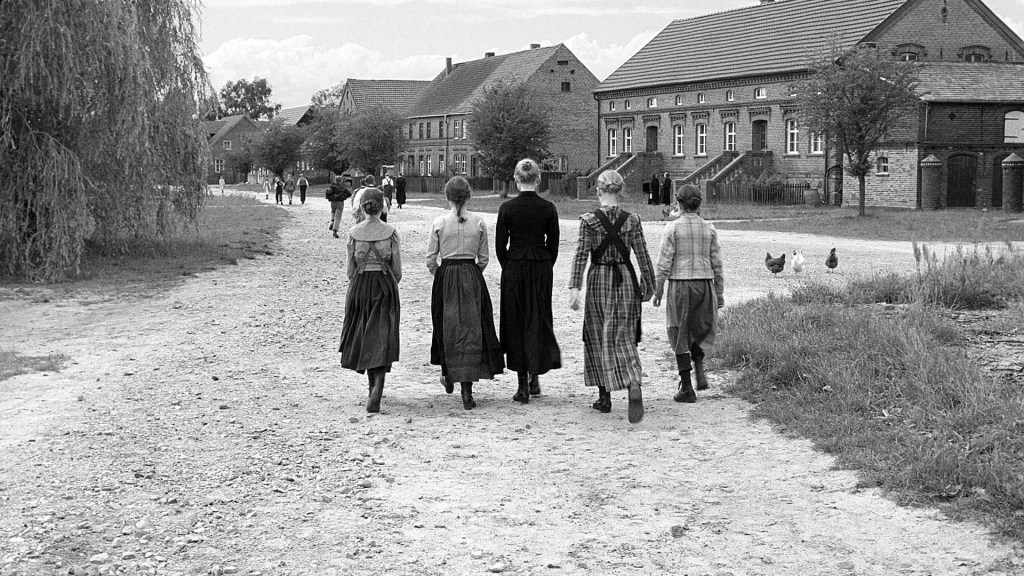

The White Ribbon was, I believe, one of my first interactions with Michael Haneke as a filmmaker and—much like Amour—it has taken me a while to come round and understand its import. In fact, I am now of the opinion that not only is this a film that requires some attunement on behalf of the viewer, but it also gains a whole new dimension when experienced through the lens of intimate familiarity with Haneke’s entire filmmaking catalogue.
According to Haneke himself, the genesis of this movie dates back to the late 90’s, presumably coinciding with his work on Funny Games. I believe this placement helps to contextualize how and why this idea must have germinated in his mind; after all, it was the time when his interests circled most directly the notions of darkness lurking somewhere in the back alleys of the human nature. However, it must be stated that all throughout his career as a feature filmmaker, Michael Haneke has consistently and unwaveringly pondered the very questions he ended up distilling into The White Ribbon.
In fact, his 2009 outing functions almost like a best-of compilation on the subject, a concept album titled “The Dark Side of the Human Condition.” Instead of hiding his intentions behind a veneer of realism warped by evil forces emerging from within the characters and the friction between the social castes they hail from, Haneke opted to encapsulate these insights within a recognizably heightened parable. This is quite frankly where a lot of the misunderstanding concerning director’s intent or sensibilities might have originated too, specifically because the format itself—that of a moralizing tale that forgoes realistic assumptions about the world at large and replaces them with narrative conveniences fit for a Sunday sermon delivered from behind a church pulpit—reinforces the filmmaker’s own didactic tendencies. In short, the movie might come across as a bit preachy.
This was honestly my first knee-jerk response to The White Ribbon when I first saw it many years ago: it was a bit rich for my blood. Watching this intentionally dense film as it slowly unfolded in front of me while also attempting to implicate me in its own moral quagmire was accompanied by a feeling that I was being told a story by a filmmaker who kept a distance both from me and the material. It was as though Haneke sat atop a horse while recounting the events that took place in the fictitious village of Eichwald in the run-up to to the outbreak of World War I and denuded moral degradation intrinsic to many of its outwardly upstanding denizens from a safe distance. A moral high horse.
Some critics balked at what looked like Haneke’s thunderous sermonizing, especially since the filmmaker himself went on to characterize his intent to describe “the roots of all evil” in telling this story, which immediately removed any ambiguity regarding intent. But having availed myself of Michael Haneke’s entire feature filmography and acquired enough resolution in my understanding of it, I no longer see this film as reductive, preachy or unnecessarily pompous. The tone behind the story is exactly the same as the one encountered in Benny’s Video, Funny Games or Caché, but it comes across differently because the storytelling modality the filmmaker chose to encase this tone within was totally different and perhaps more synergistic with a parable. Thus, the movie feels more intentional and devoid of the kind of friction between aesthetics and thematics you’d have found in his other movies.
But The White Ribbon is just as powerful and just as nuanced as anything else Haneke touched. In all honesty, it is perhaps his most ambitious and challenging effort because it attempts to corral so many ideas about the human condition that it almost looks too dense for what the narrative can reasonably support. At the same time, what I think is a mission to sketch out how an entire nation might fall under the spell of an evil ideology like Nazism cannot be simplified for the sake of convenience. Therefore, even if it comes at the cost of viewer immersion or straightforwardness of the narrative structure, it is a worthwhile endeavor.
Consequently—and this is where the filmmaker leaves room for the viewer to interpret things and trusts that they would assume the right perspective and distance from the material not to lose the sight of the forest for the trees—the story in The White Ribbon contains it all. It’s a parable of parables, if that makes any sense. Guided by (or maybe even manipulated by) the narration of the village teacher, we ping-pong between numerous sub-stories (some smaller than others) encased within the film. We see the town pastor and his brutish parenting methods. We move to the peasantry roiling with discontent, and then to the perceived detachment of the village nobility ruling over the land. Haneke moves freely between minuscule moments of human morality unraveling: a woman humiliated by the village doctor, a boy brutalized by his father for “impure touching,” a teenage girl ostracized in front of her peers, another girl sexually assaulted, a little boy tortured by unknown perpetrators. He interweaves acts of outright violence and sabotage: a wire left for the doctor’s horse to trip over, a bird stabbed with a pair of scissors, a field of cabbage destroyed in an act of retaliation. People disappear never to return. Some are found dangling from a wall having taken their own lives. Implied threats of violence percolate between the many castes comprising the village. Peasants look at the baron with suspicion. The pastor assumes a moral high ground while viciously mistreating his family. The rich and powerful squash those who depend on their generosity. Meanwhile, the village children take the most decisive action and lash out in targeted attacks aimed to drive a stake through the rotten and corrupt soul of this forlorn community.
Understandably, this is a lot to bring under one umbrella and it is incumbent on the viewer to retain the necessary perspective to keep all these insights and ideas within the frame. Failing to do so risks drawing the wrong conclusion and assuming that the filmmaker intended to reduce the genesis of Nazism to a mere backlash against class inequality, or that he suggested that authoritarian tendencies brewed in Germany long before the Beer Hall putsch of 1923. What The White Ribbon invites you to do is first to actively disarm the knee-jerk rejection of being preached to from behind the moral elevation of a church pulpit and then to take it all in at once. Assume that what you are watching is a mosaic where the kinds of stories you experienced in Haneke’s other movies are parts of a bigger picture. The moral detachment of the middle class you saw in The Seventh Continent. The desensitization to violence witnessed in Benny’s Video. The shattered sense of security bought by wealth experienced in Funny Games and Caché. The chaos of the class system breaking down in response to an invisible calamity seen in Time of The Wolf.
The White Ribbon grapples with all those ideas and suggests that seeking simple answers to complex problems is a futile endeavor. In his tale of wholesale community dégringolade he successfully miniaturized the many parallel and interdependent processes that most likely led Germany onto a path towards darkness in the first half of the 20th century. It was never as simple as lashing out against punitive surrender conditions imposed by the Treaty of Versailles or as straightforward as a single charismatic populist capturing the grievances of the disenfranchised silent majority and redirecting it towards his own insidious aims of total continental domination and rooted in foul perceptions of racial superiority. It was all that and more. The brewing class divides. The detachment of the rich. The grievances of the poor. The roiling rage of the oppressed. The vicious rebellion of the youth. They all came together, already energized and ready to unravel, and became encased in a pressure cooker of a global conflict.
What emerged at the end of the war the filmmaker does not want to get into. He trusts that we can fill in the blanks. But what he leaves us with cuts much deeper than his cursory comment about wanting to understand the roots of evil. I think Michael Haneke wanted to paint a dramatic fresco, full of detail and perspective, in which in one place we could find all that was needed for one of the most powerful countries in the world of its time to fall prey to evil forces, or better yet, to allow humanity’s own intrinsic dark side to take the wheel and drive. And pondering this fresco painted in high-contrast monochrome will reveal that for Nazism to take hold in Germany, the conditions required many conditions to align, all of which Haneke had discussed in his previous movies separately and with appropriately surgical fidelity.
It was never as simple as hijacking the grievances of disenfranchised men who came back from the war they had been duped to fight, but it involved rotting societal foundations with normalization of “othering,” increasing friction between classes and crucially convincing the youth that the only way they could secure a future for themselves was to burn the world down. The White Ribbon captures all these notions, brings them forth in front of the viewer with Haneke’s signature conviction and delivers it in an experience that is just as unsettling as his other efforts, even if at the cost of coming across as preachy. But what he leaves us with is a lesson that is as uncomfortable as any of the many lessons the filmmaker had delivered previously: that evil didn’t come from outside to possess an entire nation. It was there all along, embedded in the human condition.






Leave a Reply