
Imagine, if you will, that you are treated to a nice train ride on the Eurostar. Well, it does not have to be the famed metal tube on rails connecting England with France; what matters is that the train in question must be able to develop sufficient speeds to effectively make the world outside the train windows whiz by. Under such circumstances you might be led to believe that the landscape you are traversing at velocities ludicrous enough to obfuscate the world outside with noticeable motion blur is somehow pretty, singular and even poetic. You may convince yourself that the rolling hills of southern England are somehow imbued with magic, or that the farmlands of northern France carry a whiff of the exotic.
But it’s all a mirage because once you slow down to more manageable speeds the magic dissipates never to reappear and the visages your eyes register instead you can only characterize as conventional. They are just hills and farmland. And in fact, they are frequently obscured by shrubbery growing alongside the train line, planted deliberately to reduce the noise pollution inevitably disbursed onto the world by passing high-speed trains. You learn that velocity can be deployed as a mode of camouflage and used to trick you into misinterpreting the images fed through your optic nerves, likely because in situations where the brain is stimulated with overabundance of poor-resolution data, it fills the blanks itself using its own datasets mixing memories and generative recreations based on pattern-matching.
And why am I telling you this exactly?
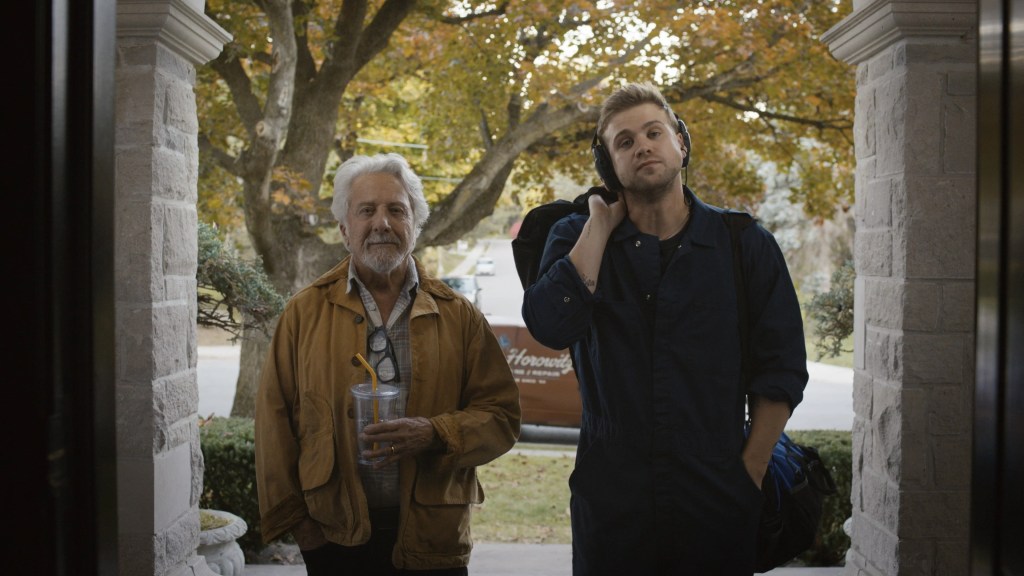
Good question. It is to tell you specifically what I felt while watching Tuner, directed and co-written by Daniel Roher in his feature debut (or more aptly, a temporary departure from his documentary work). This is a movie that works exactly like a high-speed train ride and succeeds predominantly on the back of its story developing too rapidly to leave sufficient room for you to think about what’s going on, let alone question and challenge this experience on its merits. Therefore, if you opt to look out the window only when the train ploughs through the landscape at high speeds, you shall emerge satisfied because the movie registers as amicable, entertaining, mildly quirky and fun to follow. Catchy. Tuner is catchy like that three-minute earworm you hear on the radio every morning on the way to work. It’s not the best song in the world but you hum it under your nose while doing dishes unwittingly.
There’s something innately easy to get on board with when it comes to the film’s central conceit of a young apprentice piano tuner Niki (Leo Woodall), who suffers from hyperacusis (a condition that renders him extremely sensitive to loud noises), and who must figure out a way to pay for his teacher’s (Dustin Hoffman) gargantuan medical bills. So, he learns how to utilize his extremely sensitive sense of hearing to open safes and finds himself in hoc to a bunch of shady individuals who would want to keep using his de facto superpowers to rob wealthy people. But that’s not even the half of it because Niki, the titular tuner, is also a bit socially awkward. And it doesn’t take more than a hot minute to figure out that he used to be a piano prodigy before his debilitating affliction rendered his trajectory towards professional musicianship completely unworkable. And he has perfect pitch, too. Niki is a superhero in everything but name. In fact, if Stan Lee was alive, you’d be able to pitch to him the idea for a superhero called Tuner-Man who would spend his days tuning instruments (of which there seem to be a bajillion in New York City) and by night he would solve crimes and break into vaults using his superpowers of hyper-sensitive hearing.
But you’d probably never get to do anywhere near as much thinking on the matter because Tuner would just have you constantly trained on the unfolding plot in which Niki meets a girl and then he gets entangled in criminal wrongdoings, and then he goes on a mission to earn a lot of money for his mentor and so on and so forth. The movie just flies by like an inoffensive medley of ideas plucked out of Thief and Baby Driver, seasoned gently with a pinch of Breaking Bad, and directed to evoke the spirit of a Darren Aronofsky picture. It’s an easy in-and-out experience that doesn’t give you a single chance to think about anything of note and supplies ample entertainment through its central gimmick of a piano tuner superhero with a perfect pitch and puppy eyes.
But if you slow down for even a second or, heavens forbid, do some thinking on your own time once the movie has closed, you might find the results disappointing to an extent. And that’s because underneath that gloss and motion blur of events passing you by so swiftly and effortlessly Tuner carries absolute bupkis. Zilch. Nothing of note. And I’m not even complaining about the absence of easily-decodable thematic reading I could bite into. Far from it. I don’t require every movie to supply an intellectual experience I’d get to chew on and digest for a long time. Not every movie needs to be high in fiber this way. What I do find reasonably objectionable is that when you pay enough attention, the structure of the story, the plot and the characterizations will reveal themselves to be utterly and shamelessly conventional, convenient and lacking wholeheartedly in narrative originality.
What you will find is that Tuner loses its luster the minute you venture beyond the three sentences of an elevator pitch that Roher and his peeps must have produced to convince their financiers to pony up the cash to bankroll the production of the movie. It’s nothing but a slide deck of stock photographs flicking at high frequency and strung together using cliché and baseline narrative conveniences that are so obvious that you probably wouldn’t learn about them in screenwriting courses because the teachers would assume that everyone is aware of them anyway. It’s a movie that just will not surprise you in any way and where every single aspect of its narrative conveniently foreshadows an event you will see from a mile away of pays off this foreshadowing with the flair of a postal worker finishing their Friday shift of sorting outgoing parcels.
To deploy another simile—and at this point I am aware of just how many I used in the span of just over one thousand words—Tuner is nothing but a calorie-dense fast food meal. Tastes OK. Serviceable. Cost-effective. Fills you up in the moment. But it’s mostly carbs, fats and salt. You’ll be hungry in a short while and you might think twice before going back for more once you read up on how that meal was made. So, to bring this all together: Tuner is a landschaft superhero ersatz you can only enjoy like a Domino’s pizza, assuming your rate of consumption outpaces your ability to rationalize your decisions. You can’t un-eat a terrible meal you guzzled down while looking through a window while cutting through the French country side at high speeds, so you might as well enjoy it. But if you wonder why you feel bloated and weirdly gassy afterwards, it’s because you got tricked into thinking that a poorly fleshed out gimmick stacked with conveniences was a movie worth watching.





Leave a Reply