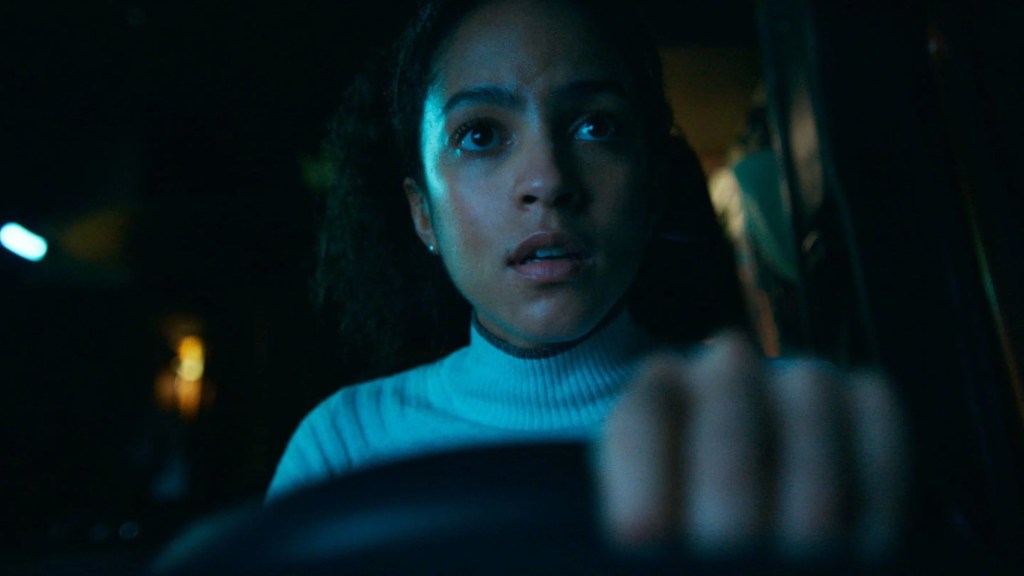

This is one of those occasions when I do feel like a broken record because I am definitely positive—100%—that I have anchored at least one of my texts around the concept of “the monster behind the door” that Stephen King discussed in his eponymous book about writing in the horror genre Danse Macabre. And here I am, about to do it all over again because the recently released horror movie Passenger directed by André Øvredal is a great example of what happens when sage advice dispensed by masters of the genre is disregarded.
The idea of “the monster behind the door” was Stephen King’s way of visually encapsulating the tension between audience expectations and what the story ultimately delivers. Successful generation of suspense, dread and fright relies on utilizing viewer’s or reader’s imagination, which is way more powerful than any other tool at the storyteller’s disposal. Great results can be achieved by building up expectations by way of hinting at the fact that a monster lurks behind closed doors. Because we don’t get to see the monster, we have to imagine the monster and it will always be (1) just as effective as our own imagination allows and (2) filtered through our own personalized fears, traumas and triggers. The monster we imagine is always frightening because it’s tailor-made to reflect what we fear the most.
But inevitably, there comes a moment when the door must be opened and the monster designed by the storyteller is revealed, set to confront the imaginary monster concocted by the viewer. And if not enough attention has been paid to ensuring its originality or effectiveness, there will be friction between what the viewer expects and what is delivered to them. This will be additionally exacerbated if extra resources have been deployed to bolster the buildup stage. After all, this is frequently where novelty and originality are found. For decades, horror storytellers have evolved the art of suspense generation and some have truly perfected this craft. But mood alone does not horror make, especially when the bulk of said mood is generated by teasing the arrival of a payoff, that monster behind the door.
And this is where horror filmmakers truly set themselves up for failure because they clearly underestimate the power of disappointment stemming from the chasm between what they spend most of the movie teasing and building up towards and the moment where they have to finally put their money where their mouths are. There’s no coming back from this and even the most effectively suspenseful movies will crumble like a stale croûton when that monster turns out to be made of papier-mâché, wood shavings and spittle. Which is exactly what happens in Passenger.
Admittedly, when it comes to building things up and amplifying the feeling of anticipation, this movie makes the right moves despite what definitely looks like a tattered premise. The film’s opening sequence—which has been deployed nearly start-to-finish in lieu of a teaser ahead of release—presents us with a scenario in which two men travel by car at night and strange things happen the minute they pull over for a quick bio break. One of the guys disappears and the car is left with its doors wide open, hazard lights on and the horn stuck in a constant, incessant honk. The man gets in the car, closes all doors and then, suddenly, his buddy is hurled through the windscreen only to be immediately whisked away by an invisible supernatural force. Accompanied by his own screams, the man turns on the car, floors it and cuts through the darkness at breakneck speeds. And as he zooms maniacally down the winding road, he briefly notices a strange figure by the side of the road, only to see it disappear in the rearview mirror. And then the same figure appears once more. And by the time it turns up for the third time, the figure is seen in the passenger seat while the score spikes a dissonant crescendo, forcing the viewers out of their seat; hearts in their throats, caca in their undies.
In a way, now that I think about it, even this little scene that sets the pace for the entire movie is a micro-encapsulation of the entire problem Passenger has with this “monster behind the door” rule of horror described by Stephen King. It keenly sets up the scene with banter and casual comedy only to veer into eerie strangeness with remarkable ease. Why is the guy missing? Why are all the doors open? And then—jump scare number one—strangeness is amplified because we still don’t know what’s going on. Our heart rate is competently controlled by a filmmaker who refuses to show us exactly what’s going on while keeping us in a chokehold. We see this blurry figure once. And twice. But then the moment comes for the movie either to cut to black and leave us in the state of completely unresolved tension—which wouldn’t have been a bad idea given the fact we still have the whole movie ahead of us to find that release somewhere else—or to open the door and at least briefly let us have a glimpse of the monster… which turns out to be a guy in Alice Cooper makeup baring his teeth in sync with an assaultive crescendo of non-diegetic music coming out of nowhere. A lot of solid work completely undermined by a resolution that makes even the most conventional narrative devices look completely original in comparison.
We then change the scenery and follow a couple who have decided to give up their apartment in pursuit of van life. And once again weird stuff begins to happen to them. I don’t want to get too deep into the weeds of how it connects to the opening sequence—because it does—but the point is that through a strange set of occurrences, they end up stalked by a malevolent entity. A shadowy figure you might see in the corner of the frame every now and then. Or maybe see it hiding in the bokeh, completely out of focus, as it advances on one of the protagonists. Or in strange reflections.
This is where Passenger truly makes good use of the cinematic language, camera placement and filmmaking technique and it is a pleasurably chilling experience to witness how whatever stalks these people—a demonic hitchhiker of sorts—persists somewhere in the negative space between reality and illusion. How it lurks in the darkness and partially reveals itself illuminated in the orange glow of rhythmically flashing hazard lights by the side of the road. André Øvredal clearly knows how to tease that monster when the door is closed or narrowly ajar.
But it is also true that absolutely no attention has been paid to making sure that the payoff would be there when the viewer comes a-knocking with an outstretched hand in a gesture of willingness to be scared stiff. Instead of even a superficial attempt at originality, what we get is stock schlock. A random exposition machine character turns up to tell us about a cursed passenger legend and then a conveniently placed book about the occult for people on the road (I am not making any of this up, I promise) explains even more and all this exposition suggests that the climax of the movie will take place in an abandoned church of Saint Christopher, patron saint of travelers, but only after that door is swung wide open to reveal the identity of that monster.
Which is where Passenger falls flat on its face because after all this tantric teasing and suggestive foreplay with out-of-focus framing and light placement we find out that the titular passenger loses all his might the second we see him unobstructed by camera work. And by the time it happens it also looks as though the filmmakers lost all desire to finish telling us the story in a cohesive way and decided to race to the finish line using nothing but shorthand, conveniences and boo mechanics. It is as though we were being told a bedtime story by a parent who grows disinterested in continuing two-thirds through the story because they remember they wanted to watch Love Island on TV so they blitz through the rest of it and bolt out of the bedroom leaving us discombobulated, disappointed and caught between wanting to hear the rest of the story properly and wishing that the other parent had stepped in instead to tell this bedtime story with a bit more vigor and conviction.
Disappointment is what we feel and I hate to be the one to point out that it didn’t have to end this way. Passenger could have been way more interesting and wholly entertaining if the filmmakers had chosen to listen to good advice. Or maybe they didn’t know… Which is their own fault too because this information is widely available with a little bit of googling. Alas, Passenger adds up to nothing more than a painful dud and it’s only because it failed to capitalize on its own solid suspense generation mechanic. It’s not an out-and-out failure to connect because the movie does look as though it knew what it wanted to do when it was working its way towards the climax but completely forgot to make sure that climax was given even a little bit of consideration.
Passenger could have been almost as successful as Scott Derrickson’s Sinister from way back when—a movie that knew how to manage the size of that inevitable chasm between what the viewer was led to believe about the monster behind the door and what the monster actually looked like. Although it is true that the journey is more important than the destination, it all depends on what that destination looked like. It’s fine when the last stop is just a mediocre hotel by the side of the road, especially when the ride was eventful and awash in beautiful vistas. Sure, you can have that conversation then. But if the destination is a bottomless cesspit of disappointment, nobody will be able to mister-brightside it all with memories of a solid day of driving.



Leave a Reply