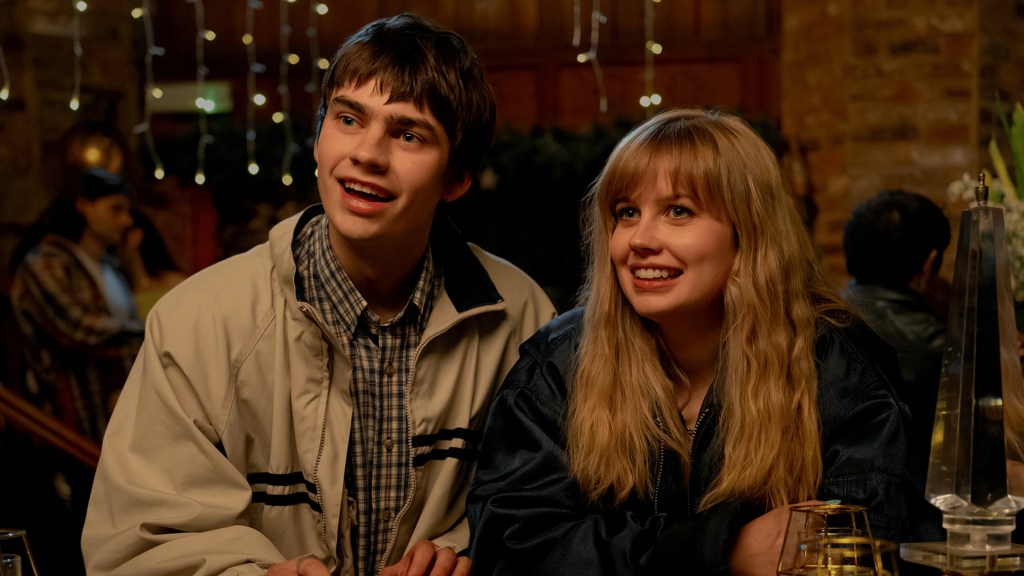

A story as old as time itself. A boy (Spike Fearn whom you might remember from Alien: Romulus) meets a girl (Sadie Soverall). They hit it off and spend a great evening together. The boy is smitten. Sparks and butterflies and all that. At the end of it all, before she’s whisked away by her friends, the girl gives the boy her number.
The boy—the puppy that he is—falls for the girl. Head over heels. He’s hopelessly, involuntarily infatuated. He picks up the phone the next morning only to see that the number the girl gave him doesn’t work. He doesn’t accept the likely possiblity that he got “fake numbered” by someone who only pretended to have fun with him or maybe someone who did have fun with him but didn’t want it to become a relationship. The boy refused to give up and went on a quest to find the girl he fell for among the literal thousands of Manchester students, helped by a sassy-yet-self-defeating psychology student (Angourie Rice) who sees the boy as a subject for her thesis about romantic self-sabotage and slowly but surely falls for the boy the way the boy fell for the first girl.
What you see in Finding Emily is a typical setup for a romantic comedy based around the tension between a trio of characters, all pulling in different direction and pursuing the attention of people who might not be within their reach or persisting in a suspended state of denial. Blinkered by the single focus of the chase after a nebulous target and blind to the opportunity for happiness and connection percolating right under their noses. Which is why this movie is fundamentally easy to watch. After all, it is for the most part a well-executed attempt at a story that doesn’t require visionary thinking or a revolutionary approach to the filmmaking form in order to fulfill its primary mission—to entertain by warming the hearts of the viewers using nothing more than basic tools of the trade.
It does, however, differentiate itself in one specific aspect. In contrast to the bulk of movies in this heavily parametrized genre, Finding Emily deliberately chooses to focus its gaze on the romantic lives of young adults who are still young enough to barely see themselves as adults, if that makes any sense. And this is an environment that many older viewers—and I do include Millennials in this designation too—might see as completely alien because the landscape of the dating market has shifted considerably in recent years. It’s not even about the rise of dating apps, or the omnipresence of social media and its downstream effect of every step and misstep young people take becoming immediately a part of their permanent record. It’s all this and more. Somewhere in there while we follow along that boy’s quest to find the titular Emily while another Emily is right there growing fonder of him by the minute we get to witness the eerie tension between sexes and how the interaction between young men and women—already a paradoxical roller coaster of sexual attraction and embarrassed awkwardness—has become a deadly minefield where one false move could lead to outright social ostracism by permanently aggrieved pitchfork mobs looking for fights to pick. And the movie does so without preconceived allusions or thinly veiled grudges. It doesn’t try to preach or take anything to extreme ends (like the mostly successful, although differently and on its own terms, Cat Person). Finding Emily wants to still function as a canonical rom-com that is set in the world of young people whose romantic pursuits are completely defined by social media and gender-based tribalism.
Or maybe it simply doesn’t know how to exist as anything else because the filmmakers behind the movie didn’t quite know how to tell this story in any other way. It is a possibility. For Alicia MacDonald, who directed the movie, Finding Emily marks her transition into feature filmmaking after a number of years in television. And it shows because when you take a step back and separate yourself from your emotional responses to what simply is a well-told canonical romantic comedy, you will find that it does after all play exactly as though it was originally conceived as a direct-to-BBC piece of programming. Although Finding Emily is decidedly rich in effective storytelling, it’s not at all rich in cinematic expression. The movie is quite pedestrian when it comes to visual language and trying to encapsulate the love story in interesting visuals framed with appropriate flair. It’s rather bland in this regard, if I have to be honest.
Therefore, you might find—just as I have—that despite being functional and entertaining in the moment, Finding Emily leaves no lasting imprint on the viewer at all. It’s here to do its job and then evaporate without a fuss. None of the performances stand out enough to be remembered for longer than it takes to come back home from the cinema. Not a single scene pops enough to be discussed among friends. Not one of the momentarily functional moments of romantic elevation is worth mentioning to anyone. The movie just is. It exists for the same reason Netflix-bound rom-coms exist: to fill a shelf. I suppose I am glad that this one in particular found its way to the big screen because in many ways Finding Emily is functionally symmetrical to the kinds of dad movies I rarely see on the big screen outside of February when nothing else is slated for cinematic release. So in a way I am glad that Finding Emily got its theatrical run instead of being unceremoniously dumped on any of the myriad streaming services to be forgotten in an instant. I just wished this story—which is fundamentally intriguing and worth telling for all the reasons I mentioned—was given a bit more of a cinematic treatment that would ensure it remains in our collective memory for more than half a second.






Leave a Reply