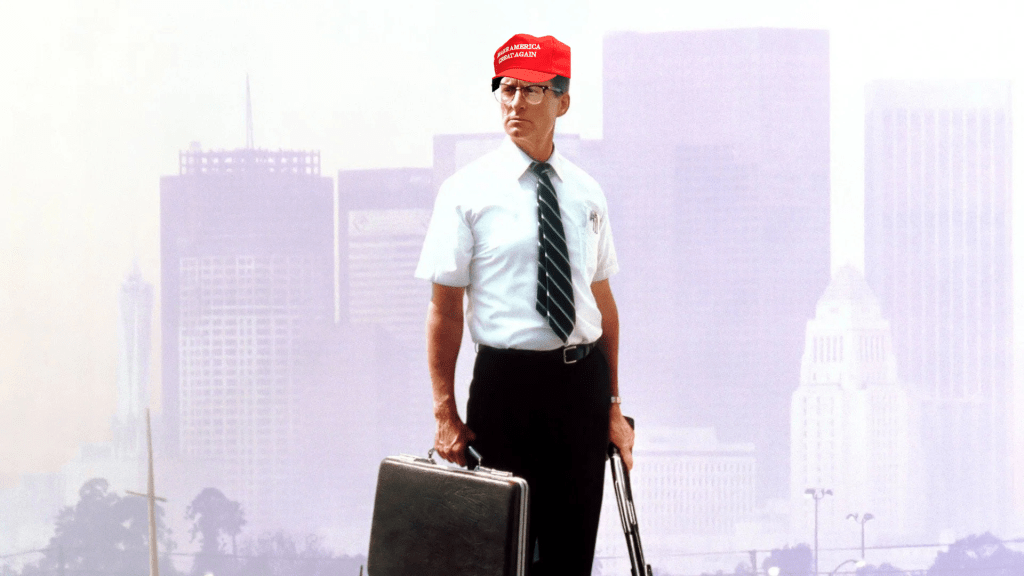
The image of D-FENS (Michael Douglas), a visibly distraught middle-aged man clad in a white shirt and tie, holding up a wildly misshapen burger and looking at it with disgust became one of the many memes associated with the 1993 Falling Down directed by Joel Schumacher. A man who seemingly snapped while stuck in traffic and went onto an odyssey of violence became an avatar of an entire class of disenfranchised men whose grievances he shared and enacted. It was not the first time American cinema had handed that class a patron saint.
In Taxi Driver Martin Scorsese and Paul Schrader introduced the world to a lone wolf on a downward spiral towards self-destruction. Travis Bickle was not a tragic hero worthy of pity, let alone glorification. He was a psychotic villain slowly inching towards critical mass of violent catharsis. Wherever he turned he saw vermin, not human beings. He openly dreamed of ridding the world of scum. Bickle cruised New York by night convinced that he was God’s lonely man on a holy crusade, while in reality his drive was seriously underpinned by latent racism, homophobia and misogyny. Yet, he was adopted by some as a symbol of their own male victimhood, perhaps helped by the fact that in the climax of the film, Bickle directed his roiling psychotic rage towards saving Iris and laying vengeful retribution on Sport and his cohorts. It was easy to overlook the ironic tinge with which Schrader and Scorsese chose to end the film, especially when watched by people whose minds had already been made up before the movie began. That Bickle saved the day was a mere accident of fate, a temporary and random redirection of his malignant psychosis; yet some saw it as an act of heroism brushing shoulders with martyrdom.
A seemingly innocuous misinterpretation of character intentions was enough for some viewers to pedestalize Travis Bickle and, likewise, D-FENS nearly two decades later. Because Bickle saved Iris, audiences were willing to overlook his stalking tendencies, the looks of disgust aimed at people of colour, verbalized ideations of mass murder, or even his attempted political assassination. Even though he was most likely a psychotic villain completely divorced from reality, Bickle was redeemed. His gaze overlooked myriad dorm rooms, a patron saint of misunderstood male victimhood casting a protective spell over impressionable young minds of male extraction.
Similarly, the image of D-FENS, a briefcase in one hand and a shotgun in the other, standing atop a pile of rubble defaced with graffiti—a symbolic admission of America’s own downfall—captured the sense of disenfranchisement emanating from a cohort of middle-aged men and became a lasting embodied symbol of their own rage, boiling subcutaneously. His body an avatar of middle-class betrayal. His tirades brimming with grievances. His frantic expression hiding unspeakable anxiety. They perhaps understood that this distraught gaze was not trained on the uncertain future but on the idyllic past… or rather its distant projection warped by heat displacement of time and media spin. A mirage. A fata morgana.
It was remarkably easy for many to identify with D-FENS, especially when presented with specific scenes removed from the context of the entire movie. His rage at the fast food joint spurred by a seemingly arbitrary decision to refuse to serve him breakfast because he was three minutes late or the disappointment accompanying the sight of a burger that looked as though someone had stomped on it was seemingly excusable. His frustration at being accosted by gang-bangers who claimed ownership over a piece of public property he passed through could be understood. His anger at a store clerk who refused to give him change for a dollar and then charged an unreasonable price for a can of pop was familiar. After all, they all stood in his way as he was “going home.” To reclaim his family he had once lost, the happy family we saw captured in home video recordings D-FENS would watch on a loop.
This way, a willing viewer could overlook multiple concerning signals. They saw a dispossessed man who had been fired from his job, a relic of the past trying to reclaim his agency. A man who longed for the days when he still had purpose: somewhere to go, things to do and people to provide for. They didn’t see a man who would argue with a Korean store clerk from a position of perceived racial superiority having berated him for mispronouncing words. They saw a distraught man who just wanted to be served breakfast, not a deranged lunatic who terrorized a restaurant by waving a loaded gun around. They probably didn’t notice that D-FENS was perfectly capable of maiming a defenceless human being lying in the pool of their own blood, just as they probably didn’t pay attention to the fact that—right after an unsuccessful drive-by shooting that saw a number of bystanders gunned down—D-FENS showed no care for those victims. He stepped right over them and walked on unperturbed. They probably identified with his discombobulation at the fact that a neo-Nazi supply store owner saw him as a fellow traveler.
It took nearly two hours for D-FENS to even fathom that he might have been the bad guy. That he wasn’t who he thought he was. That his ex-wife might have had valid reasons for restraining his access to their daughter. That despite his protestations—if it walks like a duck and quacks like a duck—the axe this man had to grind had been sharpened on a whetstone of inexcusable prejudice. Nevertheless, his image of a victimized white man on a just quest to reclaim his place in the world persisted.
And it did so precisely because of the way the filmmakers treated him. Schumacher and Ebbe Roe Smith (who penned the screenplay) wished to satirize the worldview shared by people like D-FENS. Their movie carried out a mission of its own: to denude the impotence of this scorching-hot white male rage. In their eyes, D-FENS was pitiful and ultimately disarmed by his own inability to see things through and bring about his own Hollywood ending; he stood self-emasculated. For all his lashing out, he was merely a gullible idiot driven by base stimuli, not a coherent ideology. All D-FENS wanted was to go home. To turn back time. To feel useful again. He wanted his family and job back. He was angry but didn’t know at whom. And in this undirected angst he would consistently lash out not against those who likely contributed to his misery—like the corporate bosses who chose short-term profits over the well-being of their staff or the media moguls who perniciously pointed him away from those real culprits—but at immigrants, people of colour, feminists with their affirmative action policies, and anyone else who would fit under the convenient umbrella term of “them.”
However, by the end of the film, D-FENS was completely stripped of whatever agency he had accrued over the course of his rampage. After terrorizing his wife he was finally confronted by Prendergast (Robert Duvall), a nearly-retired police officer and gunned down. The filmmakers made sure not to turn D-FENS into a martyr by undermining him completely and reducing him to a joke. As he was falling to his knees, he asked with stunning incredulity if he was after all the bad guy. The gun with which he threatened Prendergast turned out to be a toy. Thus, the movie turned D-FENS into a laughing stock. He was disarmed, defeated and reframed as a pathetic small-time villain rather than a tragic antihero and a champion of populist angst.
Falling Down rightly framed D-FENS and his directionless anger as ultimately futile. He was nothing more than an aggrieved man-child with deficient impulse control who threw a tantrum that escalated into violence. Someone so overtaken with rage that he was incapable of comprehending that his own self-perception was at odds with reality. A man who couldn’t process the fact that he was a de facto racist and misogynist because despite everything he told himself, his actions spoke volumes to the contrary. He went out of his way to target those he implicitly saw as inferior to him and ended up leaking out of a hole in his chest when reality finally caught up with him.
However, by undermining D-FENS as a credible threat to social order, the movie made a grave mistake. Portraying him as wretched, disarmed and misguided acted as a cultural sedative. His seemingly laughable male tantrum was cast as harmless but it was only so because it lacked direction and conviction. All it needed to coalesce into a formidable force underpinned by long-gestating and misplaced anger was a political voice validating it, reframing it and giving it a programme. On his own, D-FENS was merely an artifact, a lone voice in the crowd. But give him a political manifesto, a red hat, a slogan and a sense of belonging with others like him while continuously feeding him algorithmically-derived disinformation, and suddenly he becomes a force to be reckoned with. His voice becomes an infinitesimal constituent of an intimidating, frightful roar. A force capable of upending international politics, bringing down governments and inciting cultural upheaval.
Thus, Falling Down was at once prophetic and self-defeating. It correctly sketched out the canonical host for the populist mind virus: an angry, disenfranchised man, keen to seek retribution. He was Travis Bickle’s evolution: a lone wolf who was considerably more identifiable, and crucially, unaware of his own prejudices. But the movie chose to undermine D-FENS and discredit him as a threat to the societal status quo, which reflected liberal sentiments of the time. We are now entering the second decade of globally paying for this mistake because it turns out that one ought not to underestimate the power of misinformed and angry people in large numbers. Because it takes a single political figure with enough bluff and bluster to direct their rage and turn dislocated lone wolves into formidable packs.





Leave a Reply