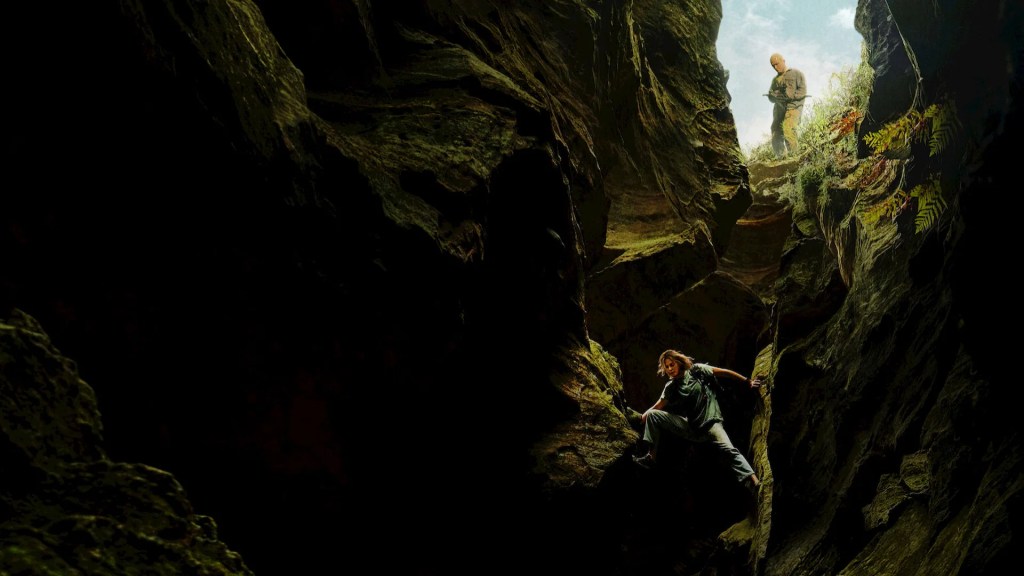

When Apex opens, you are immediately informed that the movie is a Netflix original. In media res, two people climbing a mountain—that thirty-second hook designed specifically to make sure you wouldn’t click away. So you don’t. You choose to stay.
Sasha (Charlize Theron) wants to push hard. She’s an adrenaline junkie. An incoming storm is just “a little bit of weather.” All she wants is to reach the summit. Tommy (Eric Bana) is the voice of reason and makes the executive decision that they would climb down, while Sasha sulks internally. During the climbdown, Tommy falls to his death. Maybe if they had made this decision quicker, he’d have survived. We will never know.
What we do know is that Sasha needs but a few months to get herself back up. She travels to Australia to do some extreme kayaking in the absolute middle of nowhere. Perhaps out of a desire to drown out the voices in her head reminding her of untreated grief and unaddressed guilt over Tommy’s death. Or maybe just because she needs that adrenaline to hit her bloodstream like she needs air to breathe. Again, hard to tell.
What isn’t hard to tell is that deciding to travel alone in the sparsely populated Australian outback is at best a dangerous proposition and possibly lethal for someone unfamiliar with the country, the terrain and the local population. Thus, as you might imagine, Sasha’s trek into the heart of the jungle in search for adrenaline-infused closure turns from an extreme sports getaway into a fight for survival when she encounters Ben (Taron Egerton), a slightly off-looking young man who turns out to be a total maniac with a penchant for hunting ill-prepared tourists with a crossbow.
What unfolds is, in my estimation, an attempt at evoking the spirit of Doug McLean’s Wolf Creek, a cult slasher loosely inspired by a series of disappearances recorded in the heart of the sparsely populated Australian outback. That at least looks to have been the plan. In practice, however, this aspiration is filtered through Baltasar Kormákur’s previous directorial experiences, such as Everest, Adrift and Beast, where he consistently returned to the age-old showdown between the human and the natural world. Therefore, Apex attempts to join these two notions in holy matrimony to forge a hybrid that isn’t that original either, but equally, it’s rarely ineffective.
The micro-genre of man-against-man-against-nature is deceptively simple as it requires merely a handful of concepts to be reduced to practice with requisite aptitude. Nature must feel indifferent and chaotic, not merely decorative. The antagonist must feel empowered by the environment, but not supercharged by it. In short, the killer must feel at home, while the victim must earn their place within it. Geography must be a legible threat. Character’s arc must progress along the line of increased competence in the environment. Violence and injury must play a vital role in the game of survival. The emotional core must shift from fear of death towards hope of endurance. And judged against this worksheet, Apex succeeds only partially.
Where I think Kormákur shines most profoundly is in the way the movie embeds its characters in inhospitable environments that set a considerable bar for them when it comes to survival. What’s more, the film also introduces outside threats in the form of encounters with other humans, therefore positioning Sasha at a physical disadvantage, despite her self-diagnosed mastery in traversing difficult terrain and survival skills. She is swiftly outmatched by Ben who quickly reveals himself to be completely deranged. You know you encountered a psychotic maniac in the forest when they take out a crossbow and proceed to buzz out to a song by The Chemical Brothers before chasing you with the determination of a rabid bloodhound. The setup behind Apex is textbook.
The road towards the film’s inevitable climactic resolution is, sadly, littered with potholes. And this is in my opinion because the filmmaker driving the project either consciously chose or was coerced by outside influence of Netflix bean-counters and their retention metrics to tone down violence and gore, both of which are required staples of that micro-genre. The most successful films in this space (like Wolf Creek) amplify the sense of threat with simple visuals and by constantly reminding the viewer that the protagonist is not untouchable. They must go through an ordeal. Stuff must happen to them. Alas, Sasha gets away with but a few scratches.
Equally, the killer’s monstrousness is also best reaffirmed visually. While decidedly indulgent, spending some time with the villain’s gruesome rituals and forcing us to watch on as he “does his thing” definitely ups the ante as a classical slasher tactic found in classics like The Texas Chain Saw Massacre and The Hills Have Eyes and newer pieces like Don’t Breathe or even the very recent Dangerous Animals. In short, for a movie like Apex to succeed on all fronts, the viewer must be rattled and unsettled, preferably both by having the environment inflict injury on the protagonist (which does not happen in any meaningful way) and by making the viewer complicit in the killer’s deranged debauchery.
What transpires here is somewhat middling because even at points where the story screams desire to push buttons and go a few steps towards gore-laden indulgences, the filmmaker pulls away. Therefore, Apex never crosses over to the realm of horror with which it looks as though it wanted to brush shoulders. It’s perfectly sanitized and sends only mild and performative signals in this direction to viewers, none of whom it wants to discourage from watching by accidentally slipping into body horror territory.
As a result, a movie that had an opportunity to raise my own adrenaline levels by taking a few risks here and there served me a safe experience. Instead of a free solo climb, what I got was a zip-line park where I knew at all points that Sasha would never be exposed to a mortal threat and where her own hubris would not be sufficiently challenged. While Taron Egerton’s performance as Ben is mostly delivered with requisite flair, it’s just not enough to furnish a satisfactory viewing experience, especially because even his own characterization eventually descends into a cliché. Apex could have been an effective hybrid between Wolf Creek and Don’t Breathe, but it opted for an approximation thereof optimized to appeal to normie audiences likely to stumble upon this movie by accident rather than to seek it out with intent to find challenging thrills.






Leave a Reply