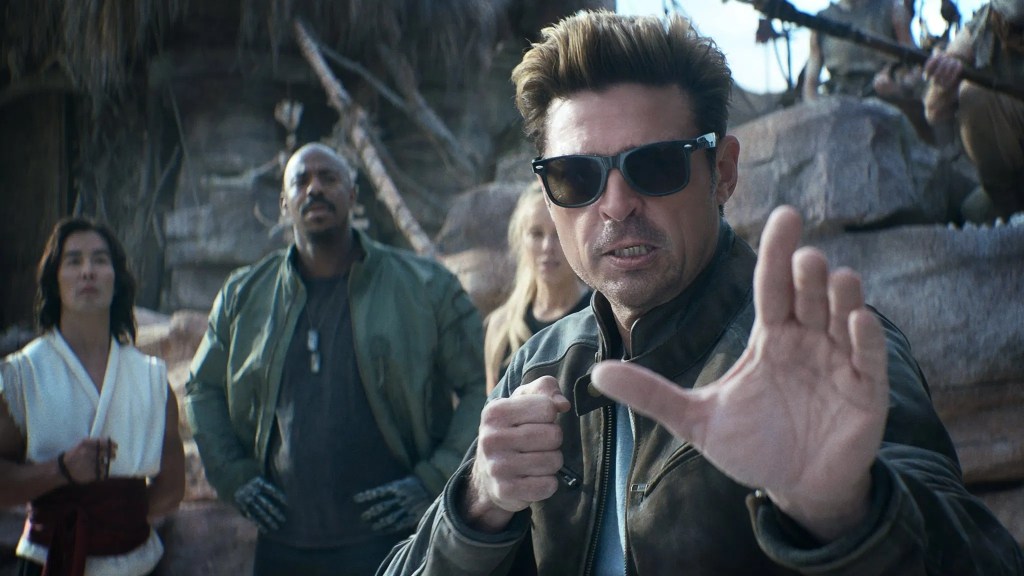

When it comes to the subject of adapting video games for the screen—which I have opined on, written and ranted into a lens about on a number of occasions—the perennial classic series among fighting games, Mortal Kombat, presents itself as a particularly intriguing nut to crack. At once one of the most recognizable brands in the industry, as well as one of the longer-lasting ones too, it is a series whose successful treatment depends on a whole range of factors. And the newest movie adaptation of it, titled simply Mortal Kombat II, shows exactly just how difficult it is to square that particular circle.
Directed once again by Simon McQuoid and written by Jeremy Slater, who most recently wrote Godzilla x Kong: The New Empire, this movie avoids convenient characterization as far as description of the story is concerned. Don’t get me wrong: it is possible to do so. It will just come across as interminably brain dead when reduced to a handful of sentences of plot summary. In its own way, this already illustrates the most persistent problem this movie has that stems directly from its roots as a fighting game. After all, only a small subsection of the fan base ever cared enough to read character descriptions of the fighters they were choosing to play with and if anything, all they ever cared about was learning their special moves, combos and mastering their numerous finishing techniques ranging from iconic “fatalities” to “babalities,” “animalities,” “friendships” and the like.
But for the sake of the conversation, let’s just summarize this movie as follows: a group of heroes who survived the last movie, which includes Sonya Blade (Jessica McNamee), Jax (Mehcad Brooks), Liu Kang (Ludi Lin) and Cole Young (a made-for-film character not originating from any of the games in the series played by Lewis Tan) led by the god of thunder Raiden (Tadanobu Asano) recruit—against his will and better judgment—a Hollywood action star of yesteryear Johnny Cage (Karl Urban) to participate in the titular Mortal Kombat tournament where the stake is the sovereignty of Earth as a planet. It just so happens that an evil emperor Shao Khan (Martyn Ford), usurper of Outworld, is about to deploy his highly skilled martial artists like Princess Kitana (Adeline Rudolph), Jade (Tati Gabrielle), Noob Saibot (resurrected Sub-Zero played by Joe Taslim) and a handful of others against Earth’s scrappy heroes. At the same time, a fantasy palace intrigue unfolds in Shao Khan’s world that may ultimately decide the fate of the tournament.
Like I said—barely legible. And it’s not like it’s a surprise either. After all, this is more or less what I’d expect from a movie based on a series of games where—at least originally—the lore was (1) confined to single slides of character back stories and endings, (2) unintentionally camp, and (3) completely irrelevant to the gaming experience. Playing Mortal Kombat was never about progressing your character through a story arc (with a handful of exceptions that is), but rather about learning their moves and pounding the absolute nuts off of your keyboard/joystick/pad while bathing in delicious dopamine.
And this is where this movie truly shines, especially in comparison to the previous entry in the McQuoid-directed reboot strand, because it at least wraps whatever narrative ersatz it has around the core of a tournament featuring everything a fan of the series would expect: familiar locations with their particular violent quirks, a good mix of characters plucked from many iterations of the games, moves, quips and a solid helping of violence. Whatever character development we get— which is mainly split between Johnny Cage’s rise from hasbeenhood and Kitana’s snowballing defiance against Shao Khan—is only here to make sure that the movie looks like a story with a beginning, a middle and an end. But we all know that all this lore is supposed to be doing is to find ways to string encounters in a queue and let the viewer admire the carnage.
But the story is still there and I’m sad to report that it gets in the way of the fun much more than it perhaps should. Speaking from a position of having a rather unsettled relationship with the original adaptation from 1995 directed by Paul W.S. Anderson all I can say that I miss the corny simplicity that movie had in spades. It was swift, surface-level and almost completely immaterial to the experience of watching those cool characters in their costumes and makeup quip lines you could shout back at the screen (which many of us did at the time) and execute their special moves. That was it.
Mortal Kombat II still remains corny—in fact, its self-aware silliness is its most effective special move—but the movie bogs itself down in world-building which nobody asked for and which comes across like a piece of third-rate fan-fic fantasy. It’s offensively brain dead (which is fine), unnecessarily intrusive (which is not fine) and bloats the running time to an excessive degree (which is a big no bueno). It honestly feels as though the movie was getting in its own way and knowingly detracted from its own strengths. But then—judging by the reaction from a rather busy auditorium during the screening I attended—some of this grotesquely incoherent storytelling bolstered the camp factor. Who knows? Maybe younger audiences trained on uber-long Marvel slug-fests are trained to expect a blockbuster to clock at over two hours. Or perhaps a longer running time has calcified into a proxy for entertainment quality. More is more and all that.
Still, this only illustrated the main problem this movie has and it is one that cannot be easily fixed or addressed. It stems from the inescapable reality that a video game as long-standing as Mortal Kombat will inevitably attract different cohorts of fans and their expectations may differ slightly. I think we can all agree that regardless of the age bracket, the movie based on a Mortal Kombat game must be appropriately violent and this is the main common denominator in residence. And actually, this is where another problem rears its head as this movie needs to restrict access to younger viewers on the back of what draws those viewers towards it. And yes, I am fully aware that the games are also supposedly targeted at more mature fans, but we all know that they are enjoyed by kids. I should know—I used to be one of those too-young-to-be-playing-violent-video-games youths and I turned out just fine. This is one of those round-peg-square-hole quandaries that would most likely eat into the box office potential for the movie while also ensuring that younger fans of the games would avail themselves of it on streaming in not too distant future.
Inevitably and predictably so, Mortal Kombat II is stuck between a rock and a hard place because it needs to execute on conflicting priorities of different viewer cohorts, some of whom skew more towards camp while others more in the direction of fantasy world-building, and the movie noticeably flip flops in paralyzed indecision. As a result, there might not be too many people out there who will fall in love with it without having to put a boatload of stuff they don’t appreciate all that much in their blind spots. If anything, the filmmakers’ only workable gamble is that the audiences will be more than satisfied with hearing their favourite iconic lines and seeing familiar characters in action. But that’s about it.
Dramatically speaking, there’s very little in here to chew on and in comparison to other movies in this space that might not have been adapted from a fighting game, Mortal Kombat II just falls way short. In fact, it repeats the egregious sin committed by comic book movies as it defenestrates any semblance of finality from the movie by way of showing that everyone can be brought back from the dead without much ado. Sure, on one hand it’s OK because you’ll get to have your cake and eat it—you shall witness your favourite violent finishing moves without having to come to terms that you won’t see them return in future instalments in the series—but as far as dramatic investment is concerned, it is all just about as meaningless as it can possibly be.
So, while I believe that Mortal Kombat II (much more than its predecessor) has what it takes to become a bona fide cult classic revisited ad infinitum by fans at home, it’s not a “flawless victory” of any kind. Not even close. Very far from it, actually. But this is a feature of this series rather than a bug. Because of the way it’s built and the kinds of fans it needs to keep on side, it’s always going to register as a movie to be filed under “so bad it’s good.” And I wished that the filmmakers had committed to this prescription with a bit more conviction, even if it came at the cost of making irreversible story decisions or trimming the adipose world-building from its flesh.
At the risk of being selfish, I would have loved to have seen an even more narratively incoherent piece of filmmaking—even an equivalent of a big budget Uwe Boll production—if instead of the fantasy bloat I’d have been given some more carnage and camp. Alas, Mortal Kombat II succumbed to a recognizable paralysis I remember from the days of my youth that arose when you finally saw the iconic “finish him” flash across the screen and instead of executing a fatality of some kind you’d end up mashing buttons aimlessly, consumed by panic and performance anxiety.



Leave a Reply