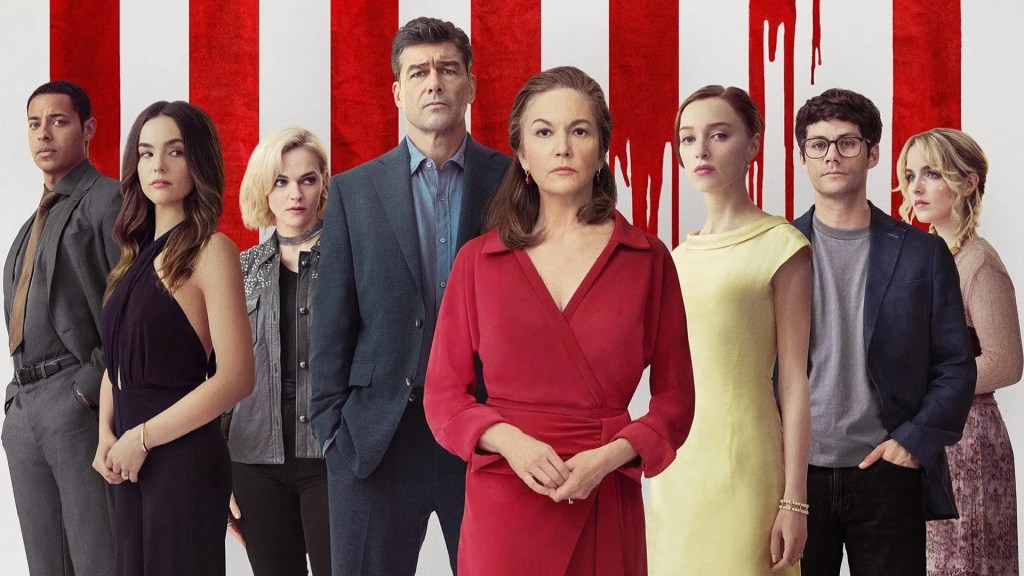

Although The Good Boy premiered slightly earlier at the 2025 TIFF, Jan Komasa’s transition to English-language filmmaking began with Anniversary. This film was shot in 2023, delayed by guild strikes, and quite probably, buried by Lionsgate on account of its allegedly incendiary content. That is, the studio didn’t want to anger the Trump regime or alienate MAGA-friendly audiences with a movie that quite clearly satirizes the kinds of fascist-adjacent tendencies they are either openly fond of or at least not vehemently opposed to.
Contrary to its label of a dystopian political thriller, Anniversary is quite unorthodox in its treatment of these parameters, which begins with the simple realization that it lacks a suitably high concept driving the dystopia. We’re not in Gilead, Bachman’s world of The Long Walk, or in an Aldous Huxley-type world that is engineered to high polish and designed to the n-th degree. Far from it. In Anniversary we are in an arthouse dystopia of the kind you find in Michael Haneke’s Time of the Wolf, Michel Franco’s New Order, or Christian Petzold’s Transit. It is not quite a world that purposefully and violently twists and warps reality and takes some things to absolute extremes in an attempt to make a point, but rather one that wants to remain tethered to our own universe and makes only select strategic changes to depart it when it matters.
Thus, in this world—which we visit in one year intervals, at anniversaries, Thanksgiving dinners, birthdays and other functions—we are invited to observe how a world just like ours would slowly come off the rails, but from the perspective of a single family. Taylors are well-to-do: Ellen (Diane Lane) is a university professor, her husband Paul (Kyle Chandler) owns a restaurant; Cynthia (Zoey Deutch), their eldest daughter, is an environmental lawyer, Anna (Madeline Brewer) is a comic, Birdie (Mckenna Grace) is a teenage future biologist and Josh (Dylan O’Brien) is a failed novelist. And by periodically reconnecting with this family as they gather around the dinner table, the filmmakers allow us to understand how the world around them—which we barely ever see—unravels and devolves into a totalitarian one-party hellscape.
However, before the world does so, the family’s integrity is shattered first as Josh introduces to the family his fiancée Liz (Phoebe Dynevor), Ellen’s former student who has just written a political book advocating for uniting America under a one-party state (which essentially boils down to childishly advocating for fascism as a protective political system). Liz, inadvertently or otherwise, sets in motion a snowball effect that turns America into a police state and rips the Taylor family apart, all of which Jan Komasa captures with his signature style.
Anniversary plays out very much like an European or South American arthouse venture, as it spends incredible energy setting up dynamic world-building and then purposefully only introduces aspects of it whenever the world invades the family, rather than letting us explore it together with the characters. The filmmaker, using techniques I have come to associate with directors like Michael Haneke, Michel Franco and Pablo Larraín, reflects the dystopian nightmare almost exclusively through the lens of this family, which arguably would have made Anniversary work rather well as a stage production.
With this decision, though, come some narrative and thematic limitations because the bulk of the storytelling and thematic messaging is hidden within dialogue, which immediately draws accusations of being uncinematic. In a theatrical way, the movie tells much more than it shows. However, it still shows a lot, I would argue, even if the stuff it decides to show would count as convenient as well.
We hear about Ellen’s career coming to an end in the new one-party America that cracks down on intellectuals and dissenters. We hear about Anna becoming a vocal critic of the regime and eventually disappearing. We see how the new system, germinated by Liz’s viral book, imposes changes on everyone in the Taylor family, and by extension on the entire world. We hear how the dinner conversations change over time from polite and civilized to agitated and confrontational, and eventually to calculated and withdrawn, as the characters realize that in this brave new world they are no longer allowed to say what they think without being persecuted or repressed. We see Taylors disintegrate, turn on each other and witness the family cannibalized in slow motion; all enabled by an intruder with a long-harbored vendetta.
What’s more, in little cut-scenes peppered into the narrative as well as in strategically positioned dialogue-led off-ramps we glimpse at the possible reasons why Anniversary may have been both deemed incendiary by its distributors and why some critics chose to accuse the film of not taking enough of a political stance (even though I am pretty sure that it does). Unglamorously enough, its dystopian driving force is starkly reminiscent of our own political realities. The world in the movie doesn’t fall apart in an act of fantastical force majeure and turns into Gilead overnight, but it is rather insidiously prompted into transforming into a neo-fascist state by way of gentle influence of a single think tank called the Cumberland Corporation. From there, it doesn’t take much for anyone with sufficient political savvy to see this choice as a commentary on political influence exerted by political action committees and think tanks running on shady funding.
Taken together, Anniversary—which has been rightly praised for the acting prowess of its central performers—adds up to a wholly unnerving, clinical and emotionally ruthless experience that stylistically belongs on the other side of the pond. It is a great example of an arthouse dystopia that uses its actors and the intimacy afforded by the ability of the camera to get up close and personal with the people standing in front of it in the mission of advancing its strong, complex and delicately nuanced thematic and political messaging. Above all, Anniversary is a movie that—together with The Good Boy—confirms Jan Komasa as an artful and audacious interrogator of reality capable of finding fine-tuned balance between keeping the viewer in a vise of anxiety, advancing a horrific fantasy with clear tethers to our world, and making outright political statements. Yes, this is a movie that overtly discusses what might happen if MAGA took over America. But it more clearly—and universally—reminds what happens when any mind virus escapes its prison of theory and, completely unshackled, begins mutating uncontrollably in the wild, only for us to reap the whirlwind.





Leave a Reply