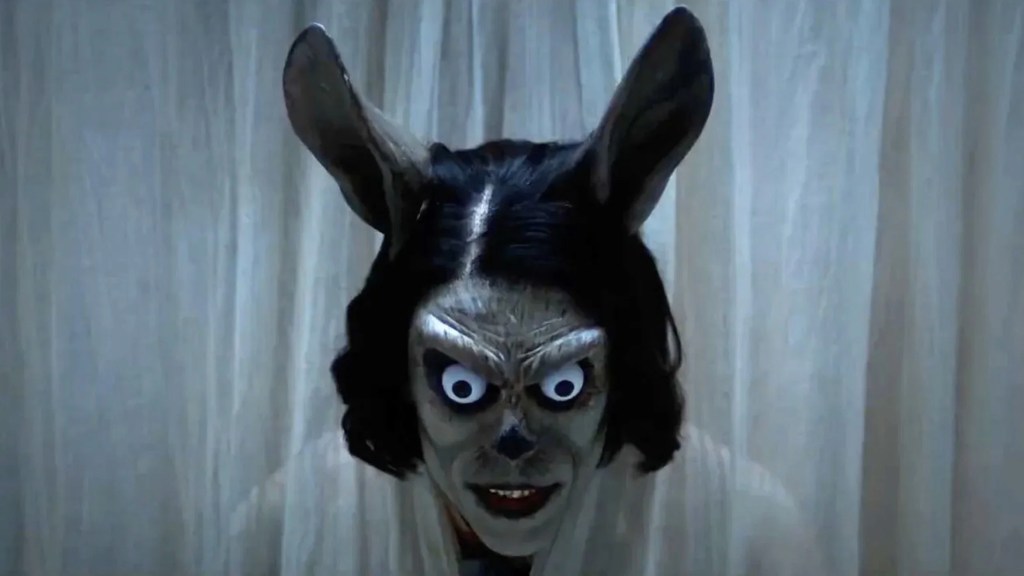

The word “hokum” is defined as “meaningless nonsense with an outward appearance of being impressive and legitimate.” In the film Hokum, the main character played by Adam Scott uses this word in a conversation after he is told that the honeymoon suite at the hotel where he is staying is allegedly haunted and this is the reason why it is out of use and inaccessible both to guests and the hotel staff. He sips on his drink and dismissively quips, “Hokum,” as he finds this account both pretentious and nonsensical.
It turns out that this word perfectly encapsulates what I felt about the movie, a self-fulfilling prophecy of sorts. Directed and written by Damian McCarthy (who has previously helmed Oddity and Caveat, neither of which I saw and both of which I now fear that they also advertise their quality with their titles alone), Hokum is probably best described as an attempt at an elevated supernatural horror that hides (not very well) a conversation about grief and guilt behind a veil of a ghost story. In it a writer (Adam Scott) wracked with unresolved issues relating to the passing of his parents travels to Ireland to stay at a hotel where they had spent their honeymoon, presumably hoping for some closure. What he finds is that the hotel is weird, goats climb on top of cars and the hotel staff is even stranger than the stories surrounding this place.
But then things get weirder: the protagonist unsuccessfully attempts to take his own life, comes back to the hotel to thank the lady who saved him and finds that she went missing soon after his suicide attempt. From there, the movie moves to become a hodgepodge of the aforementioned elevated business with our guy working through his traumas using jump scares and visions, a haunted house stuff relating to what might or might not be lurking in the walls of the hotel, and a shoddily concocted whodunit relating to the disappearance of that lady.
And… it’s a mess. Though not a watchable one, let alone likable.
It is clear as day that the primary mission of this film is to capitalize on the wave of elevated horror movies that has swept cinemas over the course of the last ten years or so and particularly looks as if the filmmaker wanted to pay due homage to Oz Perkins and Ari Aster. However, what Hokum demonstrates that Damian McCarthy—who probably meant well—either didn’t get the memo that the cultural moment has passed or he simply has the reflexes of the sloth from Zootopia and missed the boat on this account.
Consequently, nothing in this movie registers as original, fresh or at least momentarily inventive. In fact, the sheer density of ideas makes Hokum completely illegible. We are somehow trapped in a tonal dance between elevated visions speaking to themes of grief, a murder mystery and a ghost story, where our main conduit is a character who is terminally unlikable. Granted, it is a part of the film’s design to make him come across as a genuine a-hole who’s on a journey of self-discovery and closure, but even as the events finally conclude and he emerges supposedly changed, you might still wish that he hadn’t come out alive out of this ordeal because he is such an insufferable git. At least this way the movie would have injected some originality into its bloodstream.
Alas, no such luck. Hokum is a piece of genre entrapment. Not only does it not have a single original bone in its body—and it’s not a problem per se, so long as those numerous unoriginal bones are put to good use—but the entire narrative never generates enough momentum to at least come across as serviceable. Nothing here works. All scares are generic, predictable and completely non-diegetic, the character mystery surrounding the protagonist’s backstory is so terribly obvious that it takes less than ten minutes of running time to connect the dots and see where the narrative is headed and the ghost story angle feels as though it was copy-pasted from a ready-made catalogue of ghost templates. Hokum honestly doesn’t feel like a movie made by human beings driven by a genuine intention to tell a compelling story in an intriguing way but a piece of conveyor belt slop meant to capitalize on a trend that has all but fizzled out and run out of road, written by an LLM and directed with a flair of a student filmmaker infatuated with Guillermo Del Toro and Robert Eggers.
In short, you’ve seen it all before. In fact, you’ve seen bits of what Hokum tries to do in several different movies, like The Innkeepers, Hereditary, The Witch, The Night House, Antlers, Longlegs and many others (not to mention the classics like The Shining). Even Keeper, a movie that fell apart towards the end despite its best intentions, registers as a success in comparative terms.
Granted, a mosaic of pieces lifted from an abundance of successful elevated horror films has a theoretical potential to function as a meta-piece on the subject of the genre evolution, but to accuse this film of such lofty aspirations would be too generous for my liking and would definitely require both forgetting that the movie just doesn’t work on a visceral level and pretending that the filmmaker forgot to tonally calibrate the experience to enable such an interpretation.
To conclude, this isn’t one of those movies. It’s not competent enough to succeed on its own self-defined primary terms as a supernatural horror about grief and guilt, it doesn’t bring enough nuance to the operation to imbue its thematic reading with requisite IQ to stand firmly on its psychological analysis, and even its whodunit carries a pungent funk of staleness. But somehow, you can’t escape the feeling that the movie you’re watching thinks it’s absolutely and profoundly incredible. Which, ironically enough, makes Hokum fulfill its definition because that’s exactly what a movie that is a piece of pretentious nonsense would look and feel like. Hokum is exactly what the title suggests—hokum.





Leave a Reply