
I have always kept my thoughts on John Carney right up close to the ones I keep about Cameron Crowe. He makes the kinds of movies that maybe put themselves at a disadvantage by virtue of choosing to be completely and unashamedly vulnerable with their audiences and then they proceed to win over hearts and minds of those who are just as willing to be vulnerable with movies they watch.
This is why Jerry Maguire, Almost Famous and We Bought a Zoo work so effortlessly. There is a reason why—despite the fact that Crowe is rarely mentioned when great movies are a topic of conversion—so many people melt like buttercream frosting on a hot summer day whenever they hear Tom Cruise tell Renée Zellweger that she completes him and then hear her reply with “You had me at Hello.” It’s magical emotional realism at its finest and it works exactly because this filmmaker has built a direct high-voltage power line straight to your heart while you were busy looking elsewhere or even busy thinking about how the movie you were watching was unfolding like a typical rom-com with a redemption arc.
Many John Carney’s movies work in a largely symmetrical fashion, but with an added differentiating element of music as one of the main vehicles for emotional expression. Being a musician and songwriter himself, Carney has frequently managed to both hire musicians to act in his films (Glen Hansard and Markéta Irglová in Once or Adam Levine in Begin Again) and to pay sufficient attention to deployment of music as a storytelling tool to make the finished product look and feel like a musical without necessarily working as one. In a way, Carney has mastered the notion of making Cameron Crowe musicals: earnest and emotionally vulnerable movies that find a balance between groundedness of an indie relationship dramedy and an elevation of a formal musical.
Somewhere between Once, Begin Again and Sing Street he has reduced to practice and productively employed a few fundamental concepts governing our relationship with art. Stories enable us to think about emotions. Poetry enables us to feel them. Meanwhile, songs can make us feel thoughts. And John Carney’s most recent movie Power Ballad is another masterful example of this very phenomenon where the filmmaker, consciously and deliberately, hybridizes the two complementary missions without ever asking the viewer to acknowledge the confected artifice of a musical.
He sat down and wrote a movie—both the script and the songs—about a guy (Paul Rudd) whose seemingly unfulfilled life of quiet desperation rings authentic while also looking decidedly manufactured for the purposes of a movie. Much like we could never move past the fact that a character like Jerry Maguire was unlikely to exist in real life, we are always aware of the fact that Rudd’s Rick Power is not a real person either. He’s an emotional avatar of the kind you do find in musicals. He once dreamt of becoming a rock star but life chose differently for him. In fact, he made choices in this regard himself. He found a partner, settled in a shoebox house somewhere in Ireland and then had his only daughter. He understood that his dreams of being on the road and playing gigs to sold out stadiums were never going to materialize but he kept them in his back pocket just in case.
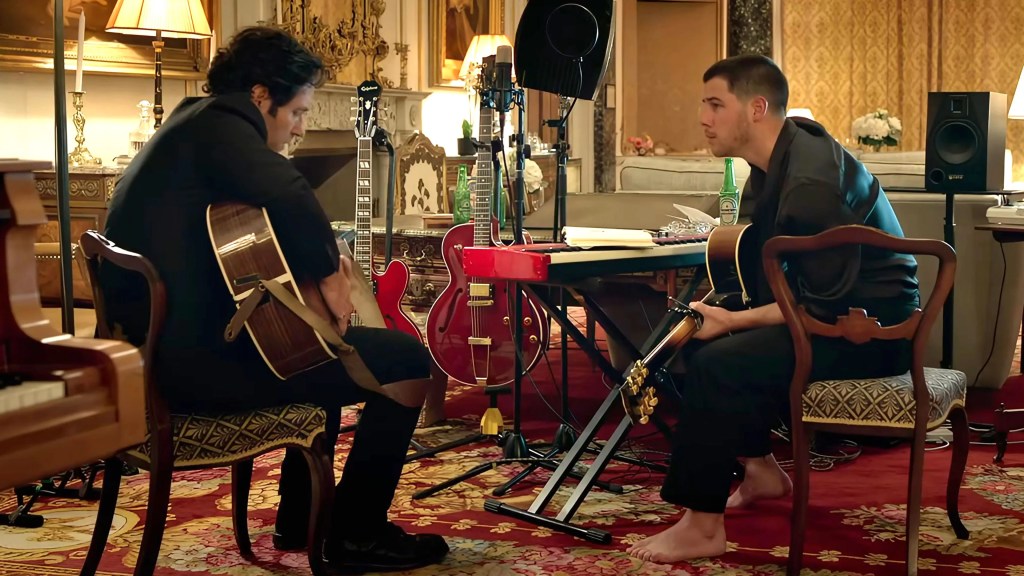
That “just in case” moment arrived for him during a wedding gig attended by world-famous pop star Danny Wilson (played by a real-life pop star Nick Jonas). Somehow Rick found himself in a room together with a guy whose life trajectory epitomized what Rick had always imagined his own life would have been if he had chosen differently. They jammed, had fun playing music and then Rick played a few chords of a song he had clearly carried with him for a long while, partly to show off in front of a guy who has made it in the music business, partly to get some validation from him. It meant a lot to Rick to see how a song that he wrote resonated with someone who clearly knows what makes a hit song.
What happened next was mostly familiar. The film refocused on Rick’s pursuit of acknowledgment of authorship after Danny claimed his song “How to Write a Song (Without You)” as his own and turned it into a smash hit. Carney’s camera follows Rick as he takes his buddy (played by Peter MacDonald) on a trip to America to get what’s his and settle the score, as he puts his own relationship with his wife and daughter at risk and seemingly falls victim to a spiraling obsession. Much like Carney’s other work, we just know where the movie is going to end up. The destination is predictable, which is fine because Power Ballad is not a “destination movie” but a “journey movie.”
We are taken on an emotionally vulnerable trek, which is just as earnest and authentic as it is convenient and moored to genre traditions, and additionally bolstered by a handful of banging musical performances. In fact, it’s the songs that are the magical ingredient here. Coming back once more to that comparison with Cameron Crowe (who was also incredibly adept at deploying music in pursuit of evoking the right emotions at the right time), Carney’s “you had me at hello” moments tend to be encapsulated in songs: “Falling slowly” in Once, “Drive It Like You Stole It” in Sing Street… and “How to Write a Song (Without You)” in Power Ballad. In fact, how the song evolves with each performance—as an acoustic piece sung by Rick in front of Danny, a pop version appropriated by him, and the most authentic of them all, the final performance that reduced me to tears—traces the emotional core of the movie.
By paying attention to the song and to a few words that Rick says to Danny during their climactic confrontation at Danny’s resplendent Beverly Hills mansion, Carney allows us to internalize the message of the film and understand deeply Rick’s journey as a character, his internal tragedy and the liberation that this song afforded him. When he opens up to Danny and tells him that regardless of how music is made and how inspirations are processed in the industry he still knows that the song was his because it was never intended to be a love song that Danny turned it into, the movie transcends itself and gets every man in the audience to lean in. The minute we are explicitly told what we always felt, which is that Rick’s song signifies his decision to pocket his dreams because a career in music wouldn’t mean anything if he couldn’t spend time with his newborn daughter, Power Ballad comes together as an emotional juggernaut. What follows from there is pure, unadulterated catharsis. I left the cinema in tears. Tears I didn’t even hide from other patrons. Tears of joy: evidence of feeling seen and validated by by a story that is functionally indistinguishable from a romantic comedy.
Funnily enough, you probably wouldn’t be too far off if you called Power Ballad a musical rom-com for middle-aged men. It is a movie that is not supposed to be original, edgy or nuanced. It is everything but. And it is precisely what makes the experience of watching it so effective and overwhelmingly feel-good. Ironically, it is also the very reason why Power Ballad, much like literally everything John Carney has directed so far, will become forgotten almost instantly. This romantic musical that happens to touch on stuff the bulk of the area under the bell curve of middle-aged men would recognize and identify with—friction between dreams pocketed long ago and the peaceful accomplishment of fatherhood that took their place—does not aspire to cinematic elevation. Power Ballad is here to make you feel something. Feel your thoughts and think about your emotions. And on your way home you might not even think about the movie that made you feel the way you did, but rather about the moments from your life it made you remember and ruminate over.
But worry not—I’m here to remind you that it was John Carney’s Power Ballad that made you feel so warm and fuzzy, That it was that song at the end of the movie that made you crumble under the weight of emotions you have held inside you for longer than you can remember. And it’s not an accident either: John Carney just knows how to make a rom-com that men can find themselves in, melt their hearts and have them at hello.





Leave a Reply