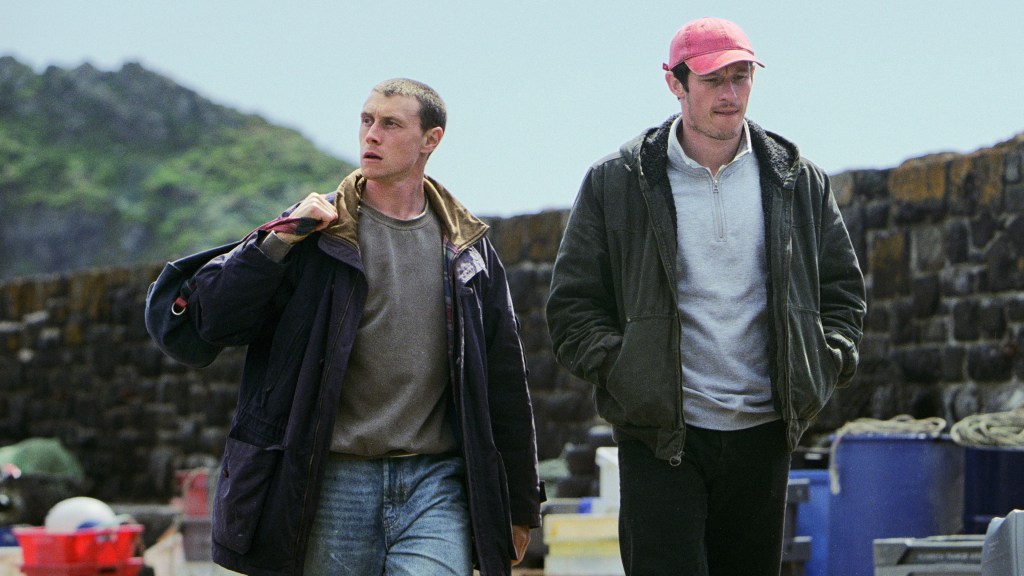

Admittedly, it is rather tempting to compare the work of Mark Jenkin to Ken Loach and examine it purely on the basis of its thematic proclivities. After all, Jenkin’s lens has remained consistently trained on the plight of the Cornish working class, especially against the backdrop of a widespread economic downturn and the progressive decline of rural communities.
Viewed from this perspective, Jenkin’s most recent piece titled Rose of Nevada could be interpreted as a work of social realism centered around the lives of young working class men trying to stay afloat in a little coastal community that both God and country have clearly forgotten existed. Jenkin spends some time setting up the mood of the picture with frequent insert close-ups and languid domestic scenes, as though to position the viewer at the right trajectory to enter the inner lives of the film’s two protagonists played by George Mackay and Callum Turner.
But here’s where the usefulness of this comparison ends because Jenkin, in contrast to Loach and other social realists like Andrea Arnold or Debra Granik, makes two strategic decisions. First of all, Rose of Nevada is heavily invested in using the filmmaking form as the pivotal element of its storytelling, which includes an artistically rendered element of magical realism, or even explicit fantasy. Instead of following the characters as they trudge through life against all odds and forcing the viewer to confront the brutal reality of their everyday existence, this movie sets up its thematic conversation using a device of time travel. The two young men board a fishing vessel hoping to earn some money and alleviate their overt desperation, and after a few days of excruciatingly hard yet immeasurably satisfying work, they make their way back only to find that they traveled thirty years into the past.
However, this isn’t a fish-out-of-water gig either because to the outside world they are both perceived as other people, one who eventually ended up lost at sea and the other who took his own life. Jenkin’s camera offers only sparse commentary and lets the fragmented narrative speak for itself. Thus, Rose of Nevada becomes an artistically inspired conversation about the invisibility of the male struggle, the many battles small coastal communities must wage in their plight for survival, and the little-appreciated toil of men who venture out to risk their lives and wellbeing attempting to bring food to their homes and feed their compatriots.
But none of this conversation is enabled, empowered or perpetuated by the inner character struggle of the film’s protagonists, which is the second most visible departure from what you’d come to expect from a work of Loach-esque social realism. Jenkin remains formally tethered to other inspirations, such as Nicolas Roeg. Although it takes a bit more focus on behalf of the viewer to pinpoint these connections, it is nonetheless visible just how much of this filmmaker’s aesthetic and tone are precise reflections connecting Rose of Nevada to Walkabout or Don’t Look Now. Much like Roeg, Jenkin empowers the environment—which he photographs lovingly, astutely and uncompromisingly—to inform the viewer about what might be lurking in the minds of the characters we otherwise never get direct access to. This might come across as fundamentally unsettling or even frustrating to viewers more accustomed to being privy to the characters’ inner lives, but it is here for a reason. Jenkin wants us to witness how the world and the environment shape the characters and inform their lives without having to spell it out. He trusts that we’ll get the message. Or maybe he does not care about it one jot and he simply chooses to celebrate the indifferent harshness of the world that shapes these characters and directs their tragic existence for no other reason than because it simply exists.
In a roundabout way, I think it is prudent to draw yet another line radiating from Mark Jenkin’s movie (and Roeg’s cinema as well) and suggest that both Jenkin and Roeg treat cinema much the same way as Cormac McCarthy treated prose. Devoutly regionalistic, deliberately coarse and completely refusing the reader entry into the minds of his own protagonists, McCarthy would write people shaped, constrained, maimed and nurtured by the worlds they traversed and the stochastic evil they encountered. Rose of Nevada is in many ways an example of that McCarthy-esque storytelling where we are purposefully denied explanations, where characters remain enigmatic exactly because we can only assume what goes on in their minds, just like we can only assume what other people we encounter in our own lives think as well.
And I dare state that Jenkin’s approach to what looks like sociopolitical realism but truly behaves like observational vérité—one where evil is not a deterministic outcome of stratification of social classes but rather where it is a probabilistic evocation of the universe’s cruel indifference to its own structure—brushes shoulders with effortless perfection. Rose of Nevada is simply spellbinding with its fragmented premise and the way the filmmaker keeps the thematic conversation going while frustrating the viewer’s natural expectation to understand what the protagonists think and feel by way of being allowed into their headspace. Much like Cormac McCarthy’s prose was as sparse as it was ornate and verbose, Jenkin’s movie says a lot by barely opening its mouth. It’s a film that places a lot of trust in the viewer’s ability to decode visual language and use the way the camera frames and constrains its characters as clues to their stories. And those who understand this assignment and attune themselves to this ambitious mode of filmmaking will be rewarded in the end and they will most assuredly count the experience of watching Rose of Nevada as emotionally enriching and somehow quietly devastating.






Leave a Reply