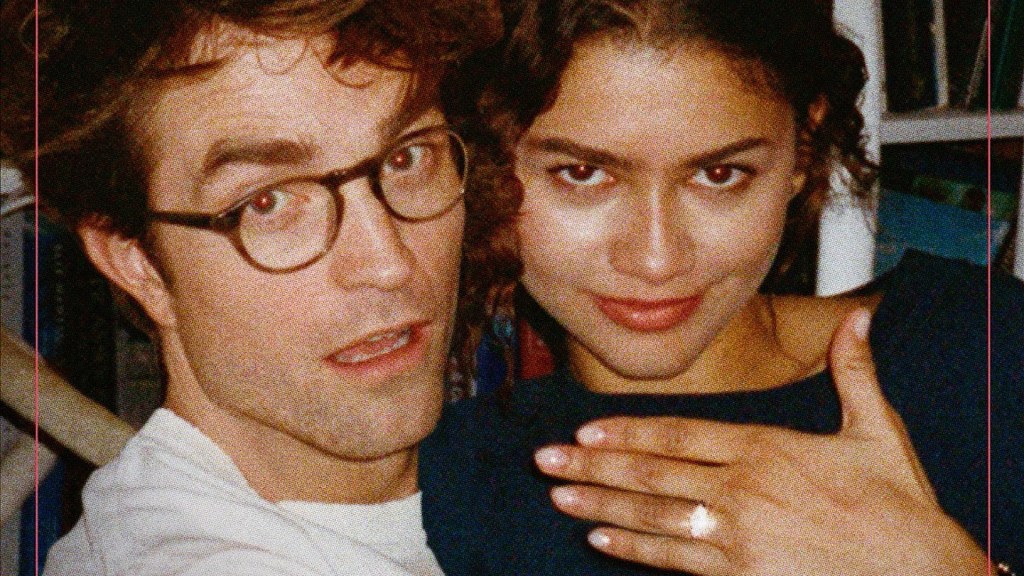

It all starts in a predictably saccharine way. The camera cuts between Charlie (Robert Pattinson) trying to write his wedding speech by bouncing ideas off of his best-man-to-be Mike (Mamoudou Athie) and flashbacks to how Charlie met his now fiancé Emma (Zendaya). And they met just how you’d imagine it if life was a run-off-the-mill rom-com.
We see Charlie notice Emma at a café. He takes a look at the book she’s reading, walks over and tries to strike up a conversation by pretending to have read it as well. She seemingly ignores his valiant yet utterly embarrassing attempt at a pickup line, but it turns out she just couldn’t hear him. Emma is deaf in one ear. She gives Charlie a smile and asks him to start over, pretend like the previous two minutes never happened. He smiles and obliges.
We cut to Charlie and Emma on their first dinner date. Charlie sheepishly fesses up and admits to have lied about reading that book Emma was reading. He just thought she was cute. Red flags everywhere, but Charlie is cute so it doesn’t matter. Smiles all around.
We move to the present. Charlie and Emma are planning their wedding. T minus one week. They are trying to juggle a number of plates: their day jobs, flower orders, dance lessons, speech writing, suit fittings, making sure the guests would get there on time, double-confirming that the DJ and the photographer would show up as well. All while trying to still find at least a few minutes for each other at the end of the day. Classic rom-com tension that is about to ratchet up a few notches, as the genre requires.
Typically, in addition to familiar hi-jinx related to guests getting lost at the airport or the venue canceling at the last minute thus throwing the wedding prep into a tailspin, you’d expect a sudden arrival. In rom-coms conflict is often introduced by way of revealing a secret or someone from the past bringing that secret out of hiding. An estranged relative. An old flame. News that the bride of honour and the groom had at one point had an affair. Something romantic and typically easy to resolve using conventional tools of the genre.
But The Drama is not a typical romantic comedy at all. The conflict it introduces is far from expected and the way it goes about resolving this central tension is also quite unique, at least as far as Hollywood commercial moviemaking is concerned.
What happens is that during a meal-tasting evening when Charlie and Emma, joined by Mike and his wife Rachel (Alana Haim)—while jubilantly plastered, tongues loosened and inhibitions lowered—begin sharing embarrassing secrets. The game is to each tell a story about the darkest thing they ever did in life. Mike once used his girlfriend as a human shield when attacked by a dog; Rachel, as a kid, locked her neighbour in a remote house in the forest; Charlie cyberbullied a kid at school so hard that their family had to move. But jaws drop to the floor when Emma admits to have planned a school shooting when she was a teenager.
And this is where the movie takes a turn because both the characters and the audience realize that we are no longer in Kansas. This isn’t a rom-com. It’s a trap. Your natural instinct might push you to quickly light up your phone in the middle of the screening, just to check what kind of a landmine you might have just stepped on. Because you know it is a landmine. You heard a rather audible click the minute Emma shared her secret with her friends, amidst the otherwise deafening silence.
What you’d find if you were to inconvenience other patrons instead of waiting until the end credits is that The Drama is only superficially an American Hollywood movie. It is written and directed by Kristoffer Borgli, a Norwegian filmmaker, and its thematic sensibilities are much more in line with what you’d find far away from Tinseltown. In fact, The Drama has more in common with movies directed by Joachim Trier, Tomas Vinterberg or Ruben Östlund (and if you were to look for an American filmmaker working this way, it would be Brady Corbet) and it is perhaps best seen as spiritually related to Force Majeure, rather than American productions. It is a comedy. It is romantic. But the experience of watching it is far from what you’d expect from a movie about two people trying to get married in spite of the drama unfolding around them. And this experience is absolutely, positively scintillating.
The moment Emma discloses what she had almost done in the past and why she had lost her hearing in one ear—which happened while firing a rifle too close to her face—the entire story becomes a different kind of drama where both the characters and the audience are pushed to take sides, suffer incredibly at the discomfort shared by the characters on screen and laugh. Laugh and laugh and laugh. Not necessarily the way you’d remember laughing at Bridesmaids. We don’t see Melissa McCarthy straddling a sink or Maya Rudolph defecating in the middle of the street. No, sir. The laughs you will hear from your fellow patrons and utter yourself would be laughs of unabashed discombobulation and utter discomfort. You will squirm in your seat and you might wish to temporarily look away. Not because what unfolds on the screen is graphic and intense but because the predicament these people are in escalates so far that it becomes psychologically unbearable to just take it in silence.
The Drama is a delicious satire that cuts along multiple cultural axes. Borgli pokes fun at the conceptual rom-com itself, jabs repeatedly at the way the American gun culture has warped perceptions of what’s right, what’s excusable and what’s forgivable, prods at gender dynamics and relationship expectations, and builds up to a harrowing climax that’s almost as uncomfortable to sit through as it is impossible to look away from. There is absolutely no debate: this will divide opinions. In fact, it has already. Look up reviews of this movie and you will find responses of two kinds: glowing praise (like here) and wiping the floor with the movie. But that’s its job, you could argue—to divide. And the movie truly excels at it.
You might walk into the screening lured by the sweet and charming scent of a lovely indie dramedy starring some likable actors. And then you’ll see the characters these actors inhabit and understand that hell is not a place. It’s a state of being unable to move or look away when something truly embarrassing unfolds in front of your eyes. Looking at Charlie as he ties himself in knots trying not to tell what he feels because he fears to hear it coming out of his mouth. Hearing Rachel cackling when the father of the bride talks about how brilliant Emma was as a child. Looking at Charlie all banged up and bruised as he sits alone in his apartment and weeps. That’s hell. But in the best way somehow.
At some point in the movie Charlie tells Emma, who refuses to engage in conversation about her past, that if you don’t talk about your emotions, these emotions can find ugly ways of making it to the surface anyway. And the movie proceeds to show what it looks like, almost immediately. In a clinical and intense way and with that Nordic edge, The Drama finds great ways to turn what would have been a sappy love story into an emotionally draining, infuriating and ultimately divisive experience that will send you up the wall or leave you lying in stitches. Or both. Or it will mesmerize you and put you in a semi-catatonic state after you become hyper-aware of just how uncomfortable the sound of your own laughter is and that you’ve sunk so low into your seat that you can barely see the screen any more.




Leave a Reply