
One of the many tricks you pick up as a home cook tasked with daily food preparation for the entire family is the philosophy of making the food you make go a little bit further. This encompasses a whole range of creative decisions you must make in order to stretch one family dinner into two, or two into three. It just sometimes happens that you’ll follow your instinct or the recipe you’re executing isn’t as precise as you’d like and instead of making enough food to last a family of three for two weeknights you end up making enough for one night and some leftovers. And it is prudent at this point—especially when cost of living is at an all-time high—to exhibit some frugality and figure out how to magically make that meal work for two nights.
Sauces can be watered down a little bit; beans can be added into the stew to fortify it. You can cook more rice or pasta to go with what you’ve made thus altering your originally intended proportions. My personal favourite, though? Slice in a bunch of frankfurters into any sauce, stew or a risotto—free cheap protein, cooks quickly in the sauce itself and I somehow always have an emergency packet of frankfurters somewhere in the back of the fridge. But! Here’s the important bit: whatever you do and whichever decision you make in order to stretch that dinner into two, there are always compromises and trade-offs. Those extra ingredients alter the flavour profile of the meal as much as the changed proportions between protein and carbs, and watering anything down removes some flavour altogether. Whatever you thought you were making—it is no longer the same. And as much as I’m a fan of these sliced frankfurters bulking up that second weeknight of chili con carne, the meal has nothing to do with the original recipe. It’s just different. But the decision I usually make is to add some protein or carbs if I can before I even consider water anything down. That’s just how I operate.
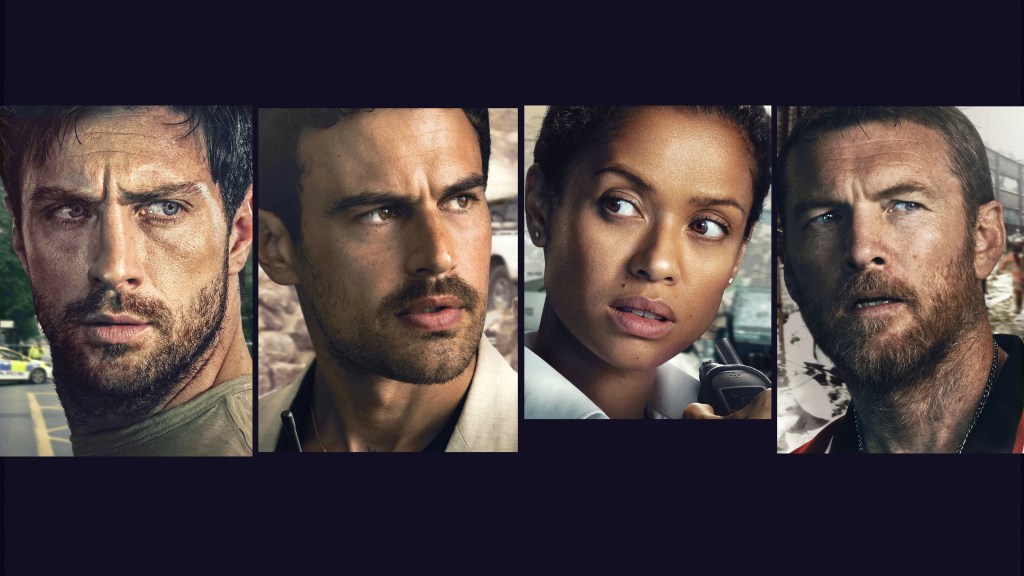
And it seems that the filmmakers behind Fuze, the director David Mackenzie (Starred Up, Hell or High Water, Outlaw King) and screenwriter Ben Hopkins (Simon Magus, The Nine Lives of Tomas Katz), decided to make a different choice. What they had was a story that in theory looked as though it should crystallize into a dad-friendly piece of action cinema with some narrative ambition to it. In essence, the movie follows multiple sets of characters: a bomb disposal expert Major Will Tranter (Aaron Taylor-Johnson), a police superintendent Zuzana (Gugu Mbatha-Raw), a group of seemingly professional bank robbers led by Karalis and X (Theo James and Sam Worthington) and some others as well. What transpires is that an unexploded WWII bomb is discovered at a building site in central London, which leads the police to evacuate the area and set up a security cordon (overseen by Zuzana); an army EOD unit (Explosive Ordnance Disposal) led by Tranter is called to dismantle the ticking threat and meanwhile X and Karalis use the fact that nobody is around in the area to rob a bank inside the evacuation zone.
And this setup plays out rather well for the most part. After all, there’s something tactile and fundamentally entertaining—especially for middle-aged male audiences which is kind of my crowd—about watching competent people doing their thing. Bonus points if at least some of those competent people are uniformed. Extra bonus points if criminal activity is also depicted with procedural attention to detail too.
Thus, Fuze shapes up to become a tightly woven thriller in which disparate groups of characters try to accomplish their goals and race against time while the filmmakers record the proceeding with what looks like an attempt at Mann-esque directorial precision. It all unfolds naturally and organically. Characters are written in broad strokes and the movie flings back and forth between the Police Command, the bomb site, the bank heist and a few other places in aptly kinetic ways. For a moment there you could convince yourself that maybe Paul Greengrass advised on set or at least was there in spirit in the editing suite.
But then, two things happen. First, as the narrative unfolds it becomes progressively more obvious that these seemingly disparate events—the bomb find and the heist—are connected and therefore the characters we are following are connected as well. And this represents a sharp left turn as far as cinematic believability is concerned because the movie veers away from procedural verisimilitude and seeming narrative simplicity to find comfort in the kind of genre complexity encountered in airport paperbacks written by no-name authors who hope to one day become the next Lee Child or, dare I say, Tom Clancy. And it’s not exactly that it is a problem per se, but rather that this narrative decision to conveniently complicate the plot and introduce numerous loose threads to it just doesn’t run well together with the vibe exuded by the way the story is told by the filmmaker. All of a sudden we are yoinked out of that gritty world of in media res action filmmaking and thrust into what seems like an artificially complicated web of subplots that lose the sight of the big picture in pursuit of small-scale intricacies. And it’s just a jarring experience.
What is more, judging by the way the entire story comes together and how some characters are conveniently forgotten, it also looks to me as though the screenwriter also forgot what the mission was and got lost in the detail of it all. As a result, Fuze looks like a movie without an ending. Or better yet, like just about a movie that was sixty per cent written before the screenwriter threw in the towel. Or maybe on paper it all looked as though the story would have somehow cohered and looked complete, but when converted into scenes with actual actors having to convert the written word into action and dialogue, it all felt a bit off. Like that pot of chili con carne you’d make on a Wednesday afternoon, hoping it would last for a few days, only to find out while serving that it won’t ever be enough for another evening without getting creative about it.
However, instead of slicing some frankfurters into the sauce the day after, measuring in some extra red kidney beans, or carefully managing portion sizes on night one, the filmmakers decided to make a go of what they had and said “fuck it.” All they did was water the sauce. Who cares about the superindendent Zuzana who just disappears before the final act? Why do we care about any ramifications of some truly profound character revelations relating to Major Tranter? Let’s just tack on a single scene at the end that flashes back to ten years earlier to blatantly explain who, what, how and where and with whom and it’ll be alright. And it just isn’t.
I fully realize that watching movies or interacting with any story for that matter is mostly about the journey, not the destination. But in case of Fuze, the destination is the bin, so it kind of matters, doesn’t it? It is truly a case of a film that starts well, keeps up the pace for a good while and then just disintegrates in real time while you watch impotently with your mouth agape. And when the credits roll you somehow find yourself keeping your fingers crossed for a post-credit stinger in which you’d be informed that indeed it was just episode one of a longer narrative and that we’d get to see some of these loose threads tied eventually.
In all honesty, this movie is a bit of an impossible paradox because it needed that big screen energy to get its two concurrent set pieces—bomb disposal and the heist—to register with appropriate scale and flair. But as far as the story goes, Fuze is a TV pilot stretched to ninety minutes that doesn’t have a satisfying ending, leaves a lot of characters dangling and a bunch of questions that truly require answers. Answers that would probably be delivered over the course of an entire six- or eight-episode season of television that this thing should have been instead of a single movie released theatrically. It all just looks unfinished, which turns whatever spectacle Fuze built initially into a steaming pile of disappointment you’d be handed on your way out of the cinema to carry home and think about.





Leave a Reply