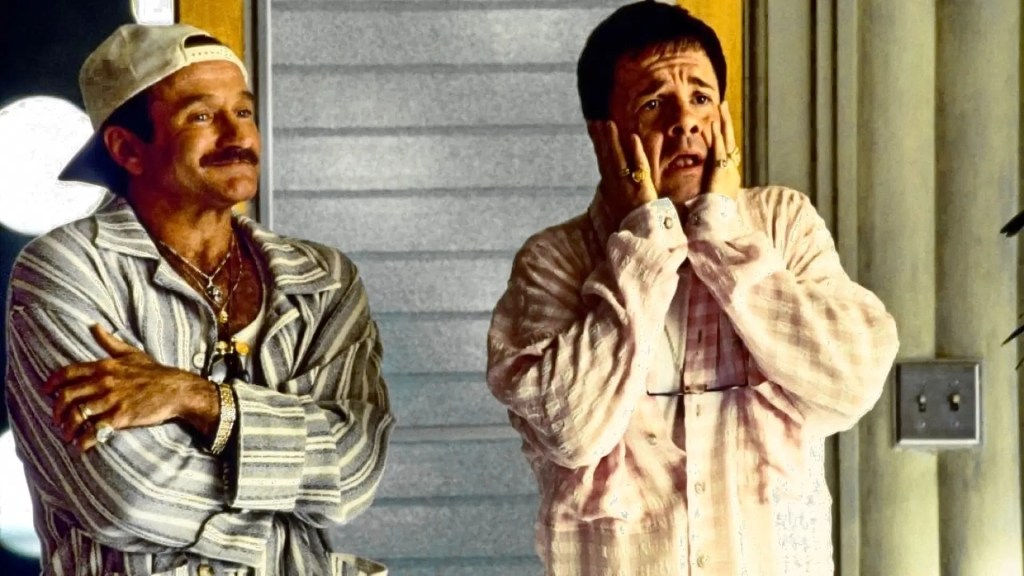
When I rewatch The Birdcage now, what strikes me isn’t just how funny it is, or how precise Mike Nichols’s direction feels, or even how beautifully Elaine May’s dialogue snaps into place. It’s the strange feeling that this is a film that shouldn’t quite have worked, but still somehow changed things anyway. A glossy studio comedy about a middle-aged gay couple running a drag club had no business becoming a cultural turning point. And yet, it did.
1996 was a comeback year for Mike Nichols. Having finally reunited with Elaine May, whom he had asked to essentially bring the screenplay of Wolf back from the brink, the pair immediately set their sights on another project. It was The Birdcage.
This remake of the 1973 French play La Cage aux Folles, which ended up also adapted into a French movie in 1978, had been on Mike Nichols’s to-do list for years. In fact, he was supposed to direct its Broadway adaptation in the early 1980’s, but he was fired from the production. Because Nichols had a longstanding reputation as a Broadway director despite his many ups and downs as a Hollywood filmmaker—he had won six Tony Awards after all—and he was good friends with John Calley, the head of United Artists who held the rights to the 1978 remake, he was able to convince MGM/UA to renew the option for the film and give him a shot at making a movie based on a story he had always seen as a phenomenal comedy.
Long story short, The Birdcage became the biggest financial success of Mike Nichols’s career, unadjusted for inflation, and proved that the old dog still had the guts and wherewithal to make great movies, especially since his directorial precision and his unique, trust-based way of dealing with actors paired exceedingly well with Elaine May’s incredibly witty writing. And let us not forget that the movie also happened to star Robin Williams, arguably one of the biggest comedy stars of the time, who—perhaps against type—played the foil as Armand to Nathan Lane’s outlandish yet deliciously resplendent drag diva Albert.
This comedy of errors full of ingenious setups, quips and high-speed dialogue exchanges built out of quirks and caustically intellectual commentary was not only a smash hit—as it became the talk of the town for a long while, attracted audiences to return for more, enjoyed success on home video and ended the year as the seventh highest-grossing movie—it was also a cultural watershed. The Birdcage was one of the very few major studio films at the time that openly tackled homosexuality with honesty and tact—with Philadelphia and The Crying Game being two other prestige efforts exploring queer themes—but it was most certainly the first mainstream comedy to do so. It demystified and disarmed many preconceived notions and deeply-rooted conservative views about gay people, specifically because the movie portrayed them as what they were—people. Granted, some critics at the time harumphed at what they saw as the film’s tendency to exaggerate, or the infrequent use of slurs, but on the whole the audiences fell in love with Armand and Albert’s atypical family setup where two gay men successfully raised a son and saw him off as he ventured into independent adulthood. Still, Nichols and May offered a prestige counterpoint to the blossoming New Queer Cinema that their intended audience was quite unlikely to seek out and watch.
More importantly though, the fundamental setup of the movie was the key to its success as a cultural moment that described and deflated tensions between evangelical conservatives who feared gays and the young liberal mainstream. It was a comedic exercise in exposure therapy where a pair of ultra-conservatives (played by Gene Hackman and Dianne Wiest) were invited for dinner with Armand (Williams) and Albert (Lane) because their daughter Barbara (Calista Flockhart) was about to get married to Armand and Albert’s son Val (Dan Futterman). Of course, the guests were never told about Val’s unusual and progressive parentage and therefore elaborate schemes and scenarios needed to be concocted to disguise Val’s family and make them pass as “normal” in the eyes of his prospective in-laws. Chaos ensued only to climax in one of the most heartfelt and incredibly poignant moments of the year (perhaps even in the entire decade) when Val openly admitted in front of everyone that Albert was his real mother, the most nurturing and sensitive presence in his life. Not only did it melt the hearts of Val’s in-laws, it positioned The Birdcage as a momentous cultural bellwether and a beacon of normalization of homosexuality in America.
However, it is important to remember that The Birdcage didn’t just come out of nowhere and landed as an entirely original piece of cultural commentary. In fact, it was a spiritual successor to another groundbreaking piece of cinema, the 1967 Guess Who’s Coming to Dinner? In the Stanley Kramer-directed film that also happened to be Spencer Tracy’s final performance before his death the cultural shock came from the idea of introducing conservative parents (Katharine Hepburn and Spencer Tracy) of young Christina (Katharine Houghton) to her boyfriend who happened to be black (Sidney Poitier). Even though the Civil Rights Movement had been well underway at the time, the concept of an interracial relationship in the late 1960’s was well beyond comprehension for many staunch conservatives. It was still illegal in some states.
Kramer’s film did not try to be a laugh-out-loud comedy. Guess Who’s Coming to Dinner? was more of a drama with some levity mixed into the dough and—very much in in the style of this aging liberal—it was more decidedly a movie wrapped around a moral message. Furthermore, it didn’t have the edge of some of the more iconoclastic counterculture movies of the time, and it was still very much a studio picture aiming to introduce socially-relevant concepts to older audiences who enjoyed more prestige-slanted cinema, as opposed to the incoming New Hollywood.
In 1967, the cultural frontier to be tested and broken was race. Granted, homosexuality had always been in the same conversation at least as far as young people’s objectives of introducing progressive ideas to the cultural mainstream were concerned. But I think we all know that with older, more entrenched sections of our societies, such ideas need to be introduced in moderation. By 1996, many such embattled conservatives were more acclimated to black people, though it has to be acknowledged that in the intervening twenty-nine years, racism in America had not been extinguished. It is incredibly difficult to weed out such fundamental bigotry and it might take many more decades, if not centuries, of hard work on behalf of everyone in our societies—and it also includes mustering courage and exercising patience and empathy in doing so—before we see lasting effects of this work. Ironically enough, the defining feature of culturally-entrenched conservatives is that they are not known for changing their opinion much.
Nevertheless, one of the most important achievements of Mike Nichols’s The Birdcage was normalizing homosexuality in a similar manner as Guess Who’s Coming to Dinner? normalized interracial relationships. It was an exercise in exposure therapy disguised as a lighthearted comedy aimed at the very people who needed this kind of therapy the most. It was not a hip blockbuster for youngsters. Younger audiences were more likely to go see Executive Decision instead, and over the course of the year they were more likely to have championed Independence Day, Mission: Impossible and The Nutty Professor. The Birdcage was what I often term “catnip for Boomers,” a movie specifically designed to resonate with older audiences who do not seek radical exhilaration, only mild amusement at best. What they got was more “intellectually spicy” than anything else in this category, thanks to Elaine May’s writing, Nichols’s visual acumen and the cast’s complete devotion to the bit. The movie disarmed knee-jerk negativity because it was unbelievably funny and just as warm. It was built on fundamental humanity, germinated the fundamental idea of empathy for people conservatives would have viewed as “others” and introduced them to the unimpeachable reality that gay people had problems and anxieties just like them; they also had families and partners to worry about and support.
Now, thirty years on, I believe we are due a movie that would extend the tradition laid out by Stanley Kramer and Mike Nichols. In 2026 we are now a whole decade into the “post-truth era” where Donald Trump is a major political figure. Populism is no longer just on the rise—it has established a beachhead in nearly all major Western societies. Tensions between young progressives and entrenched conservatives are at an all-time high. But now it’s all on steroids, catalyzed by social media organically engineering echo chambers where people’s entrenched beliefs are reflected back to them, thus making them feel that they are all a silent majority and that “the other” side is in the wrong. It is almost a no-brainer to think that we badly need a Boomer-friendly four-quadrant comedy in the style of The Birdcage that could serve as much-needed exposure therapy for inflamed right-wingers who have been fed a steady diet of algorithmic rage bait. But what would be the social frontier to be chipped away at this time?
Could this year’s hypothetical successor of The Birdcage be a movie about conservatives being introduced to their daughter’s trans-boyfriend? Maybe so. Though, judging by what’s happening currently and what dominates the news cycle, the more socially relevant issue now would have to once again circle back to racial equality and tolerance as well as acceptance of other ethnicities in our grand cultural makeup. With immigration raids in America and right-wing nativists growing in numbers on both sides of the Atlantic, that dinner trap set for conservative parents would probably have to involve someone being introduced as the son of undocumented migrants. The conceit would involve hiding their ethnic origins through comedic contraptions and conservative mindsets being altered by dint of understanding that people from other countries are people too. Or maybe societal divisions have gone so deep that it’s enough for a movie like this to work if the counterpoint to MAGA-tinged conservatives in need of having their worldviews widened were simply a family of left-leaning and well-meaning liberals. Like Armand and Albert, but straight. As I wrote a few paragraphs back—radical ideas need to be dispensed in moderation, so we might need another The Birdcage in 2056 to reintroduce homosexuality once more.
Although I think it would be a terrific idea to release a new incarnation of a movie that probes cultural frontiers at dinner right now—and I know we have seen My Big Fat Greek Wedding twenty-something years ago, a valiant attempt but two decades early in my humble view—we might no longer be able to receive a movie like this with empathy it deserves. In fact, The Birdcage itself, when watched and reviewed by modern audiences, generates completely different feedback.
A single glance at recent Letterboxd reviews of this film will alert you to the fact that if it were released right now instead of thirty years ago, The Birdcage would have been boycotted as insensitive, biased, morally compromised and mired in cultural appropriation by young viewers who would technically need this movie to be shown to their older relatives to get them to update their ossified beliefs.
What is even stranger, younger audiences seem completely incapable of basic empathy towards the characters in the film as it has become a frequent occurrence to see the character of Val—the son who asks his gay parents to hide their gayness for one evening with his prospective in-laws—as an irredeemable villain of the film worthy of nothing but disgust and wholesale contempt. They refuse to acknowledge what came natural to most people thirty years ago, which is that Val is not ashamed of his parents being gay, but rather embarrassed by his parents in general. Like nearly all young people are, regardless of the demographic cohort they hail from. Therefore, today’s The Birdcage would be unable to exist in its original form and hence it would have to be re-engineered around inflamed sensibilities of youngsters who look for stuff to get offended, let alone MAGA zealots who would dismiss the film on principle, walk out in protest and refuse to hear a word of what they’d identify as “leftist propaganda.”
Hence, the conclusion I am about to draw is chilling. It looks to me that despite the fact the world needs a movie like The Birdcage to bridge social divides and bring the ever-separated factions of our societies down from the brink of all-out civil war, it might not work at all. We might be too far gone because the young are no longer talking to the old, nor does the left talk to the right. In this multivariate conflict of class, race and political convictions, each side seems no longer willing or able to acknowledge that the other side is fundamentally human. Maybe the time to release a movie like this was five or eight years ago. Now, it seems that we have gone past the point of no return and a heartfelt comedy would no longer suffice.
Despite its humble demeanour of a middle-of-the-road comedy built on quirks and the controlled insanity of its outrageous predicament, The Birdcage was, much like Guess Who’s Coming to Dinner?, a tool of social de-escalation. A cultural safety valve that allowed different age groups slowly drifting apart to temporarily reach through their divides and build a bridge. Today, de-escalation is no longer on the table, it seems. In a world where people tend to only have conversations with people they already agree with, cultural divides may be “unbridgeable” in a dinner setting.






Leave a Reply