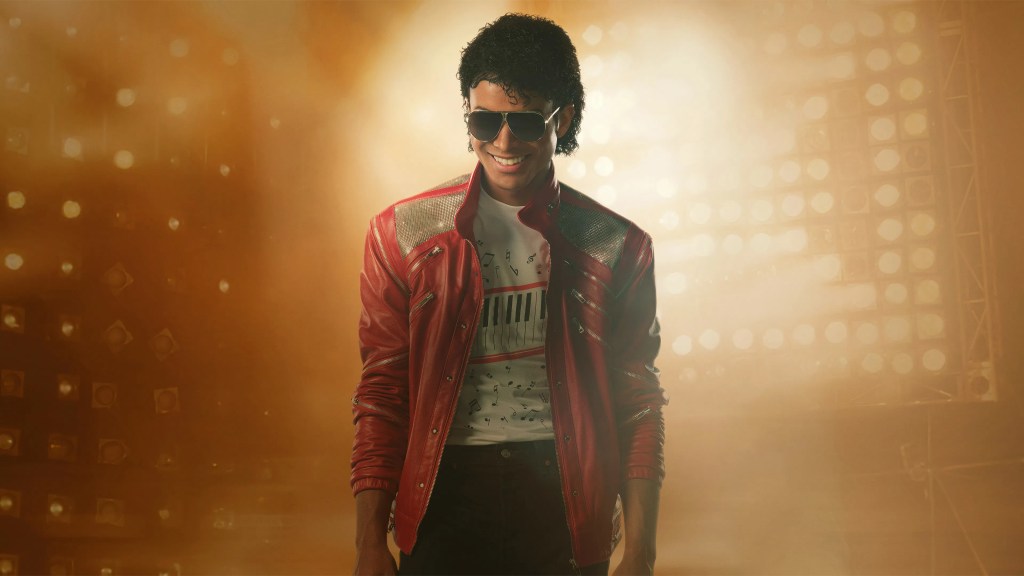

Ever since Michael Jackson’s death in 2009 it was a matter of time before a Hollywood studio would greenlight a prestige biopic recounting his life and career. And the minute the Bryan Singer-directed Bohemian Rhapsody returned nearly a billion dollars in box office receipts, the countdown was officially on.
Now, in 2026, what looks like a deliberately coordinated effort to co-create a shared universe of musical biopics—in addition to Bohemian Rhapsody we have seen Rocketman, Elvis, A Complete Unknown, Springsteen: Deliver Me From Nowhere and a number of others—has officially added Michael. Directed by Antoine Fuqua from a script penned by John Logan, this movie follows the logic of the more successful biopics in this space that could be dubbed “cradle-to-grave biographies,” as opposed to following the efforts limited in scope and biographical ambition. At least to a point.
Michael stars Jafaar Jackson (who happens to be Michael’s nephew, Jermaine Jackson’s son) in the titular role and recounts Michael’s life from his early childhood, breakout with the Jackson 5, rise to solo stardom and tops out at the iconic tour promoting his album “Bad.” And this immediately throws into question the entire logic behind painstakingly tracing the man’s life and touching base with him every couple of years, which is what these kinds of biopics usually do. Instead, Logan and Fuqua decided to find a middle ground between this mode of decidedly prestige and pretentious filmmaking and the more artistically intriguing modality where the movie concentrates on a particular short period in the subject’s life, like recording of a particular album or even a few days in their life (like in My Week with Marylin).
And it would all be cool and normal because Michael Jackson, still considered one of the greatest acts of all time and revered together with The Beatles and Elvis, lived a rather full life despite the fact that he tragically passed at the age of fifty. Maybe the filmmakers had a plan to follow up in a few year’s time with another part of this story, which might be called Jackson. We just don’t know. However, it might just be that the filmmakers specifically chose to end their movie where they did—right at the moment when Michael decided to leave The Jacksons for good and stood up to his tyrannical father (Colman Domingo)—because that way the movie would speak to his legacy as an influential icon of pop music and an unparalleled success as a recording artist.
Conveniently enough, the way Michael is structured allows for the narrative to shape around Jackson’s struggle to gain independence from his father, reflected in Jackson’s childhood favourite hero Peter Pan’s struggle against evil Captain Hook. Using familiar biopic beats the movie plops along between important moments, following in the footsteps of Bohemian Rhapsody, and shows us exactly what a prestige biopic designed by an LLM would. We see young Michael berated and abused by his father because he didn’t want to rehearse after a performance. We cut to him a few year later when he’s thinking about going solo. We see him interact with Quincy Jones. We see him watch a news report on TV about gang wars which then immediately cuts to a sequence in which he records “Beat it,” which is so saccharine that it might give you diabetes on the spot. Bubbles the chimp makes an appearance. “Thriller” is recorded. Joe Jackson meddles once more and is told by his wife (Nia Long) that he wasn’t going to whoop nobody and that his brutish dominance had come to an end. And then we predictably finish with a long musical performance before the lights go up.
Therefore, if you’re after a nuanced portrayal of a man who destroyed his body with plastic surgery as he mistook body dysmorphia for a pursuit of perfection and whose persona became progressively surrounded with accusations of sexual abuse of children, you won’t find it here. Michael is effectively sterile in this regard and only barely scratches the notion of Jackson’s relationship with his own self-image, let alone anything else. If you want to delve deeper into controversies, you might have to go and watch Leaving Neverland and educate yourself on your own time because this movie pretends these controversies simply do not exist. Granted, this is apparently because the filmmakers were hamstrung by a legal settlement which rendered these topics effectively off limits; the movie underwent reshoots and re-edits to remove all hints at impropriety, so you can imagine that Fuqua and Logan had originally been after a more well-rounded, true-to-life portrayal rather than a piece of sterilized propaganda. Though it might just mean that we would have seen a movie that is just as pretentious, familiar and pedestrian; only longer.
But nevertheless, here we are. Michael is still effectively half a movie because it behaves as though it wanted to tell Jackson’s life story but cuts short at the halfway mark, while adopting a cadence of a movie whose mission was to recount his entire life start to finish. Still, Jafaar Jackson’s mimicry of his uncle’s mannerisms is more than enough to earn him some praise, but that’s not enough for the movie to stand up to scrutiny as a whole. Because taken together, this thing is as workaday and template-driven as they come. It’s a by-the-numbers execution of a tattered recipe that aims to entertain in such predictable ways that it is tonally bordering on self-parody.
All you will get from Michael is a sanitized highlight reel of Jackson’s biggest hits, a close look at how some of his iconic moves and songs came together and it will all add up to diddly-squat. There’s so little originality in this movie that it could have just as well been written by an LLM and we wouldn’t have been able to notice. At least the film’s blissful lack of awareness that all of its dramatic beats are laughably close to parody would have been somehow excusable because originality is not something you’d expect from an AI. But I do expect it from human filmmakers and I got very little of it out of this piece of prestige-adjacent schmaltz fit to entertain pensioners.
Shame.



Leave a Reply