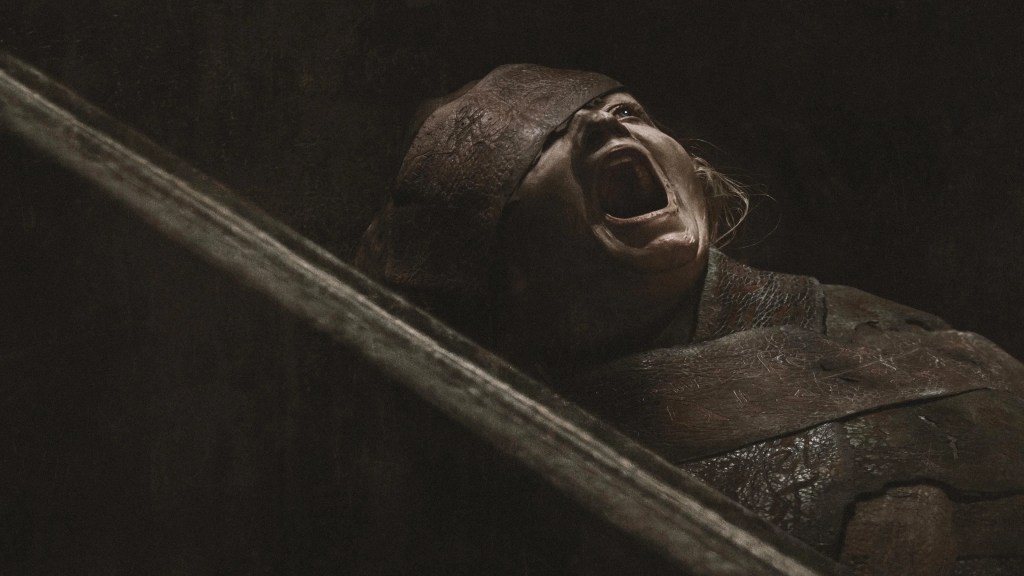

After buying a ticket to see Lee Cronin’s The Mummy, waltzing down to your seat popcorn in one hand and an over-sized drink in the other, and then doing your level best not to consume all your snacks during the twenty-five minutes of pre-show ads and trailers, you will be greeted by two things: a swelling wall of cacophonous noise comprising multiple instruments and choral voices and the film’s title stating what looks like the obvious. That the movie you are about to see is written and directed by Lee Cronin and that the story is going to involve mummies.
And I think it’s important to linger over this for a little while. Or maybe it’s a good idea to use this film’s title card as a structural anchor to talk about what this movie wants to do, what it actually achieves, how it goes about doing so and why it ultimately fails on all counts.
So, let us go back-to-front and first consider the latter two words in the title: The Mummy. You might have ideas about the content of the story or even be inclined to think that this movie might have anything to do with any of the many iterations of the Universal Monsters universe, but nothing could be further from the truth. In fact, the Universal-produced films in that series cared about lore consistency only to an extent. So, in contrast to a movie titled Dracula or Wolf Man, there’s only so much you can expect. And Lee Cronin knew that.
Lee Cronin’s The Mummy therefore treats the titular concept of an ancient Egyptian corpse, ritually bandaged and kept in a sarcophagus, as a narrative vessel for what the filmmaker is really interested in. We’re not here to unleash dormant curses by way of invading forbidden tombs or to try to stop Boris Karloff from finding a wife. Not directly. There’s still a sarcophagus, though it looks decidedly art deco, a sinister priestess (Hayat Kamille) and a demonic curse. Although we only get to see bits and pieces in the opening scenes of the movie, we can infer that somewhere in the middle of nowhere in Egypt there is a house where a family guards an ancient tomb in which something malevolent slumbers. Or at least it used to. From then we proceed to follow a family who temporarily lives in Egypt. Charlie (Jack Reynor) is a journalist deployed on a foreign assignment and together with his wife Larissa (Laia Costa) they are trying to keep a lid on their two little rascals, Seb and Katie. One day, however, Katie is abducted by that sinister priestess and the local police are not able to recover her.
Years later, Katie (Natalie Grace) is found after a plane carrying ancient artifacts destined for illegal trade crashes unceremoniously in the middle of an oasis. She’s found hidden in a sarcophagus, wrapped in gauze and locked in a catatonic state. Charlie and Larissa immediately bring Katie back home hoping to nurse her back to health but—surprise, surprise—it’s not that simple. In fact, Katie isn’t exactly herself as she might have brought something back from Egypt that is about to send her entire family into a tailspin. In order to combat whatever entity piggybacked onto Katie’s paralyzed soul, Charlie seeks help of an Egyptian detective (May Calamawy) who unearths the terrifying supernatural truth behind Katie’s abduction.
So, you see that the mummy gimmick—despite its titular importance—is merely an excuse the filmmaker used to advance his own mission. It’s more an exotic makeup applied to a small set of familiar archetypes that Lee Cronin seems to be very passionate about. When boiled down to bare essentials, Lee Cronin’s The Mummy is nothing more than a re-imagining of The Exorcist mixed with some influences of another classic Cronin is fond of, The Evil Dead. Between the themes of a teenage girls possessed by an ancient demon, an insidious entity taking over a house, a possessed individual behaving very much like a deadite and the grand climax of the entire movie looking decidedly as though it wanted to blow a kiss to William Friedkin himself, there’s absolutely no debate about what this movie is. And at this point—since originality of whatever transpires on the screen is thrown into question—it’s all down to execution.
Which is where we transition to the first part of the title, the filmmaker’s own signature. Now, you could imagine that some filmmakers stamp the titles of their movies out of nothing more than a desire to tickle their own egos, but rest assured that in the horror tradition this operation has its meaning. John Carpenter used to leave his authorial signature on the title of most of his films. Wes Craven did it on a few occasions. Rob Zombie marked with his name his desire to separate his own treatment of the Halloween lore from the glut of sequels polluting the franchise.
And in all those cases, seeing the director’s name adorning the title signified one thing—an attempt at style. A calling card. You see “John Carpenter’s” in front of anything, you know you can expect certain decisions, specific refences and an aesthetic. And I believe that Lee Cronin is at this point interested in proving to himself and others around him that his name carries a brand as well. Or it might just be that simply titling this movie as The Mummy would have confused audiences expecting Brendan Fraser to make an appearance or maybe it would have precipitated a litigious response from Universal who own might own the rights to this title. Hard to tell.
Nevertheless, what I think Lee Cronin is after is establishing his own calling card that would inform anyone who ventures to see any future movies adorned with “Lee Cronin’s” in front of the title that what they are going to subject themselves to will comprise of the following: (1) Raimi-esque fisheye closeups of human appendages in various states of decay, (2) sequences of nails and teeth being pulled out in an attempt to leave the viewer viscerally squirming, (3) closeups of skin being peeled off people (remember that cheese grater scene in Evil Dead Rise?) and (4) split diopter shots. In fact, on that latter point: watching this movie offers an opportunity for a drinking game. Drink whenever you spot a split diopter shot. I guarantee you will be comatose before the movie hits the halfway mark. It must be Cronin’s favourite camera technique. He sometimes cuts from one split diopter shot to another with nothing in between. Occasionally he would split the lens vertically and then horizontally. There are more split diopter shots in this movie than in all Brian de Palma movies combined.
And unfortunately, I don’t think they work as intended because they fly in the face of that old “less is more” rule. One or two such shots sprinkled into the movie draw attention to certain things. Doing it in every other shot becomes impossible to see as anything other than a gimmick and it ultimately undermines viewer immersion. You don’t want to be constantly made aware of the fact that you are watching someone’s directorial decisions made flesh and this definitely draws attention to the filmmaker, not the film.
Consequently, in contrast to the very movies it attempts to hybridize and wrap in gauze, Lee Cronin’s The Mummy simply fails to entertain or envelop the viewer. While it is occasionally squirmy—as much as any scene where people pick at their wounds or pull at massively overgrown toenails would elicit a visceral response—the film just doesn’t connect on an organic level. It’s not frightening or suspenseful in any meaningful capacity and I also believe that the filmmaker was aware of that because every single opportunity to scare the viewer was accompanied by a sudden spike of non-diegetic cacophonous music. The cheapest scare tactic of them all. And after a while, a movie reliant on going “boo” every so often without even trying to pull the viewer into its own universe and keep them in a state of suspense will inevitably become tiresome. Which it does. And the matter is further exacerbated by the simple realization that this film for some unfathomable reason runs well in excess of two hours, which is indulgent, unnecessary and ultimately exhausting.
As a result, Lee Cronin’s The Mummy is not the kind of roller coaster of visceral and emotionally affecting horror that a combination of The Exorcist with The Evil Dead could have theoretically been, but rather a pale imitation kept together by low-rent scare tactics, an overwhelming score and a whole bunch of squirmy scenes that, while effective in the moment, do not elevate the experience at all.
This is a real shame because hidden somewhere underneath what clearly is supposed to work like Cronin’s attempt to be recognized as a household name among horror hounds there was an opportunity to explore some interesting wrinkles. Charlie and Larissa’s frayed family dynamic having to withstand the ultimate test amplified by the tried-and-true archetype of ultimate sacrifice that clearly resonates with Friedkin’s 1973 classic could have worked much better than it did in here. I’m not sure exactly what should have been done to mitigate against what ultimately was a failure to compel me; I can only say that this movie felt as though it deserved more than camp exhilaration stretched over a running time that was nearly thirty minutes too long for its own good. I think the biggest shortcoming of Lee Cronin’s The Mummy is that the movie most likely sees itself as a midnight festivity, a cult classic in the making riding on the strength of its few memorable moments of repulsive squirminess that mistakenly gambled on going for a “more is more” approach instead of the more canonically effective “less is more.” An opportunity squandered wholesale.





Leave a Reply