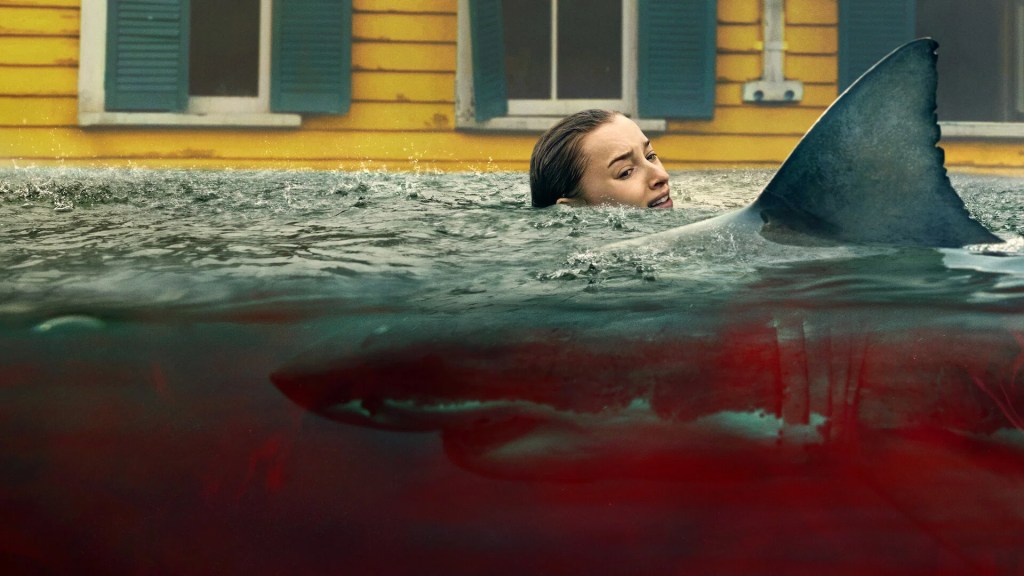

I will watch anything with a shark in it. I watched Jaws for the first time when I was way too young to be watching it and therefore I remain biased this way. In fact, anything that even vaguely qualifies as an animal attack horror of any kind will have a fair day in court whenever I am presiding. Orcas, bears, wolves, alligators, crocodiles, snakes, ticks, piranhas; it doesn’t matter. The bar for me to emerge with a positive review is much lower whenever there’s an animal hunting and eating people in the movie.
This also means that whenever a movie of this kind—which already has a leg up in this regard—fails to entertain me, it should give you pause. This is coming from someone who considered Crawl a fantastic animal attack horror and who also gave the original Sharknado four stars on the back of its unrepentant cheap-o ridiculousness.
Make no mistake: there is a reason why these two particular titles—Crawl and Sharknado—received a mention at the top of a text that is supposed to discuss why Thrash, the recently-released shark attack movie available globally on Netflix, disappointed me profoundly. It is because it had an opportunity to follow in the footsteps of either of these two movies and instead it chose to blaze right between them, thus never committing enough to the tight character-led survival angle we witnessed in Alexandre Aja’s alligator attack movie, nor did it lean sufficiently hard into its ubiquitous camp potential. And it wouldn’t have required much to do it either—just a few steps in either direction would have sufficed. See for yourself.
The premise behind Thrash is the following: a major category-five hurricane is barreling towards the American coast and as it does so we are introduced to a bunch of characters whom we will later follow: a young woman Dakota (Whitney Peak) who suffers from agoraphobia and therefore will become stranded in the town hit by a hurricane; a pregnant Lisa (Phoebe Dynevor) who fails to get the hell outta Dodge in time, Dale (Djimon Hounsou), marine researcher tracking bull sharks for a living and Dakota’s uncle who will make his way into the gathering storm to save his housebound ward together with a few extra characters; Ron, Dee and Will (Stacy Clausen, Alyla Browne, Dante Ubaldi) who are a trio of kids living in a foster home run by a couple of deplorables who look like transplants from a Roald Dahl book (Matt Nable and Amy Matthews), wear trucker hats and believe that a major hurricane is “just a little bit of weather.”
So, in essence what you have is an Emmerichian disaster movie scenario setup with disparate groups of characters between whom the attention will be divided when the calamity arrives. And the calamity is three-fold: the world’s shortest hurricane with winds that dissipate after about five minutes, a comedically massive storm surge and a bunch of sharks that make their way through the broken levees into the town to do some chomping. I think we can all agree that as far as the premise goes, Thrash sets up its pieces suggesting that something of interest would follow. For instance, like in Crawl, that we’d focus on Dakota and Lisa’s ordeal and Dale’s race against time to save them from the shark-infested rising waters. Or that we’d pull back a little bit and give only a little attention to any of the character groups and extract some gutsy camp out of the film’s central “sharkurricane” scenario.
But here’s the problem. For the movie to work in the way something like Crawl does, the camera needs to actively choose to divide the time between Dale and Dakota’s points of view and to actually introduce credible threats for us to understand the urgency of this survival scenario. Which Thrash simply does not. Both Dakota and Lisa always remain safe, even when stranded in water with dorsal fins visible in the background. Conversely, you could have turned this predicament into that Emmerichian sharkisaster film and make good use of that larger character sheet. But for that to work, the movie would have to commit to losing a good handful of characters (and some bystanders including those Roald Dahl redneck foster parents do end up eaten, though in rather tame ways), some of which should be the ones we’re supposed to care about. In a disaster movie, some of the cast is expendable and in a camp disaster film this presents an opportunity for ridiculous violence, which is only used on one occasion.
Therefore, Thrash just coasts unpropelled in a leaking dinghy and refuses to commit to getting its hands wet and paddle in either direction. Because the camera flip-flops between those many sets of characters, we never establish a good enough relationship between Lisa, Dakota and the distant rescuer (which in a disaster setting would make the movie look like a cross between Crawl and The Day After Tomorrow); and because the filmmakers don’t lean into the film’s intrinsic camp potential, there’s very little fun to be had while watching the movie. Sure, by the end we do get to see Lisa deliver a baby, cut the umbilical cord caveman-style and fight off a shark. There is at least one instance of a great white shark jumping out of the water and sawing through a bull shark, too. But this kind of entertainment should have been the heart and soul of the entire movie, not just garnish for the final five minutes.
It honestly feels as though the movie was embarrassed about having to be out there for others to see; as if the filmmakers cringed at the very prospect of becoming vulnerable with the audience who may or may not vibe with the movie they were making. Thrash plays down its own dramatic authenticity while equally refusing to show its ass a little and risk doing something dumb for laughs. And this is key in my opinion because successful movies of this kind—trashy genre flicks about sharks chomping down on stranded people—tend to be made by people who genuinely don’t care about their street cred anywhere near as much as they care about having fun making movies. Which begs the question: Did Tommy Wirkola, who wrote and directed Thrash, even liked being on set? His previous experience directing purposeful camp trash like Dead Snow and Violent Night would suggest that he theoretically should have known what recipe he was working with and what he should have done to make the best of the hand he was dealt.
Then again, maybe Thrash is a victim of producer-level meddling from nameless Netflix moguls who tend to leave data-derived notes suggesting that certain elements be included to increase viewer retention or that mathematically speaking the idea of crossing Crawl with Sharknado should endear both the audiences who gravitate to survivalist grit and the audiences who come for camp laughs. In reality, they might have alienated both.
They sure alienated me—and I’m a weird hybrid specimen who would have been fine with either of the two options. I am the Venn overlap between these two sets and I thought that Thrash was not trashy enough to be considered fun trash, nor was it serious enough about its own mission to be considered authentic trash. It was just… trash.






Leave a Reply