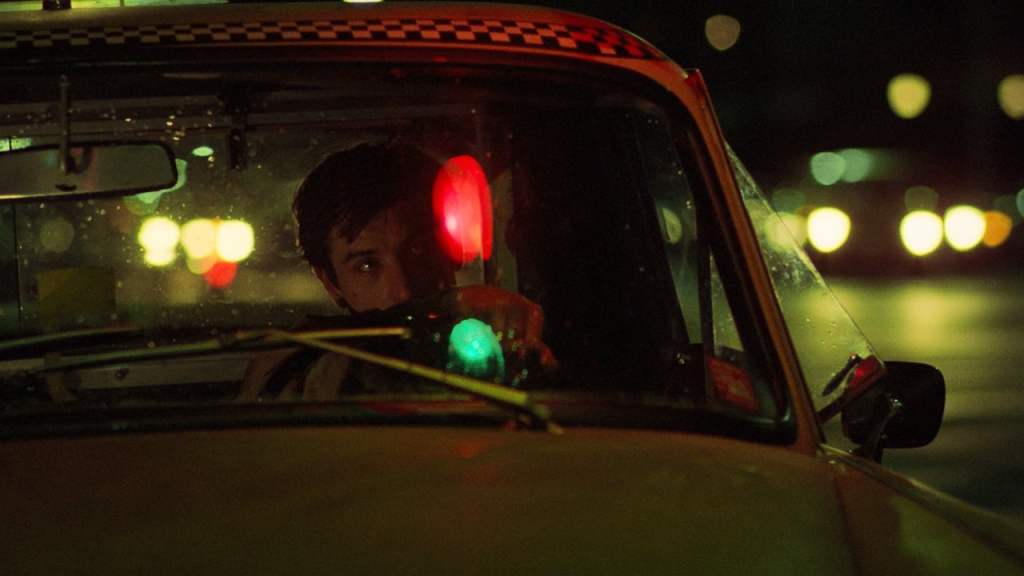
Yes, probably. Or at least he would think it’s a good idea before seeing through his lies and deciding he must be assassinated instead. Similarly, Travis Bickle would likely think it’s a good idea to storm The Capitol and vandalize America’s epicentre of parliamentary democracy. Though, I don’t think he’d actually show up on the day, because a chaotic revolution is not his scene.
You might ask where exactly I am going with this train of thought and to be completely frank, I am not so sure either. I guess what this is intended as a preamble to is an attempt at articulating how my own perception of Martin Scorsese’s Taxi Driver has changed over the years. For a very long time I have seen this film as an anti-superhero story that interrogates the pulp mythology of ‘the lone rider’, a western archetype of a silent hero who traverses the world and saves damsels in distress from dangerous men. And I have to say I have been quite fond of this interpretation as it fits quite well with the general zeitgeist of The New Hollywood and epitomizes a cultural shift away from the flawless leading men of the Golden Age and embraces an idea of a flawed hero. Problem is, Travis Bickle is not a flawed hero. He’s not even an antihero. He is a straight-up psychotic villain on a downward spiral towards an inevitable catastrophe.
When you think about it and pay attention to how his character is defined and how he behaves as the film progresses, there is very little about Travis Bickle to sympathize with or even pity. Sequestered from the outside world inside his taxi cab, he prowls like a predator and – by talking to himself – becomes increasingly convinced that the whole world is against him. This in itself could be seen as a metaphorical commentary on the plight of Vietnam War veterans who were often left to deal with their severe PTSD on their own once they were back home (if they were lucky enough to come back in one piece). However, while this interpretation is valid and carries a fruitful conversation about important societal problems of the time, it might have been completely projected on by the viewers based on what Travis Bickle looks like.
Again, if you pay close attention, we never hear or see anything that would corroborate the notion of Bickle being a disenfranchised veteran struggling with severe mental issues because the country had left him behind. All we know about his past comes from his mouth alone. He is the one to tell us about being honourably discharged from the marines. He is the one to tell us about his tour abroad. On one occasion when he comes into contact with a fellow veteran, the encounter is awkwardly devoid of even a semblance of fraternal recognition, as though Travis was perhaps afraid the other guy might figure out he was lying about his military record. And to be completely honest, the film itself hints on multiple occasions that the reality Bickle exists in and the real world might be two different places. After all, there is a case to be made that the entire ending of the film takes place entirely in his mind. So why should we believe a word he says?
In fact, it might be best not to. If we assume from the get-go that Travis Bickle is a demented psychopath whose downward trajectory ends up redirected to ‘do something good’ by a sheer force of accident, then Taxi Driver becomes a completely different experience, which is just as incredible if not more than if we were to treat Travis as a pitiable antihero. It instantly becomes an incisive and damning exploration of evil that lurks in our societies without us ever noticing its existence until it’s too late. If we dismiss the entire final act as either incidental or even a wholesale concoction of Travis’s demented mind, the film will present itself as a powerful odyssey into the heart of darkness of our society. We’ll then be able to see Travis as a manifestation of an unshackled and undirected male frustration that slowly crystallizes into a misogynistic rage that remains extremely valid today.
That’s because the world is full of men like Travis Bickle: bitter, angry, and confused. And their fragile state of mind is oh-so-easy to capture and manipulate by populist snake oil salesmen. They can be easily fed lies and untruths that recontextualize the way they see the world outside. They can be effortlessly turned into mindless pawns in political games. A real Travis Bickle would not be watching soap operas on his beat-up TV; he’d be watching Fox News or Newsmax. He’d be stuck in a self-amplifying echo chamber brainwashed by Youtube videos the algorithm would think he’d like and agree with, tweets reinforcing his growing hatred towards women, minorities, immigrants, ‘the establishment’ and eventually everyone who isn’t him, which would turn him from a mentally volatile victim into a fully weaponized agent of self-righteous hatred at the disposal of sinister forces of the far right. He would have become Anders Breivik or Brenton Tarrant, a mass murderer and a lone wolf terrorist. And there’s nothing pitiable or redeemable about that.



 Flasz On Film
Leave a reply to On the Underappreciated Effort in Democratizing Film Preservation – Flasz On Film Cancel reply