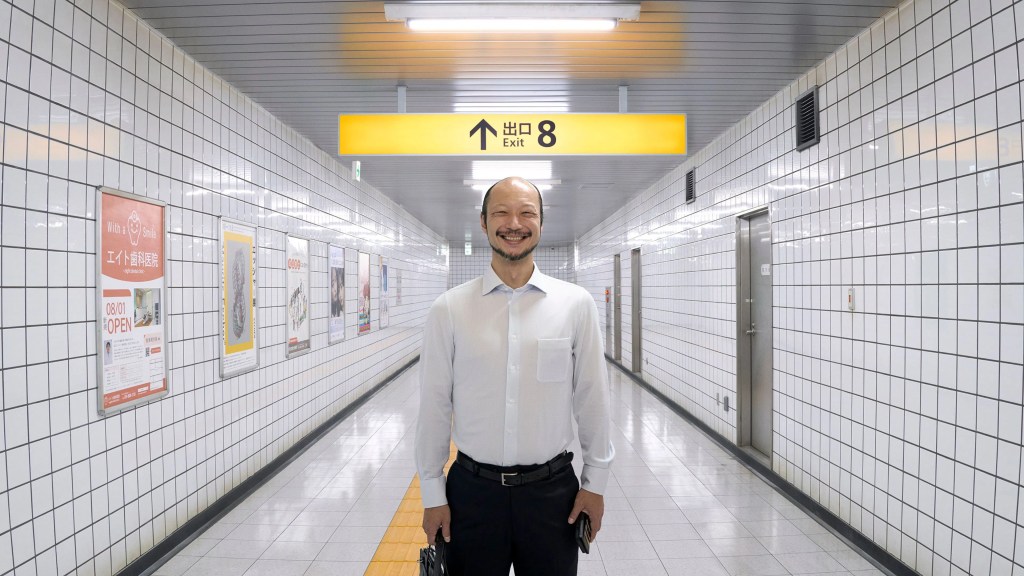

The video game upon which Exit 8 is based is nothing but a simple puzzle in which the player walks through an underground tunnel and must either continue on their way if everything is in order or turn back immediately when they notice an anomaly. If they succeed eight times in a row, they win. If not, they might wind up walking in that tunnel indefinitely. A consummate player typically needs a few minutes to win. The world record stands currently at sixty-three seconds. That’s a shorter experience than having to read this paragraph.
And yet, a movie based on this video game was developed, produced and released. Somehow, someone thought that this gimmick-based video game experience would translate to the screen and add up to something—pardon the pun—passable. How could it? What would it be about?
Good question. What could Exit 8 potentially be about and does it even matter?
Let’s address these issues in order. Directed and co-written by Genki Kawamura, Exit 8 does the absolute bare minimum of storytelling and character-building to give the viewer enough of a reason to stick around for the ninety-five minutes during which they would be watching the screen. It follows a man (Kazunari Ninomiya) who receives a phone call from his ex-girlfriend while on the subway. He learns that he is pregnant and, while wrestling with anxieties of coming to terms with becoming a father, he becomes trapped in a Möbius-like seemingly never-ending labyrinth. What he must do to escape it is to do exactly what the video game entails—turn back when stuff is not right and continue unperturbed when it is. To spice up the narrative and give the movie a semblance of a story structure, we do meet additional characters and occasionally cut to oneiric sequences involving the man’s girlfriend and the like. But on the whole, we don’t get too much of a story here because the game didn’t have one either. Nor did it have any lore tucked behind the couch.
And does it matter that the movie is as straight as a freshly produced cast iron rebar? Absolutely not and this is because the game didn’t care about the story either. What it did care about was the mood, tone and the sense of slowly creeping frustration that accompanies the experience of playing it, especially when you fail to notice that the poster was growing on the seventh pass and you find out that you’re back at square one.
Therefore, even though the game itself couldn’t be classified as a horror, it contained enough creepy and moody elements for the movie to adopt the tone of a cerebral indie horror, in which one might hide additional thematic messaging to give the experience a little bit more girth. Consequently, Exit 8 sort of works and it is exactly because the filmmakers understood which aspects of the gaming experience they needed to reflect on the screen and where they had some room to play and—most importantly—they took the idea of making this movie seriously despite the fact that the central gimmick underpinning the story is silly at best.
Also, in contrast to something like Iron Lung, which is a movie that is similarly adapted from a moody and simple video game experience, Exit 8 knows that its welcome has a short runway and the movie needs to get to the point rather quickly, give the viewer what they came for, maybe ruminate for a little bit about some themes of paternal anxiety and respectfully GTFO. There’s no room for two-plus hours of self-indulgence here and everyone on the creative team knew that from the get-go. Appropriately, the camera quickly establishes and frequently returns to the game’s innate first-person perspective, checks off a bunch of anomalies you might remember from the game, dips its toes into the backstory of the man who walks in the opposite direction and turns some of the anomalies into formally effective jump scares, while maintaining the brooding tone of the game. In and out. Simples.
As a result, if you’re after some thrills and chills, Exit 8 works on this level and supplies the required entertainment. It’s just about fun enough to pass the time and it doesn’t burden the viewer with lore and superfluous world-building nobody asked for. What it does, however, is use its Möbius mind-bending capacity as a makeshift launchpad for whatever esoteric conversations you might want to have on the way home. In fact, if you really want to read into this movie, I think you might be enabled and encouraged by the filmmakers who left enough symbols and breadcrumbs to point you towards a conversation about the Buddhist philosophy, identity crises and paternal anxieties, surface-level as it may be. But do proceed at your own risk when reading into this film because its primary purpose is to suffocate with its mind-bendy aesthetic and send shivers down your spine on at least three occasions. Anything more is entirely optional and subject to personal circumstances.
Taken together, weird as it may be to admit given what this film’s provenance is, Exit 8 is a competent enough piece of moody genre entertainment whose closest cinematic cousin might be the largely forgotten indie classic from 1997 directed by Vincenzo Natali titled Cube. It’s a fun little riddle with just enough meat on the bone to provide sufficient sustenance for the ninety-five minutes of the film’s running time, a few fun moments and an opportunity to peel back the narrative and talk about male emotional intelligence and Buddhism for exactly seventeen minutes tops.





Leave a Reply