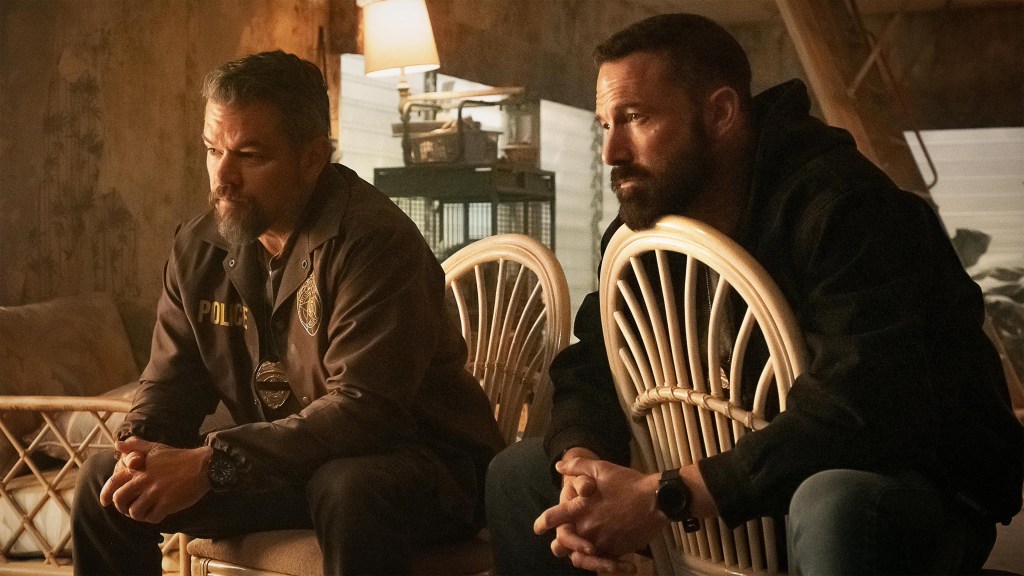
Recently, a number of outlets reported with what I can only describe as a mildly sensationalizing bent that Matt Damon and Ben Affleck have “said the quiet part out loud” and confirmed what everyone has apparently suspected for a while, which is that Netflix enforces strict guardrails with regard to how movies are made on their dime. And here I am wondering if I am the only one out there who’s totally nonplussed about it all and not even remotely surprised by this revelation.
Damon and Affleck have appeared on Joe Rogan’s podcast to promote their new movie The Rip. This is just what people do these days: if you have a new movie or a book to push, you might find yourself booked to appear on a bunch of podcasts in addition to late-night talk shows. And because The Rip is the kind of movie that Rogan’s target audience is likely to enjoy, this is where they popped up and engaged in a freewheeling conversation that ranged from discussing the movie itself and the shifting sands of the movie industry to MMA and martial arts; which is where a lot of Rogan’s conversation end up converging organically. Nevertheless, what they did have to say about how their production company Artists Equity is structured and what it wants to achieve—which involves including everyone involved in production of their movies in participation in profit-sharing—was genuinely interesting. Doubly so because they also shared a few details about how movie financing and profit distribution are arranged for streaming-only productions. In contrast to traditional models that have been the well-established norm for decades, profits at the back-end are predetermined, according to Damon and Affleck, based on viewer engagement, drop-off rates and other metrics relating directly to the time spent watching their movie and tiered accordingly so as to reward the principals (or in case of Artists Equity—everyone on the production team) with increasing bonuses depending on how well the movie does with their viewership.
This is arguably what was the most intriguing about their entire conversation because these details are often not available to the public at all, related incidentally, or in passing. However, what drew the attention of the entertainment press and social media pundits were those comments relating to the ways in which Netflix wants to guide their productions, specifically how they insist on making sure that important plot points are reiterated on multiple occasions throughout the movie because people tend to look at their phones and might space out, and how they want movies structured so that big “money shots” and action sequences were frontloaded into the first 3-5 minutes to hook viewers and increase the odds of them staying and watching the movie in full.
This latter bit isn’t exactly new because it has been reported before that streaming-first productions tend to open in media res and hook the viewer within the first minute. People make up their minds within the first 30 seconds as to whether they’d commit to watching the movie or the show, or if they’d click away and find something else to watch. But that comment about Netflix moguls insisting on altering screenplays to coddle viewers with phone addiction was what ended up reported on the most. In fact, the way this was commented on suggested that we just never expected they’d do that… which is where I ask, “really?”
Maybe we have all been lured to believe that Netflix (and other streaming platforms with their own production arms; let us not limit ourselves here), the industry disruptors that they are, are some kind of a bastion of artistic freedom. I think it’s safe to say that they used to be seen as such, specifically in the early years of their original programming operation, and even more specifically by artists they wanted to attract to imbue their brand with prestige clout. I’m pretty sure they wouldn’t want to lord over filmmakers like David Fincher or Martin Scorsese whose name recognition they were after. I’m equally certain that other directors who struggle these days to find financing using traditional processes would also know how to play their cards right, make sure that Netflix would bankroll their movie and still do mostly what they wanted. In fact, this is what Affleck and Damon said. They were told this was something they needed to take into account, to which they nodded politely and disregarded these instructions completely. Because it’s not news to them. And it’s not news to us either.
I swear to God that sometimes I feel as though we have been going through a technology-induced cultural amnesia of some sort. We have such easy and unimpeded access to knowledge and information that we somehow choose not to retain any of it ourselves because we can always search whatever we’d have remembered back in the day on moment’s notice. And hence I sometimes see people make a fuss over stuff that has been a fact of life for as long as I can remember.
What Damon and Affleck described during their conversation with Rogan was simply what has always been a part of the filmmaking process in Hollywood—dealing with producers, their notes, demands and other lines in the sand. When Billy Wilder and William Wyler were at their peak, these directors had to “edit in camera” because at the end of the shoot they’d be locked out of the editing suite and producers would bring in other people to cut the movie together the way they saw fit. Sam Raimi’s Spider-Man 3 was saturated with superfluous characters because a Sony exec wanted to push toy sales. In Blade Runner, producers insisted on including off-screen narration and altering the ending, all of which Ridley Scott undid in later cuts of the film. MGM folks imposed the framing device in The Wizard of Oz to turn the movie into an extended dream sequence because they thought that audiences wouldn’t buy it as a literal world. And these are just a few examples off the top of my head. There’s plenty more where they came from.
Studio execs and producers have always insisted on making changes to movies, like adding ADR lines to scenes they thought viewers wouldn’t understand, including off-screen narration or even removing entire subplots. Making movies in Hollywood has always been a delicate political dance where directors blessed with a combination of stubbornness and charm with a gentle seasoning of don’t-tread-on-me I-don’t-give-a-fuck-ism would get to make their movies the way they wanted, or at least with minimal compromises to contend with. However, traditionally they’d be fighting against personal whims of well-positioned people or anecdotal guidelines coming from test audiences, which were innately mercurial and unpredictable.
Netflix on the other hand relies on data, which makes the matter look as though this was a novel phenomenon. They have sufficiently vast data sets and models to back what even twenty years ago would have been just an opinion of a guy in a suit. They can tell filmmakers that when a movie opens with an action sequence, viewer attrition drops by a certain percentage. They can tell if the plot is hard to parse or when viewers space out because they can see at which points viewers decide to rewind the film. Equally, this is how they also make decisions as to which productions to back. Famously, House of Cards was greenlit because Netflix subscribers loved (at the time) Kevin Spacey, political dramas and David Fincher, so Netflix guys surmised that combining all three would result in a hit, which it did.
I suppose this is where media outlets and the general public might become a little bit anxious because it looks as though this revelation unveiled another battle line in the ongoing war between human-led expression and technology-first industrialized entertainment. It probably doesn’t take much for folks to add two and two together and extrapolate into a future where all movies look the same because they are made according to algorithms and where artists’ expression is permanently curtailed.
Maybe they’re right to be worried. But then again, we already have many thousands of cookie-cutter movies that predate the advent of tech companies in the film industry space. We never needed data-driven approaches to extinguish artistic visions. We had people do that to other people. And yet, great filmmakers still got to make their movies as they saw fit and not-so-great filmmakers got to make movies that all looked the same.
But I guess, for the purposes of generating clicks and attracting readers based on sensationalizing headlines, it was a good idea to effectively reinvent the concept of a producer’s note and catastrophize about the uncertain future of the film industry. After all, engagement is king in the attention economy of today.

 Flasz On Film
Leave a comment