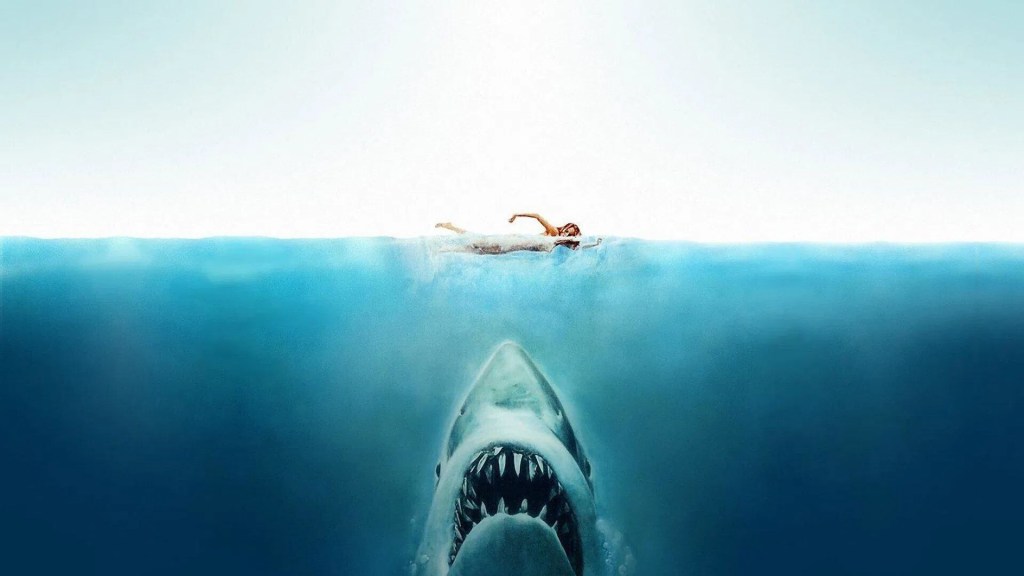
This time fifty years ago, Steven Spielberg’s Jaws was already a worldwide phenomenon. Released on the 20th of June 1975, it steamrolled through the box office recouping its budget, which had ballooned from 3.5 million dollars to 9 million (or 12 million dollars if you remember to include print and advertising as well), within its opening weekend. It eclipsed the domestic revenue of The Exorcist and The Godfather after only seventy-something days in cinemas. When all was said and done, Jaws had ended its theatrical run with nearly half a billion dollars in the bank. In today’s money, this would be equivalent to 2.5 billion dollars, an Avatar-level of success. It was unparalleled and unprecedented.
For many of us, Jaws remains an important movie. In fact, I personally hold it in the highest regard as perhaps the most important Hollywood movie I have ever seen. It was my gateway drug into cinema that I watched when I was perhaps too young to be watching anything like that and, perhaps in conjunction with Raiders of the Lost Ark and Jurassic Park—both of which I saw right around the same time—it recontextualized in my young and impressionable mind what movies could look like. It was magical.
And it remains so, as despite its simple premise—a shark terrorizing a peaceful island community inspires a trio of protagonists to go fishing—Jaws holds a number of conversations within its seemingly tight and lean two-act structure. The script forgoes several complications Peter Benchley’s bestselling source material leaned on and places a lot of its weight on a perennial hero’s journey archetype. Roy Scheider’s Brody must prove something to the town (so as to make them accept him, a New Yorker, as one of their own) to himself (a man with a fear of water stuck on a piece of land surrounded by it), and to his partner (Lorraine Garry), who supports him all the way but still needs convincing that her husband can step up to the plate and protect his family. And in fact, Jaws would have been just as successful if it had leaned into this tried-and-true narrative template upon which it is built. But there’s more.
Jaws is also a conversation about the power struggle between those who need to make hard decisions for the greater good of the community they serve and those who choose to diminish or overlook the threat looming over the community in order to make sure the local economy does not suffer. As the shark roams the waters off the coast of Amity, it threatens the “Summer dollar” and brings in a real prospect of the islanders having to starve through the winter if beachgoers choose to go elsewhere. This is perhaps the aspect of the movie that has been rediscovered in recent years, because it mirrors perfectly the powers tussles that we witnessed first-hand during the COVID pandemic, as many leaders chose to gamble with people’s lives to save the economy instead of gambling with the economy to save people’s lives.
And then, there’s also a conversation about class, which comes to the fore when Brody, Hooper (Richard Dreyfuss) and Quint (Robert Shaw) head out to sea to hunt down the killer shark. Awash in subtle comedy and tirelessly and effortlessly flinging between levity and sombre sobriety, Jaws leaves ample room to talk about the friction between the blue-collar been-there-done-that Quint with his lewd songs and tales of adventure and the wealthy know-it-all Hooper with his gadgets and academic wherewithal, with the frazzled fish-out-of-water civil servant Brody trying to do the right thing, attempt to fit in and keep his eyes on the prize.
And then, of course, there’s the bountiful conversation about the magic and woes of this movie coming together. Between the tales of horror about mechanical sharks not working, sinking barges not sinking, the not-supposed-to-sink boats sinking, fighting to keep the horizon steady and free of boats, having to ask extras to bathe in frigid ocean water and pretend they were having a good time at the beach, the costs ballooning with each passing day, Robert Shaw realizing he would not make a dime off this picture because he’d end up owing the IRS a fortune, great acting opportunities flying by the principal cast members as they were stuck on Martha’s Vineyard for endless months, crew members going on strike and much more, the simple idea of recounting just how incredible the feat of putting Jaws together is enough to engender plenty of interest. After all, nothing of this scale and magnitude had ever been done before. Nobody had filmed a movie so complex on open water. Nobody had ever attempted to build life-sized animatronic sharks and have them work. Nobody ever attempted a tonal shift of such magnitude between a clearly Hitchcockian first half of the movie scored with Stravinsky-esque grit, and a seafaring swashbuckling adventure feel of the latter half of the movie. In any other people’s hands, Jaws would have looked like two miniature movies forced to cohabit against their will, but the filmmakers somehow made it look like it all belonged together.
In fact, we tend to either forget or completely overlook that underneath all these plentiful conversations surrounding Jaws lies a simple truth that this movie was special (partly for having the capacity to hold them), and more specifically, why it was so special that it was so special. The movie is often credited with inventing the modern blockbuster and reshaping the landscape of film entertainment by simply showing the world (and Hollywood moguls) just how much money was there on the table for those who knew how to rake it in and had the right tools to do so.
It was an example of a great gamble—banking on a simultaneous nationwide release during the summer season (and in 1975 it wasn’t natural for Hollywood producers to see it as a time for big movie releases; this was reserved for Christmas)—as it required incredible frontloading of costs. After all, when you release across four hundred and fifty screens, you need just as many prints. And if you spend so much money on printing so many copies of the movie, you need to make sure to advertise it well enough for people to know that they need to show up at the box office and buy a ticket. Thankfully, Benchley’s book had been a juggernaut bestseller and the multimedia campaign (radio, TV, print ads, billboards, you name it) that you wouldn’t be wrong to call “viral” made Jaws into an event. First of its kind. A singularity. But the genius of it all lies not necessarily in the fact that it simply happened, but because it happened when it did, perhaps serendipitously to an extent and maybe partially by design, helped by the cumulative hunch the filmmakers had exhibited.
The release of Jaws happens to divide the decade neatly in half. In more ways than one, mind you. There’s a clear “before Jaws” and “after Jaws” and that’s not merely an observation of the fact that the movie made so much money and that its release gamble was so successful that there was no turning back for studios like Universal, Disney or MGM that had either eschewed most of the New Hollywood craze or hadn’t had the first clue how to capitalize on it and strike the post-Bonnie and Clyde iron while it was nice and hot. It was a cultural moment that both acknowledged what the New Hollywood brought to the cultural conversation while also reminding the audiences about the reason why people used to go out to cinemas back in the day, which was to allow themselves to be swept away into the neverland of moviemaking magic.
Ever since Warren Beatty and Faye Dunaway had taken over the box office with their chic bank heists and the down-and-dirty aesthetic courtesy of Arthur Penn’s nouvelle vague direction, a new era dawned in Hollywood. With musicals, epics and western becoming increasingly out of step with the moviegoing public, it was the time of counterculture led by maverick directors and enabled by culturally switched on studio executives at Paramount, Warner and United Artists. This was the time when Francis Ford Coppola, William Friedkin, Brian De Palma, Martin Scorsese, Peter Bogdanovich and many others took over the Hollywood cockpit and began dictating the terms of what constituted good entertainment.
Gritty realism, uncompromising direction and incredibly personal storytelling drove the successes of such films as The Exorcist, The Godfather, The Last Picture Show, The French Connection, M*A*S*H and Mean Streets. Masses flocked to see those inarguably great movies as they offered a much-needed respite from the bloated glitz and predictable fare of what movies used to be. However, it wasn’t exactly the case that the entire Hollywood establishment got turned into its new iteration. While The Godfather, Chinatown and Five Easy Pieces gave disenfranchised youngsters a chance to watch stuff they loved, the “old” Hollywood didn’t remain idle either. It evolved in different ways.
With the release of Airport in 1970—a movie that ended up being the second-most commercially successful project of its year behind Love Story—the old guard found a way to adapt to changing times without necessarily doing much. After all, if you ever sit down to watch Airport, you will see that it bears no resemblance to other successful movies of its time and in fact it looks as though it stood in stark opposition to the New Hollywood aesthetic. It’s a thoroughly 60s picture that ended up spawning an entire microgenre of disaster movie that ended up ruling the box office with such hits as Earthquake, The Poseidon Adventure, The Towering Inferno and Airport 1975, all the while the cheap-to-make New Hollywood darlings rode the critical wave and shaped the culture around movies.
By 1975, both cultural traditions—one rooted in the idea of adapting to changing times by course-correcting and the other based on the wholesale rejection of the old status quo—had reached their apex. Sure, in 1976 we’d still see Taxi Driver and Airport 1977 register a strong response at the box office, but it has to be acknowledged, specifically with the benefit of hindsight, that the writing was already on the wall by then. Sure, a movie like Nashville, which arrived mere nine days before Jaws, is considered by many to be the pinnacle of New Hollywood, but it may also be seen as the first of its many last gasps.
Cultural trends don’t often die of sudden cardiac arrest. Instead, they are more likely to succumb to cancer over a longer period of time. While it is common to point at Apocalypse Now! and Heaven’s Gate as the movies that doomed the New Hollywood movement, I think it’s safe to acknowledge that when Nashville opened in the summer of 1975 and saw extremely low interest from the audiences who chose to go and see Jaws instead of a nearly three-hour long dissection of the American society laden with country music and crowded with Altman’s signature ensemble acting and proto-mumblecore directorial method, the shift in the cultural mood had become apparent. Even Altman himself recounted years later when asked about the box office failure of Nashville that he didn’t have a shark or King Kong to attract viewers. Which is true but also indicative of the simple reality that by the halfway point of the decade, viewers simply wanted different things. And Jaws gave these different things to them in spades.
What I think remains largely unappreciated about the spectacular success and importance of Jaws is the way it managed to capture the essence of both the old and the new Hollywood and packaged it all into a single cinematic experience. And this in great may respects is owed to the acumen of the guy at the helm of the project—Steven Spielberg.
Much has been made of the auteur theory and how a single person’s artistic vision drives the production of a movie, but very little is ever said about the way in which this vision materializes on the screen. In a big budget Hollywood movie, it is not for the director to go and micromanage all the aspects of the production (though there are filmmakers who insist on doing so), but rather to hire the team that is best positioned to execute on the vision behind the film, convey the message to the team, empower them to hire their own teams to fulfill the mission, and also to convince the financiers that the mission is worthwhile and that it will make a sound return on their considerable investment. In short, a big studio director has more in common with a company executive. He or she is a movie CEO. Meanwhile, when it comes to smaller movies where the director has no other choice but to get involved in many more aspects of the filmmaking process, they have more in common with a small startup entrepreneur, a jack of all trades wearing many hats on the job.
Jaws was no startup venture, though. It was a big S&P500-listed company that needed to be driven with the acumen of a seasoned executive. However, it was such a long shot with its incredible demands on the production process that it required a visionary approach of a small startup CEO, too. If Jaws was a company, what it needed was a Steve Jobs-type to drive it; a guy who could see what others didn’t and could surround himself with people who had what it takes to deliver on the mission. That’s who Steven Spielberg was: a twenty-six-year-old visionary who also happened to be culturally bilingual.
After all, Spielberg was not a movie brat. He dropped out of film school and found his way into the movie industry through television. He rose through the ranks the way old studio hands did in the 40s and 50s. But he also hung out with the likes of Scorsese, De Palma and Schrader. He spoke their language. He watched their movies.
At the same time, he also knew how to work with the money folks. He was proficient in studiolese. This cultural bilingualism was just the right skill for him to find himself right at the time when the New Hollywood and the disaster microgenre had begun their downward slope while still holding considerable sway over the public and crashed them into each other as though they were two hadrons traveling at light speeds at the CERN Large Hadron Collider. He took Peter Benchley’s story and hired the right people to shape it into what in great many respects builds on the tradition of a disaster movie (which is also why it was so easy to reinterpret it as a pandemic movie during COVID) and banked on crafting bona fide studio magic by building a working shark.
At the same time, he insisted on shooting this movie on open water and not in the tank, as though to tip the hat to the Friedkin school of go-out-do-cool-things-and-film-them moviemaking and surrounded himself with the artistic team that would give the movie a realistic New Hollywood sheen. This included Verna Fields as the editor who had worked with Peter Bogdanovich and Bill Butler as the director of photography, together with Michael Chapman as the camera operator, who had worked with Coppola and Hal Ashby. It was a creative team rooted in the desire to bring the two strands of Hollywood moviemaking together under one roof to deliver something truly special—a singularity.
In cosmological terms, a massive black hole can form when a sufficiently large star runs out of fuel and collapses under its own gravity. It can also happen when two sufficiently large stars that are also old enough to be called supernova-ready collide with each other. By 1975, the New Hollywood and the disaster genre-driven evolution of the old guard where such supernova-ready entities and Spielberg’s Jaws brought them into close enough proximity to create a spectacle like nobody had ever seen.
Even the movie itself illustrates this sentiment in the second act of the story when the three men head out to sea with the mission to catch the man-eating shark and save the Amity community. You can clearly see that Quint’s Ahab-like character represents the world of the old. He’s a seasoned fisherman and a shark hunter who relies on instinct, tried techniques and hard graft. He looks at technology and science with suspicion and thinks that a shark can only be defeated with Hemingway-esque manliness. He’s Old Hollywood, the world of this-is-how-we’ve-always-done-things. Meanwhile, Hooper represents the new world. He’s George Lucas, a guy who thinks that gadgets, technology, science and logical understanding of the world will deliver them their much-needed victory. Both Hooper and Quint puff out their chests and engage in what many have deciphered as class warfare. Meanwhile, it can also be seen as a conflict between the New Hollywood of American Graffiti and THX 1138 and the Old Hollywood of Ben-Hur and The Sound of Music.
However, what matters is that they are both unsuccessful. Quint’s harpoon isn’t enough for the shark. He becomes completely discombobulated by the animal’s raw strength as it refuses to yield to the multiple barrels shot into its body by the seasoned shark hunter and nearly capsizes the boat after being tethered to its cleats. He looks at Hooper and asks if he has any good ideas in a tacit acknowledgement that the ways of old would never be enough to conquer the beast. The problem is that Hooper’s shark cage and a strychnine-loaded harpoon fail to deliver on the mission too. The shark eats through the cage with ease and forces Hooper to seek cover at the bottom of the ocean having lost his poisoned weapon.
This leaves only chief Brody to fight the shark, especially after Quint’s utterly gruesome demise (which is also a truly unforgettable scene). Up to this point, he had been a quiet student of both men. He listened intently and learned about the tradition of shark fishing from Quint and the scientific background explaining its biology from Hooper. He never had what it takes to participate in the scar-comparison contest (another amazing scene culminating with Quint’s iconic USS Indianapolis speech) but when pushed came to shove, it was Brody who delivered. And how did he do that?
By embracing both worlds. He understood that indeed he needed a bigger boat. The shark wouldn’t be defeated with indie resources or without creativity. He used Hooper’s technology and gadgets (an oxygen tank he stuffed in the shark’s mouth) and then had to resort to a Quint-like man-versus-beast showdown. He couldn’t afford the safety of a shark protection cage. He had to get wet and expose himself to mortal danger to get the job done. What resulted was an epic flurry of blood and guts, an explosive ending to the man-eating beast.
And by now you must understand that Brody and Spielberg are the same person.
He was the guy who looked at both worlds, took the best of them and conjured up a whole new entity. He took two supernova-ready stars, crashed them together and created a cosmological singularity, a blockbuster explosion of galactic proportions that gave birth to what is now a supermassive black hole of blockbuster entertainment; one that dictates the terms of what gets made, what’s successful and what isn’t. And that’s on top of fashioning the short-lived subgenre of animal attack horror that took over Hollywood and making sure that Zanuck and Brown would turn Jaws into a film series itself (which is way more fun than people think, by the way).
The invention of the blockbuster was not only about the money Jaws made, but what it took to make a movie that could in fact become an overnight sensation and the biggest hit of all time… until George Lucas came back with a vengeance in 1977 with Star Wars to seal the deal and to chart the course for Hollywood moviemaking for several decades.
That is in my opinion the true legacy of Steven Spielberg’s Jaws.




 Flasz On Film
Leave a reply to Uncut Gems Podcast (July 2025 Round-up) – Flasz On Film Cancel reply