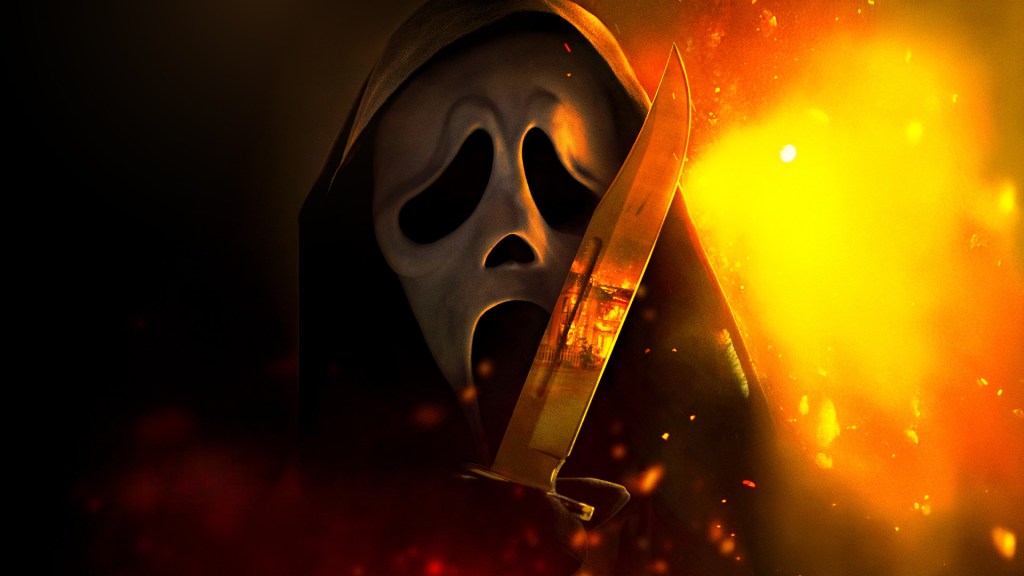

As is the case with any longstanding franchise in the horror genre space, or any genre for that matter, it was merely a matter of time before the Scream series originated by Wes Craven and Kevin Williamson would run out of road. And it just so happens that the wheels would come off in the year when the original Scream is turning thirty. But that’s not necessarily precise because those wheels fell of long before the movie saw the light of day.
Scream 7 became a mess long before the cameras rolled. In fact, some would say that the previous installment was already a herald of incoming disaster because Neve Campbell, the most prominent scream queen of the 90’s slasher revival era, refused to come back after Scream 5 following a pay dispute. Therefore, Scream 6 sported a few throwaway lines about how Sidney had to go into hiding to explain her absence. But the real bunker-buster that turned the production of Scream 7 into a swirling vortex of chaos came later.
It had already been on the cards that the directors of the two revival movies in the franchise, Matt Bettinelli-Olpin and Tyler Gillett, would not come back to direct Scream 7, as it would clash with their work on Abigail. Instead, Christopher Landon (Happy Death Day, Happy Death Day 2U and Freaky) was going to step in and finish the assignment. And the assignment was to turn the seventh movie in this long-running series into a mini-finale of the Sam Carpenter Trilogy. But this became impossible when Melissa Barrera who played Sam Carpenter, Billy Loomis’s daughter, was fired from the production for political reasons. She had been a staunch opponent of Israel’s brutal war in Gaza that the UN themselves characterized as potentially genocidal and Spyglass Media Group who produced Scream 7 saw Barrera’s pro-Palestine stance as antisemitic. Whether leadership at Paramount was involved in any way in this decision remained unclear.
Furthermore, Jenna Ortega who played Sam’s half-sister Tara, quickly left the production as well. The initially reported reasons suggested scheduling conflicts with her work on Wednesday, but Ortega quickly set the record straight. She left Scream 7 out of solidarity with Barrera. Consequently, any idea of finishing the Carpenter storyline and retaining even a semblance of narrative continuity—something that the series thus far had been mostly successful with—was for the birds. Shortly thereafter Landon also bowed out. The movie he had signed on to direct was no longer happening.
At this point, the production of Scream 7 was in peril. Many standalone projects would have been mothballed or at least delayed if they had been hit with so many setbacks in such a short space of time—and I even forgot to mention pre-production delays on account of the industry-wide SAG-AFTRA strike action, which most definitely added insult to injury—but in franchise land rules tend to be different. I can only speculate but it wouldn’t be uncommon for franchise rights being at stake (if you don’t produce a movie within X years, the rights revert to [insert whoever]). Additionally, a certain degree of nonchalance might have been present in the mixture too because how hard can it be to put together the seventh movie in this franchise? It’s not rocket science, is it? Many other horror series suffered through such setbacks: Halloween: The Curse of Michael Myers was a production battlefield; Saw 3D was supposed to be two movies and ended up merged into one. Ideas can be nixed. Decisions can be retconned. Hell, characters can be brought back to life if they’re needed or euthanized as appropriate between movies. In the world of long-running genre series there is but one rule—the show must go on.
And go it did. Producers got on the phone with Kevin Williamson and asked him to direct… despite the fact that he hadn’t directed a feature film since Teaching Mrs. Tingle in 1999. And that movie was a total misfire too. Now, this is not the time or the place to pick it apart, but the point stands that as much as Williamson is a screenwriting powerhouse, his directorial CV is awful slim.
It was however enough to convince Neve Campbell to come back to the fray. Either that or Spyglass and Paramount agreed to pay her the kind of money she was owed as the de facto driving force of the entire series. The screenplay was binned, Barrera’s character completely excised from recorded history and a new story was quickly thrown together. After all, the clock had started long before all those personnel changes, which meant there was no time for dillydallying, let alone subtlety.
And that’s how we found ourselves here. Scream 7 saw the light of day and—surprise, surprise—it is a hot mess. Absolutely nothing in this movie coheres or even pretends to make sense. After a cold-open sequence meant to bring us back to 1996, specifically to Stu Macher’s house where the final act carnage took place, we re-unite with Sidney and her family. She now has a daughter Tatum (Isabel May) who’s just about the age Sidney was when Billy Loomis and Stu Macher took it upon themselves to terrorize Woodsboro. And because this is a Scream movie after all, another Ghostface killer turns up in their neighborhood with murder on their mind.
What follows is both predictable and somehow haphazard. Sidney needs to protect her family, Tatum needs to come out of her mother’s shadow and become the kind of fighter everyone around her thinks she should be, Gale Weathers (Courteney Cox) turns up to help flanked by the two remaining carryover characters from the previous movie, Chad and Mindy (Mason Gooding and Jasmin Savoy Brown) and the hunt begins. Oh, and it all looks as though Stu Macher (Matthew Lillard) is somehow back from the dead and that he might be responsible for the killing spree. Or partially responsible. We all know that it’s almost never a single person behind Ghostface’s mask. Or… it could be AI. It’s 2026 so if you need to retcon a few things and plug a number of plot holes—AI. Need a red herring? You guessed it. AI. What it buys you is the caché of getting a beloved actor to come back to reprise one of his most iconic roles, which I am told works when it comes to getting butts in seats.
What it does, however, is it lobotomizes whatever semblances of logic one could expect ouf of any movie with a number 7 in the title. Because—let’s be honest—nobody should really come to the cinema thinking they are about to watch A Nightmare on Elm Street or The Texas Chain Saw Massacre. The ceiling of what’s possible in Scream 7 is much lower and it’s naive to expect anything inspired, especially in light of all the chaos behind the scenes. I was happy enough that the camera was on and pointed at the actors and that the sound was in sync. That was the bar I set for this movie.
And even with all those mental accommodations, Scream 7 remains a bizarre mess. Sure, it’s fun to come back to this franchise and experience the Ghostface terror once more, just as it is always fundamentally cool to see Michael Myers or Jason Voorhees make an appearance in their respective franchises, but nothing really makes sense in here. Scream 7 doesn’t sport a single meaningful sequence of the kind we have seen plenty of in the original Scream, Scream 2 or even Scream 5. Because the scare factor is no longer there—partly thanks to those pesky franchise-wide diminishing returns and partly because Kevin Williamson lacks directorial confidence and insists on wholly non-diegetic boos and jumps—what we are left with is flimsy character work scribbled hurriedly on a napkin by James Vanderbilt and Guy Busick and the series mainstay meta-commentary.
On the former, there is something theoretically intriguing about the idea of establishing a new relationship between Sidney and her own teenage daughter, who even tries to fashion herself after her mom. In that, the movie makes a handful of nods towards Scream 2: Tatum wears her mom’s leather jacket from the movie and a few narrative beats are vaguely symmetrical as well. Tatum rehearses for a school play when the murder spree begins, which is what Sidney did in college. However, while Sidney played the lead role of Cassandra in her play in Scream 2, Tatum plays a dog and her character has only one line. And in direct contrast to the 1997 movie, the play’s director expresses nothing but disappointment in Tatum’s perseverance and character resilience, directly outlining the arc for her to embark on. This is a genuine highlight, even if it remains hidden under a think blanket of who-gives-a-toss that the rest of the movie comprises of.
When it comes to meta-commentary, this is where you are presented with a choice as a viewer. If you rely solely on what’s presented to you in the movie, then Scream 7 will count as the least interesting out of the entire series when it comes to its stance on its own existence. Instead of pulling back and acknowledging the precarious place of this movie in the series—and any seventh installment in any given horror series would have been aware of its own perilously short life expectancy at such a juncture—Williamson and the gang return to the well and retreaded the ground covered in previous movies. This is cute only in so far as it is cute to see how scenes involving Tatum synergize directly with appropriate moments from the 1996 Scream and its follow-up (both of which were written by Williamson). But Scream 5 had done it already. This is a clear-cut case of uninspired filmmaking. Let’s put anything in the series commentary space. I don’t know. Whatever. I don’t care that it’s unoriginal or that it’s a rehash of something we have done as recently as four years ago. We have a deadline to hit. Chop-chop. Can we put characters in an enclosed setting and remind the viewer about the rules of horror movies and how everyone is a suspect?
Instead, what the movie ought to have done—and this is an opportunity for any franchise fan to do some coping post-fact rationalization—was to pull sufficiently far away to acknowledge the simple reality that the seventh movie in any franchise would become ridiculous and repetitive, or that it would ignore its own rules and retcon a bunch of things because of political reasons behind the scenes. This has happened before and the horror geek squad wishing to uncover who the killers were this time round should have been able to outline it for the benefit of the audience. Problem is that they didn’t.
Which is where you might be able to step in and explain this omission by way of acknowledging yourself that this is just what happens to horror franchises that have been around for long enough to develop these cancerous problems. You could see it as charming that a series thus far mostly resistant to logic-based criticism—for reasons I might explore on a separate occasion—would still fall victim to this affliction. Everything gets old and even the series that have been de facto rebooted for modern nostalgia-driven markets—like David Gordon Green’s Halloween trilogy—can only do so much. The fact that Scream 7 is a mess is not an accident but a natural consequence of surviving for thirty years without formally rebooting the franchise.
However, this realization does not excuse the very binary reality in which a movie like Scream 7 exists whether it likes it or not. Mess or not, the movie is either fun to watch or it isn’t. And on the whole, Scream 7 simply fall short. Not quite because of its continuity issues or its uninspired and refried commentary, but rather because nothing is scary, compelling or exhilarating. And most importantly, the storytellers failed to capitalize dramatically on the film’s core: Tatum’s journey of self-actualization and Sidney’s acknowledgment that in order to move on, she’d have to pass the baton to her own daughter and trust that she’d be prepared to face masked killers on her own. Believe it or not but Scream 7 harbors this drama somewhere beneath the uncouth mess of haphazard plotting, uninspired villain choices and that truly abysmal decision to drop AI somewhere into the plot, only because it’s culturally relevant, it gives a bunch of actors an opportunity for a cameo performance and—if pushed—you can use it when the script eventually paints itself into the corner. Which it does. Repeatedly.
And that’s how wheels came off the Scream franchise on the precipice of the thirtieth anniversary of the release of its progenitor. Shame.
 Flasz On Film
Leave a comment