
Before I go any further—and at this point I can’t promise you anything because I might black out while typing—I just want to make an important clarification and state that the star-rating you see above this text is not supposed to be interpreted as a fiver, the highest distinction I could muster. In fact, it’s just the opposite. I have decided to award the Timur Bekmambetov-directed Mercy a grand total of zero stars out of five. For context, the only other time I remember doing so was almost exactly five years ago when I had the displeasure to sit through Songbird, an escapist pandemic movie that was so tone-deaf, ill-timed and braindead that I could not fathom how it was allowed to ship.
So, yes. Mercy is an absolute travesty. I’d like you to know that upfront. In fact, this film was so bad that I had to actively fight the fight-or-flight urge to leave the cinema in protest. The only reason I stayed was to be able to sit down and plop a thousand words down on the subject, which I knew was going to be a piece of cake and oddly pleasurable. I guess being able to sit down and pour vitriol on a terrible movie made by people who should have known better—this is an important distinction by the way—is what I assume a bottle of cold beer on a Friday night is to Boomers and Gen-X-ers. I don’t know. We don’t see eye-to-eye, alcohol and I.
And here we are. Mercy was directed and produced by Timur Bekmambetov and just the mention of this name alone should prepare you for what’s to come. That’s because Bekmambetov is probably the world’s staunchest supporter of what’s known as a “screenlife” movie, a narrative gimmick of telling a story that takes place exclusively on someone’s computer screen. Granted, he directed only one such movie before (Profile), but he produced a good handful, including last year’s remake of The War of the Worlds starring Ice Cube, which I still want to see out of nothing but morbid curiosity.
What I can only surmise happened based on the limited information available and my own dot-connecting skills, which may or may not amount to complete hogwash, is that Bekmambetov got together with his pals, one of whom must have been Marco van Belle who wrote the script for this film, and imagined that they could potentially convince Amazon MGM to give them a pile of money to make a movie that looks as though it was going to be timely, topical and fun. They got Chris Pratt (who has already starred in a few straight-to-Prime productions) and Rebecca Ferguson and decided to make a movie that would be the next evolution of that screenlife gimmick. On top of all that, it would be a blood-pumping action thriller in a futuristic setting and it would all be revolving around the incredibly timely topic of artificial intelligence. Great idea on paper. A lot of boxes ticked. Two thumbs up from data analysts who think that culturally relevant ideas are somehow additive and capable of synergistic amplification.
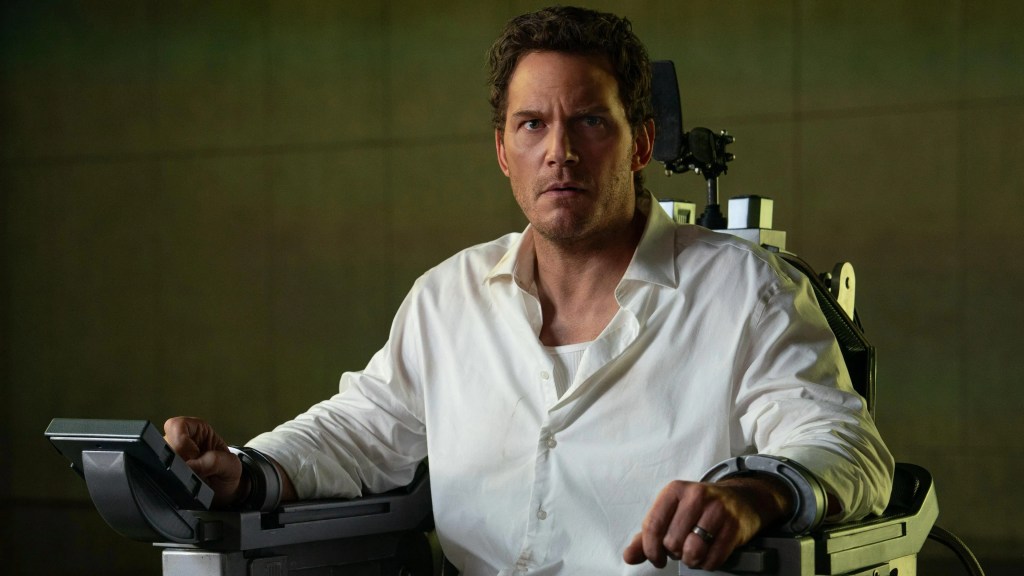
Thus, I found myself in a dark room watching a movie where Chris Pratt wakes up without his shoes, strapped to what looks like an electric chair in an empty room and a totally enveloping screen in front of him. He is greeted by Rebecca Ferguson who introduces herself as an AI judge and tells the totally discombobulated Pratt that he is being put on trial for the murder of his wife. Which he obviously doesn’t remember. And also, because one of the keywords required for this movie to have been green-lit must have been the word “dystopia,” the whole conceit of his predicament is that he is not assumed innocent until proven guilty or that the burden of proof lies with the prosecution. It’s the opposite. He’s guilty until proven innocent and he must find evidence to support his innocence from the discomfort of this electric chair before ninety minutes runs out and he gets taken out like a cow in a slaughterhouse, or something.
And off we go. Wait. No. No, we don’t. We spend the entire time fettered to Chris Pratt as he effectively uses futuristic technology and magic to navigate an action movie from his chair, gets in touch with witnesses, finds clues, extracts video evidence and finds a narrative that will be strong enough for Rebecca Ferguson to let him off the hook. And it’s so damn laughably ridiculous that it honestly beggars belief that someone looked at the finished product, nodded in approval and congratulated the filmmakers on a job well done.
As I said at the top of this piece—rarely do I see movies as braindead as this one, especially since it’s not a micro-budget indie made by first-time filmmakers who were learning on the job and made rookie mistakes because they didn’t know any better. This is a high-profile Hollywood production with a budget of sixty million dollars, backed by one of the biggest studios out there, and starring one of the most bankable actors of our time. And it looks as though nobody—I repeat: nobody!!!—ever paused for a second to make sure that the movie they were making and the narrative they were building made fundamental sense. Or that it at least succeeded in temporarily suspending viewer’s disbelief, which is a must for a film that (1) takes place in a dystopian future, (2) happens to utilize a formal gimmick that requires extra legwork on behalf of the viewer to ensure complete immersion, and (3) aspires to disrupting the action movie template.
None of that was in operation here. Absolutely nothing makes any logical sense and neither do the actors try to convince me by dint of their own investment in the lines they allow to leave their mouths. Every single problem the story encounters—and these are fundamental problems found in murder mysteries and conspiracy thrillers, so no new ground is being traversed here—is solved with magic. Or technology. In fairness, it is one and the same. Wasn’t it Arthur C. Clarke who said that any sufficiently advanced technology is indistinguishable from magic? There. Magic it is.
Oh, we need access to someone’s phone records. The AI judge says “abracadabra” and we’re there. We need to track a suspect. Don’t worry, we have magic for that. We need to communicate with someone inside a truck. Can we speak to them through their car infotainment and read their lips in real time? Sure. How? Magic. And AI. It is honestly as though all of the movie’s main narrative solutions were inspired by tech executives who never speak to their engineers and think that every problem in the world can be solved with an AI wand. And maybe this will be a fact of life in 2029 when the story takes place, but I think I need a little bit more artistic creativity to believe that for the purposes of following a character who’s strapped to a chair and forced to participate in a screenlife experience—which makes me a second-hand movie-watcher in this scenario because I was asked to watch someone watch a screenlife film against his will, but I was the fool who paid for the ticket; so the joke’s on me—and somehow buying into the outlandish conceit supposing that his life is somehow in danger than simply because Rebecca Ferguson says so.
Sloppy is what Mercy is. Incredibly sloppy. It is as though the only reason to make this film, apart from indulging Bekmambetov’s insatiable screenlife fetish, was to either appease a set of algorithmic commandments imposed from the top, all suggesting that a movie like this would statistically do well, or—which is where I’m going to put on a slightly conspiratorial tone—because it is supposed to play as an engineered tech-bro backlash aimed to push against the cultural clapback against the rise of AI and technology encroaching on our lives. Could it be that the idea to make Mercy came from the very top, much like directives to make patriotic war movies would trickle from the highest echelons during World War II to keep the public whipped to do their patriotic duty?
After all, not too long ago the CEO of Microsoft ranted in an online article against the use of the word “slop” to describe AI-created content, presumably as an inopportune retort to “slop” being chosen as the word of the year by a number of journalistic outlets. What a silly thing to have done. Predictably, the Internet mob responded en masse by renaming Microsoft as MicroSlop, as though to remind that silly executive that stamping your feet and making demands of anonymous crowds of Internet users would only result in an even bigger backlash. Newton’s third law of dynamics says hello.
So, maybe Mercy is specifically designed to desensitize viewers to the incoming rampant adoption of technologies that are essentially indistinguishable from magic while also acclimating us to the fundamental take-home message the movie leaves us with: that AI and humans can make mistakes and it’s OK apparently. We can forget the ninety minutes we spent looking at a shoeless movie star frantically making video calls, emoting like a replicant and delivering lines that make George Lucas’s writing look comparable to Eugene O’Neill, and navigating the Internet using an AI agent because he was staring down the barrel of that very AI agent happily making a mistake and executing him for a crime he didn’t commit.
Therefore, it is a possibility that someone in a position of influence at Amazon MGM decided that it’s time to attack those AI vegans and go on a bona fide propaganda campaign by way of making a movie that involves me staring at a guy re-enacting The Fugitive through a futuristic-looking interface and where by the end of the film we are supposed to be happy that AI had a change of heart, or something.
I see what you guys are doing. And here I am telling everyone that Mercy is a completely unwatchable—and this is not a hyperbole—piece of shameless slopaganda and everyone involved in making this movie and setting fire to sixty million dollars that could have been used to do literally anything else should hang their heads in shame.



 Flasz On Film
Leave a comment