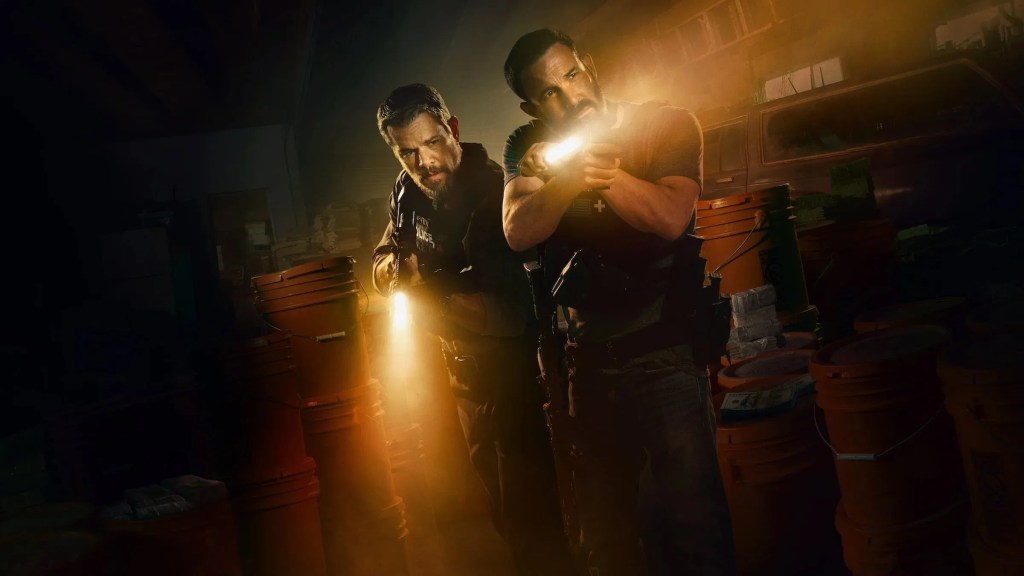

January is one of those few months in the year when dad movies briefly come out of hibernation, visit upon our cinemas and greet us with a musky “bonjour.” This is the time when you should be able to sight Jason Statham in a movie like The Beekeeper or A Working Man. Gerard Butler might come out of hiding to make sure that the [Insert Noun] Has Fallen series would not fall. Topically, this year at least in the States he is surviving the apocalypse in the sequel to Greenland. Blockbusters are fast asleep. Most of the prestige stuff is out of the way and this is the only time in the year—some would call it a dumping ground—to reliably revive old-school action thrillers as financially viable programming instead of treating it as counter-programming to tent poles, box office juggernauts and other dollar magnets.
Therefore, I would have expected a movie like The Rip, which is directed and written by Joe Carnahan—a man with enough clout to pull elder Millennial and Gen-X dads out of their houses and into the cinemas; after all, he did direct The Grey and Narc—and also stars the dynamic duo of Ben Affleck and Matt Damon to make its way to the big screen, especially when its release was scheduled for January. No such luck though. Netflix guys only reserve the privilege of theatrical exhibition—and presumably only under duress and because otherwise awards bodies would give them funny looks—to a small selection of their prestige fare.
Thus, The Rip, a simple and fundamentally archetypal cop thriller about rough-and-ready police veterans, cartel money hidden in houses in Miami and conspiracies of silence, was made available to us just a few days ago as homebound counter-programming to a grand total of not-a-whole-lot that is currently playing theatrically. And predictably, it became an instant streaming hit. However, it is still hard to determine what that means because we have to rely on the goodwill of Netflix PR folks and trust that the numbers they share with the public at large are not totally made up. So let’s assume that it is true and The Rip did truly hit the ground running and saw millions of people click on it and refuse to click away for the duration of the entire movie, much like they did for Rebel Ridge, The Gray Man or Extraction.
In truth, it was always bound to be a single-quadrant hit aimed specifically at adult males. It’s the kind of movie that David Ayer used to make before he signed on to direct Suicide Squad and slowly embraced that glitzy and campy post-Joel Schumacher aesthetic that for the most part has divided audiences. It’s a hard-graft cop thriller that is simple in its premise and executes exactly on what it promises. Nothing more, nothing less. No ambitions to reinventing the wheel. No gimmicks. Small scope. Sharp focus on relatable character archetypes. Believable dialogue aiming squarely to resonate with viewers who enjoy that twilight zone between realistic authenticity found in Michael Mann films and mildly escapist expressionism elevated with micro-dosed camp found in straight-to-video fare from the era of home video rentals. And it all predictably builds, through deliberately paced tension accumulation, towards a satisfying and action-laden climax where loyalties are tested, guns are fired and squibs ruin everyone’s clothing.
As someone who finds himself in the very demographic this movie is trying to titillate, The Rip is the kind of fun I dig. And I’ll tell you more: this is the kind of movie that is so easy to put on and watch—a dad equivalent of what Frozen did for little girls—that I won’t be surprised if I end up periodically revisiting it just for the hell of it, or at least to half-look at it while I get on with cooking dinner or something. This is the kind of robust and recyclable hit The Rip is. It’s not here to win awards or break new grounds but to remind those of us who are either old enough to remember those kinds of actioners or who innately gravitate towards them regardless of their age that these mid-budget adrenaline-soaked cop procedurals are still perfectly viable and fun.
And as I was watching this movie, all I could think of was that it would have been so much cooler to see it theatrically. It would have rocked to have been able to prance back home on a frosty January evening, just a few pounds lighter from that nostalgia-induced excitement at having interacted with a living fossil that happens to be my jam. The Rip could have been the perfect counter-programming to everything else that’s playing theatrically right now. In fact—and this is a more general comment with regard to streaming—it would have vastly benefited from a theatrical exhibition for at least two reasons.
First of all, the final act of the movie when things get hot and action gathers momentum would have registered as more enveloping and compelling on a massive screen with great quality sound to boot. And secondly, because a lot of the film is shot in dimly lit interiors and at night, what tends to happen while watching the movie on Netflix is that occasionally the picture would look as though it temporarily lost its definition. Sporadic yet large single-color blotches would appear on the screen when the relative difference in color between neighboring patches of the screen would drop sufficiently, presumably as a result of some smart interpolation going on behind the scenes to increase buffering speeds. This simply looks ugly and you would never experience it when projected at the cinema or using a high-definition physical medium like a Blu-Ray or UHD where every pixel is hard-coded. As a result, the entire experience of watching The Rip on Netflix feels as though it was inherently—yet only minimally—cheaper.
Therefore, despite the fact that it’s a very well-made thriller I will go back to many more times, I feel slightly saddened. This could have been a cinematic experience that also could have become a surprise mid-winter hit on the big screen instead of at home. In fact, if its fate was to always and only be released as a Netflix Original, why push it out in January? It’s already an oven-ready piece of counter-programming and it would have been a bad call to release it theatrically against a major blockbuster like The Odyssey or Super Mario Galaxy, but it could premiere at home around that time without risking much. After all, viewers wouldn’t have to choose between heading out to see a new Christopher Nolan film and this; they’d be able to go out and see all the blockbusters in the world, come back home, kick back and watch Ben Affleck and Matt Damon wrestle with a lot of cartel money, no questions asked.
So, while the Netflix moguls continue disrupting the movie industry, they might as well disrupt the institution of counter-programming and challenge the very concept of a dumping ground month. But they didn’t. The streaming market has effectively claimed ownership of mid-budget genre filmmaking that used to rely heavily on home video revenue, specifically after accelerating the collapse of video stores, which made movies like The Rip increasingly difficult to make with theatrical exhibition in mind. So it is perfectly expected to be released the way it was. But to do so in January, one of the only times in the year when a movie like this could thrive theatrically felt like a deliberate slap on the face. I know, I know. I’m repeating myself. But it bothers me.
Still, The Rip is well worth your time even if you have no choice but to always, only and exclusively stream it on Netflix when all you’d like would be to see it theatrically and then go to the shop a few months later and buy a physical copy of it like you used to when you were younger.


 Flasz On Film
Leave a reply to Matt Damon Saying the Quiet Part Out Loud and Apparent Cultural Amnesia – Flasz On Film Cancel reply