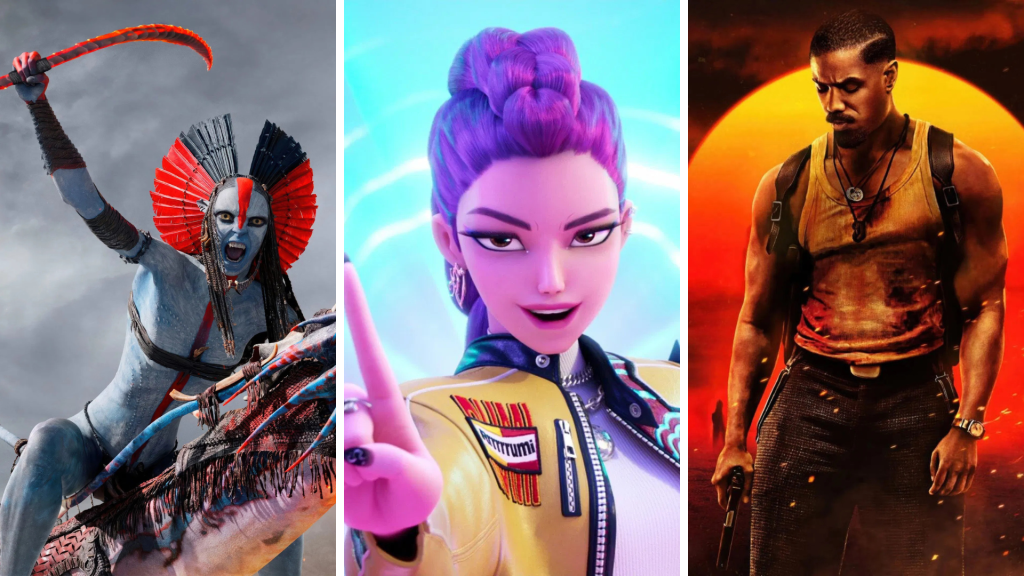
When I read that James Cameron was disappointed with what he saw as his newest movie Avatar: Fire and Ash underperforming at the box office—and it has to be said that having raked in excess of a billion dollars, this movie has probably just about broken even—I perked up just a little. He threatened that if more people didn’t get off their behinds right this minute to go and see the movie, he’d abandon the production of the remaining two Avatar sequels in protest and divulge his plans at a press conference. This is a move that was referred to in a movie called S.W.A.T. from twenty-something years ago as a “Polish hostage situation” where someone would threaten to harm himself if his demands were not met.
I suppose it must have filtered into his field of vision that his movie wasn’t all that important after all, despite everyone around him behaving as though their third movie about native space Smurfs was a groundbreaking cinematic event. I have seen the documentary Fire and Water; I have witnessed these yes-men at work. For filmmakers trained to equate technical ambition with cultural importance, this must have been genuinely worldview-shattering.
But there has never been much more to these movies than technical wizardry and an almost athletic challenge of making movies in ways that movies have not been made before. At first it was the way 3D projection was deployed. Later, with The Way of Water and Fire and Ash it was all about filming mo-cap underwater and using high frame rate competently. And despite the fact that some awards bodies anticipated recognition and perhaps even rallied support for it—particularly exemplified by nominating Avatar: Fire and Ash in a box office-related category of Golden Globes before it was even released—James Cameron’s movie just doesn’t have what it takes to be called the most relevant cinematic event of the year. If Avatar once stood for cinema’s belief in its own cultural centrality, 2025 quietly revealed how outdated that belief has become.
Instead of Cameron, Ryan Coogler’s Sinners came away with the award that had been established in response to the enormous success of Greta Gerwig’s Barbie; although to be perfectly honest, it should have been called the Barbenheimer award to acknowledge the unique box office craze Gerwig’s movie caused together with Christopher Nolan’s Oppenheimer back in 2023. Indeed, Sinners has become the cultural dark horse of 2025. Released around Easter, it was never projected to make a lot of money. However, thanks to a great cultural reception and—crucially—strong word of mouth, Coogler’s R-rated horror underpinned by strong racial themes and adorned with a handful of truly inspired sequences became the talk of the town among film fans. Some would even say that it remained on their lips for the remainder of the year.
Look, it’s hard to dispute that especially in moviegoing circles and among critics, Sinners is the movie of the year as far as its cultural footprint is concerned. The breadth and volume of conversation it sparked was nothing to sniff at, especially because the film’s sprawling and multi-layered structure simply lent itself to critical deconstruction, analysis and contextualization. Sinners was both an easy target for cultural essayists and a genuinely intriguing and thematically rich well to draw from: a medley of artistic inspiration, cutting social commentary and genre-aware execution, all of which contributed to the movie being seen as stimulating, poignant and relevant. Sinners mattered intensely, but intensity is no longer the same thing as reach.
And to be perfectly honest, movies did need a win this year. The American box office has still not recovered from the pandemic dip. Who knows—maybe it won’t for a while. Therefore, seeing an original film, completely unattached to any existing series and franchises and crucially colon-free, become a hit and reinvigorate the kind of excitement and buzz typically reserved for big Marvel tent poles and Christopher Nolan features was truly remarkable. Sinners was a reminder that films still matter and can wield power over audiences like they used to in the past.
However, the cultural significance of Sinners does not extend beyond the circles of people who care about movies. Its imprint is found on the foreheads of critics. Instead, the true phenom of 2025 and the movie that gained substantial significance well outside the moviegoing circles is none other than KPop Demon Hunters. Released at the onset of the summer on Netflix, this unassuming animated musical fantasy about a trio of singers who fight demons setting out to defeat a demon boyband puppeteered by a malevolent god took the world by storm. In fact, even though until earlier today I had not seen it start-to-finish, I felt as though I had already seen it numerous times. This movie appeared on my radar peripherally, as a function of the simple fact that my twelve-year-old daughter would watch it on repeat for months. Hence, I absorbed it osmotically, perhaps even against my will, until I finally sat down to lend it a focused ninety minutes and to see who the wizard was.
KPop became the kind of cultural sensation James Cameron and his inveterate zealots wish the Avatar movies were. The movie continues to reside on Netflix’s lists of most streamed films months after its release, nearly all songs from the soundtrack have been added onto millions of Spotify playlists and blare from radio speakers the world over, while some even went on to top singles charts. Various moments have been memed, edited, and shared. Little girls adopted the main characters as personal avatars. KPop Demon Hunters touched the same cultural nerve that Frozen did many years ago.
And quite frankly, I can’t tell you what it is that made this movie resonate so profoundly. Though I can bet substantial amounts of money that people with important-sounding titles and obscene salaries at Netflix have been looking at their streaming data and analyzing the movie frame-by-frame looking for clues as to how to recreate and industrialize this phenomenon. It could be anything: the relatability of the characters that spoke to gen-alpha audiences, great visuals reminiscent of Into the Spider-Verse, simple and compelling storytelling that never bogged itself down in excessive plotting while it leaned on well-worn archetypal progressions, and extremely catchy tunes. Who knows? Maybe the secret sauce to the success of KPop Demon Hunters lies in the bouncy triplet feel of its songs that distills the vibe of the culture youngsters identify as their own. Maybe it’s because the main character struggled with feeling seen for who she was and it reflects the collective feeling of this nascent generation. But it remains undeniable that the success of this movie was seismic.
Sinners was a phenomenal victory lap for adult cinema-goers who longed for the day when original movies would come back into vogue. KPop Demon Hunters became much more—a weather forecast. It showed where the culture has shifted while we all mused about the greatness of movies. It galvanized multiple micro-fandoms and permanently penetrated spheres of short-form content creation, social media trends and most importantly climbed into the ears of millions like an infectious earworm. Sure, this movie never received a theatrical treatment and perhaps if it had, it would have become an Avatar-sized juggernaut. KPop was a streaming-first blockbuster of unparalleled significance, which in itself proves that the culture has changed while we were all busy writing essays on Sinners.
Movies have permanently moved into people’s homes and from there it took a little musical with great but not groundbreaking animation and catchy songs to prove that your living room can be just as effective as a forward deployment base for future cultural touchstones as cinemas have been thus far. Now that’s what I call impact.



 Flasz On Film
Leave a comment