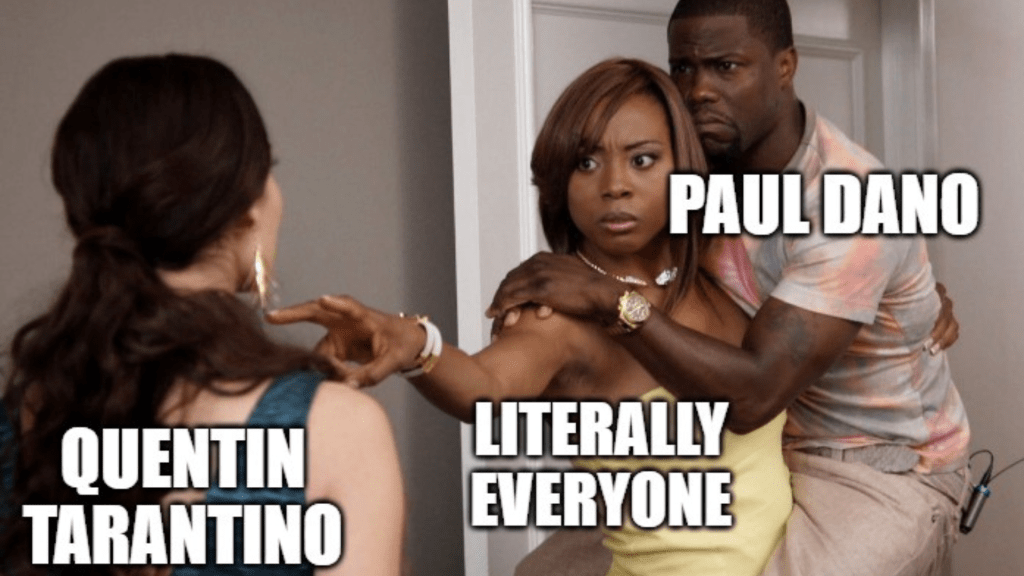
For a second there, I thought I was experiencing déjà vu earlier this week while scrolling through news items and noticing that the world has decided to get outraged at Quentin Tarantino for some reason. And not the kind Neo experienced in The Matrix when he saw a cat walk by twice.
Then again, it wasn’t a real déjà vu either. It was a simple case of Tarantino opening his mouth, again, and saying something profoundly provocative, again, which prompted masses of commentators to respond, again, and a number of outlets to report on this outrage, again. And if you think there is a bit of a pattern to this, you might be somewhat correct. What happens is that Tarantino will have something to plug or promote, so he might end up being interviewed here and there or he’ll appear on some high-profile podcasts, he will then talk about random stuff—and if anything, he’s a great podcast guest in this regard because you don’t need to prompt and prod him to speak; he’ll naturally just ramble if you let him—and, because the man has no filter when he speaks, chances are he will say something spicy. That thing will then go on and get traction and the engagement-farming media engines will pounce on an opportunity to report and sensationalize it all.
In this case, the hoo-ha involved Tarantino appearing on Bret Easton Ellis’s podcast to talk about his favourite movies of this century thus far, or at least this is what I think this entire conversation must have been about. The guy’s podcast is not freely available and I’m not in the mood to dish out six bucks to fact-check this, so if you want to check the transcript, feel free to do it on your own dime. Based on the snippets available, the uproar concerned Tarantino’s comments about Paul Thomas Anderson’s There Will Be Blood, or more specifically the reasons why he couldn’t call this movie a masterpiece, which boiled down to his distaste of Paul Dano’s performance as a counterpoint to Daniel Day-Lewis’s character.
In typical Tarantino fashion, he didn’t necessarily sugarcoat the matter either and went straight for the jugular by calling Dano “weak sauce” and “the limp dick of Hollywood.” Which is where everyone decided it was a good idea to jump to Dano’s defence and organize a good old-fashioned pile-on. All sorts of commentators came out to bash on Tarantino, which included actors, filmmakers, and critics as well as fifty shades of practitioners of performative online outrage. As a result, the Daily Mail has begun reporting on Dano’s career and alerted their readership that he has secured a new movie despite the vitriol poured on his work by one of the most influential filmmakers of our time.
Look, I’m not here to defend anyone or to join in on the pile-on. All I can do is shrug my shoulders and chuckle at the simple realization that this stuff inevitably happens when Tarantino has stuff to promote. Last time he got himself in hot water when he was promoting Cinema Speculation and spoke on Joe Rogan’s podcast about his relationship with Harvey Weinstein. This time, he has been more visible on account of the recent worldwide rollout of his long-awaited Kill Bill: The Whole Bloody Affair.
What I find interesting in all this is that you will rarely hear about anyone else putting his foot in his mouth with comparable razzmatazz, as though to suggest that Tarantino is just singularly prone to making inflammatory comments. He’s uniquely qualified to come out of hiding every now and again, drop a turd in the middle of the street and retreat to observe from afar as a mob of disgusted bystanders assembles and pitchforks and torches are distributed. Why is that? He’s always been at the heart of some controversy, be it his long-standing feud with Spike Lee over the use of racial slurs in his movies, his comments about Polanski or Weinstein, or a number of others.
I think the reason the media drop Tarantino into hot water every time he says something remotely provocative has to do with the fact that (1) he doesn’t care what people think and (2) he cares even less about preserving the Hollywood omerta. Over the years, Tarantino has built a brand that is powerful enough to be impervious to criticism and he doesn’t need to play the Hollywood back-scratching game like many other insiders do. It has long been an open Hollywood secret that you don’t badmouth people in the business because doing so can and will close doors for you. Therefore, even if you don’t like or respect someone, you will still praise them in interviews, compliment where applicable and always remain open to possibilities of working together. And Tarantino doesn’t care about that one iota.
In fact, he has always behaved more like a ruthless critic than a well-adjusted Hollywood insider. He’s massively fond of hyperbole—hence the “weak sauce” comments and other anti-superlatives. He exaggerates, inflates and dresses his comments in flowery language, which is one of the many reasons he is interesting to listen to. And because he remains provocatively authentic, he simply stands in contrast to literally everyone in the business.
By the way, I am not suggesting here that loads of people who jumped to Paul Dano’s defence are doing so because it makes them look good or that they all secretly agree with Tarantino. I think Dano is a wonderful actor and I disagree with Tarantino’s assessment of There Will Be Blood, which I think is at least partially coloured by his personal rivalry with Paul Thomas Anderson. But it doesn’t change the fact that his takedown of the movie is interesting to listen to and actually stands apart by dint of its contrarian constitution. And it also doesn’t change the fact that most other Hollywood insiders rarely say anything worth reporting on, let alone getting up-and-arms about.
But this recent micro-crisis in Hollywood does illuminate that provocative authenticity is not something the movie industry is prepared for, especially when it comes from within. This kind of language is usually reserved for critics, specifically those who don’t care about their access to filmmakers and stars they might shade with their comments, or ones whose stature is unlikely to be shaken by online outrage. These days, many frontline critics and influencers are afraid of panning high-profile productions out of fear of losing access to early screenings, not getting swag in the mail and becoming openly ostracized in the biz. Some big names can still get away with the kind of impassioned takedowns folks like Pauline Kael, Gene Siskel and Roger Ebert were known for and I think it might be time for us to realize that Tarantino, like Paul Schrader who has also made a few outrageous Facebook posts in recent years, has always been a film critic at heart. Recently he has begun transitioning away from filmmaking with the publication of Cinema Speculation and the launch of The Video Archives, a podcast about underseen movies that is almost as good as mine, and I believe his journey will continue in this direction after he officially retires from directing.
It seems that the idea of crossing the floor and becoming a critic after a successful career as a film director comes with these liabilities, especially for a guy like Tarantino who doesn’t hold back, says what he thinks and also says those outrageous things just to get a reaction. He’s not going to become a permanent three-and-a-half-star Letterboxd influencer who lives in fear of Disney cancelling his backstage pass, so he’s going to break the Hollywood code of silence on more occasions, I am sure. I only wonder if this is something the media and online communities are going to get bored of becoming outraged about. Maybe they’ll soon realize that a potty-mouth like Tarantino who has thrived despite (or maybe thanks to) his lack of filter might be completely immune to cancellation in the court of public opinion. And to be completely honest, at least he has a voice and opinions to share, contrarian and inflammatory as they may be. I might not agree with everything he says but I’m definitely interested in reading his brand of film criticism, which simply stands apart from conveyor belt coverage and gentle-gentle reviewing performed by people who care more about how they are perceived in the industry than what they think about movies they write about and discuss.
 Flasz On Film
Leave a comment