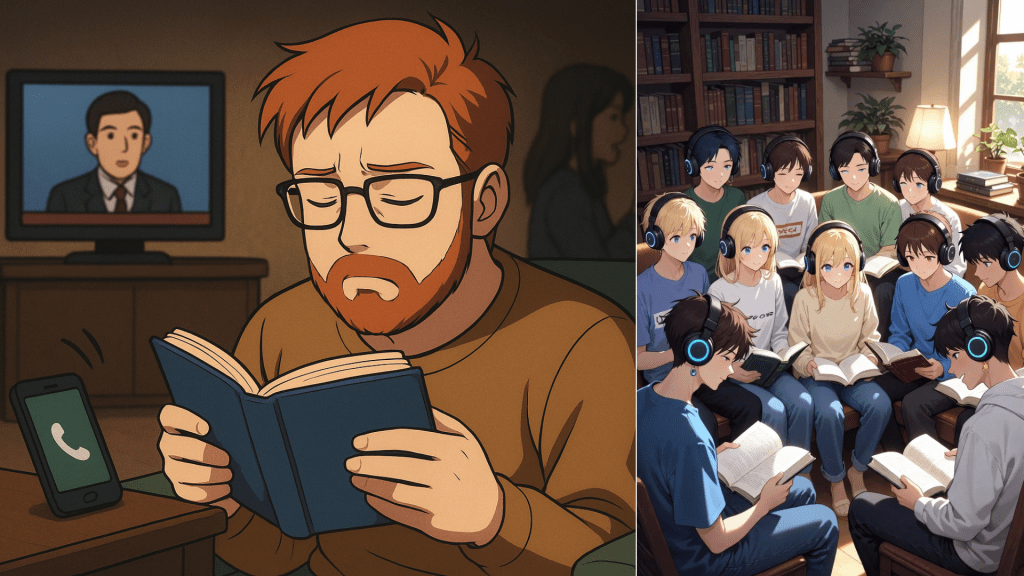
A little while ago, a Substack article by James Marriott blew up,at least as much as long-form writing can “go viral” these days. In it, the author discussed how an observable decline in reading correlates with dropping test scores and how it is all caused or at least catalyzed by the widespread adoption of smartphones and how, more importantly, it spells the incoming doom of our vastly literate society. This is a topic that has been niggling at me for a while now and while I think Marriott offers a handful of interesting insights on the matter, I wonder if there are more nuances and caveats to this problem that could tell us a bit more about where we are as a society.
What I noticed in recent months is a marked increase in marketing (on social media, YouTube videos and podcasts I listen to) of apps like Blinkist or GetAbstract, which are designed to condense and summarize books and serve them to you in a distilled form to enable you to extract whatever value they offer without having you commit precious time to read the whole thing. Now, there’s a place for solutions like this and, quite frankly, there has always been a market for book summaries like CliffsNotes and others. But I think the rise of popularity of those solutions complicates the whole “reading is in decline and we are all getting collectively dumber” picture, especially when placed against the alarmist metrics in book sales and consumption and the simultaneous rise in popularity of audiobooks.
It is now widely accepted that book reading has drastically fallen in recent years and nearly half of US teenagers hardly ever pick up a book, at least as far as print books are concerned. At the same time, though, audiobook sales are continually rising and platforms like Spotify and Apple see increased usage of audiobooks they offer. What I think this means is that people do want to read after all. Or, more specifically, people still hunger for access to what books have to offer, but they don’t want to spend their time reading. And the question is why.
This is where Marriott and others easily default to “it’s the smartphone, stupid” and they might as well be correct. While the device itself is perfectly harmless, it also offers access to services whose entire business model relies on capturing and retaining user attention with short-form content inducing mild dopamine spikes, engagement from other users and other forms of limbic hijacking. And it just so happens that out of all forms of ingesting information, reading is the one process that requires 100% cognitive commitment; otherwise you’re not reading and comprehending and you’re mindlessly looking at words whose meaning you’re not retaining at all. You can easily engage with your smartphone while watching Stranger Things or listening to podcasts, but you won’t be able to read Pride and Prejudice while doomscrolling on TikTok. What you will end up doing is just doomscrolling on TikTok with a book in your lap.
Audiobooks offer an alternative of freeing you up to do other things. You can listen to it while driving your car, walking your dog or washing dishes and you still might get the full benefit of the book without having to carve out enough uninterrupted time to commit to a physical act of reading. With your eyes and stuff. Now, I have found in my travels that I cannot listen to fiction in audio form and audiobooks work for me only when it comes to non-fiction work. I can listen to Obama’s biography or one of the five recent books on how Silicon Valley tech bros are going to ruin our lives, but listening to Heart of Darkness was simply out of the question. This was a book I had to sit down and actually spend time reading.
Equally, there are books that I read or listened to that count as book equivalents of meetings that could have been an email. I think I didn’t need to commit multiple hours of my life to reading Patrick Lencioni’s The Five Dysfunctions of a Team and could have easily extracted whatever value this book had to offer as a list of bullet points, which is something that Blinkist or AI-powered services like NotebookLM can offer. In fact, this last one is a life saver for anyone who gets sent a massive report fifteen minutes before an important meeting and needs to quickly skim through a committee-created wall of text to make sure they wouldn’t waste anyone’s time in the actual meeting. So, there’s place of everything in our busy lives.
And this is where I think I’d like to offer a piece of nuance to this sensationalist claim that suggests that reading is in decline and this is why we are doomed. While it may be true in the long run and we might be on the way towards converting to a non-literate society of mostly reactive mammals with temporarily overdeveloped cognitive capabilities, it may also be true that we still want to read but we might not have the time to do so. And whatever time we do have at the end of a busy day is fought for by other, less cognitively demanding activities. Which is where smartphones come in and swallow our attention completely and irreversibly.
I think what gets frequently overlooked is a realization that over the last twenty-five years or so, the economic uncertainty stemming from a string of allegedly once-in-a-generation calamities has continually exerted undue downward pressure on our living standards. In contrast to our parents and grandparents who actually did have time to sit down and do whatever after a day spent working, our lives are just different. We face longer commutes because we can’t afford to live close to work. We struggle to switch off and take work home and those of us who work remotely frequently never truly leave work. Many of us juggle multiple jobs, manage childcare and other responsibilities and consequently, there’s less time for us at the end of the day to commit to anything but vegging out while watching a tiny screen only minutes before passing out in bed.
It is simply way easier to listen to a podcast or an audiobook while walking to the train station or driving than it is to find enough quality time to read a book. I still try to do so (and it requires incredible discipline in the long run) because I value the ritual of reading more than the information I can extract out of any book. In fact, I strive to read fiction specifically because I want to temporarily disconnect from my everyday woes and live vicariously through imaginary characters in their make-believe worlds. Non-fiction I can listen to while cooking dinner. But the fact remains that what I lack is not necessarily the discipline to put my phone away—there are solutions to help you with this problem, too—but enough minutes in the day to commit to even a handful of pages.
And I think I’m not alone in this. Smartphone supremacy is surely a major driver in dissuading us from reading because it offers a highly addictive alternative to an otherwise time- and attention-consuming process but the fact that we are collectively struggling to pick up a book while also showing a willingness to ingest books in other means, specifically ones that allow us to accommodate it without an extra time commitment, may just illustrate that we are not quite post-literate. We’re simply overworked and tired.
This is where structural and policy changes would be required to give us some of our free time back. Rich people can buy time. Poor people exchange time for money needed for survival. And it just so happens that the wealth inequality in Western societies is at its all-time peak which means that, statistically speaking, more people than ever simply do not have time or mental bandwidth to think about reading while their lives are consumed by such trivial problems like worrying if they will have a job tomorrow and if they’d be able to put food on the table, let alone give their own children a good enough upbringing as they push them out into an ever uncertain future.
Something tells me that while smartphone and social media addiction are a big part of the problem, it is heavily caveated by the inescapable reality that for many of us it is downright impossible to scrape together enough time to engage in leisure, let alone to pick up a book. It’s hard to immerse yourself in that new Richard Osman novel when all you can think about are rising prices at the grocery store, politics sliding towards fascism, wars brewing beyond our borders and the slowly swelling tsunami of climate change about to hit us like a ton of bricks. It might just be that the post-literate society will emerge not because they choose to focus their attention elsewhere, but rather because in times of strife only the privileged few will have the luxury to retire to their sofas and read some Hemingway.




 Flasz On Film
Leave a comment