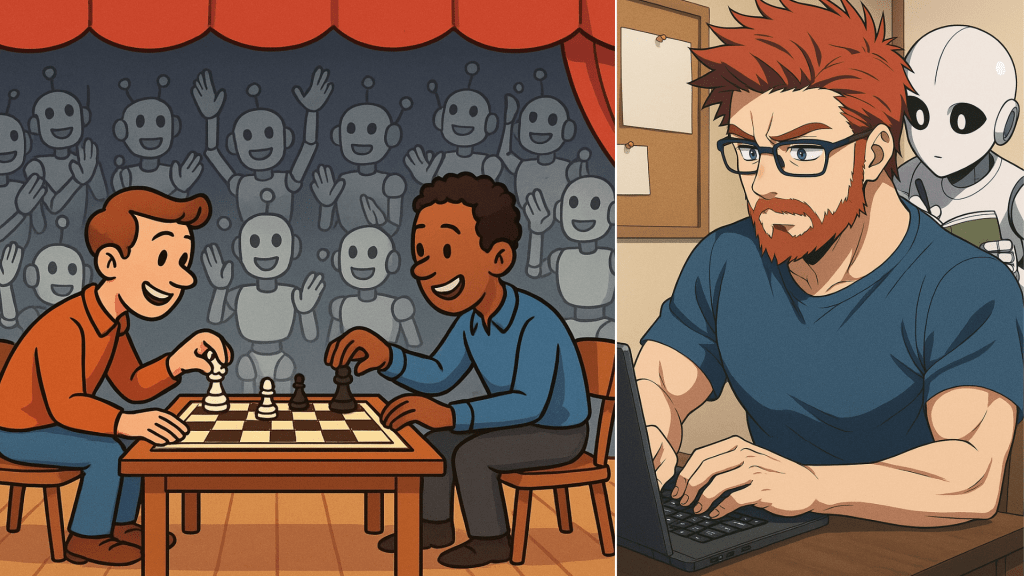
When I first learned the rules of the game of Go, in 2003, the prevailing belief was that this ancient board game would be the last bastion of human ingenuity. In contrast to chess, which is a game with fewer possible variations and with a less abstract structure, humans had failed to teach computers to play it competently, and writing a program that could beat top professionals felt like a pipe dream. Or at least it was until folks at Google DeepMind created AlphaGo, a deep learning algorithm trained on millions of expert games and reinforced with self-play that defeated Lee Sedol in March 2016 and demonstrated superhuman creativity.
That’s it. Bob’s your uncle. In 2016, we have created an AI that was better at Go than any living player and could get even better with continued reinforced learning. But… people still play Go, don’t they? In fact, computers have been better at chess than the best humans ever since Kasparov got his behind handed to him by DeepBlue in 1997 and people still play chess. Why is that?
It’s probably because having access to superhuman AIs who are better at Go and chess than anyone who’s ever lived still doesn’t change the simple fact that playing board games is fun. The ritual involving two people, a board and a bunch of pieces where two minds do battle remains unchanged by the fact that there is an artificial entity somewhere out there on a GPU in a data centre in the middle of nowhere that could beat either of these players in a straight engagement. In fact, I don’t need an AI to know there are always way better players out there. It is true for every discipline of human endeavour and expression that there is always a high probability that whatever it is that you like to get better at doing—playing Go, painting, playing the piano or literally anything else—there will always be a five-year-old child better at it than you. And it’s not discouraging at all. And that’s because human expression cannot and will not be constricted by commercial viability.
A lot has been made in recent weeks and months of the allegedly imminent arrival of Artificial Superintelligence (ASI), an artificial intelligence that surpasses humans in all key tasks and cognitive processes. This is immediately sensationalized into the end of everything ever because it will render human thinking completely pointless. Why think when ASI can do it better? Sure, we can already experience widespread disruption on global job markets as smaller AIs capable of competing with human productivity in specific domains are slowly replacing it in some economically viable processes. Data entry is becoming automated; research, text and image generation, transportation, manufacture and much more. The world as we know it is changing forever and all we can do is adjust to these changes.
In the long term we might no longer be able to find work any more. However, a benign scenario of the AI-powered industrial evolution assumes that thanks to vast increases in productivity, governments will have no other recourse but to introduce generous universal income schemes for the many jobs that AI and automation will inevitably render obsolete within the next 5-10 years. In reality, it will probably be a struggle because the few tech companies that stand to benefit the most from this revolution might not be open to sharing their spoils. Trickle-down economics has never worked before and is unlikely to work now without strong administrative oversight. Thus, we are now told by AI safety experts that the best course of action for us all is to learn a trade that AI and automation will struggle to replace. Like plumbing, bricklaying and carpentry. Everything else will go.
But here I am telling you—or maybe myself, too—that there’s nuance to be found in this recommendation. The arrival and widespread adoption of LLMs like ChatGPT and image-generating diffusion models like DALL-E 3 are not going to eliminate the fundamental human need for expression through language, writing and art. What they will provide is a commercial alternative for companies that will choose to create content for commercial purposes using AIs instead of relying on human-commissioned work. Sure, in here there still remains a lot of oversight to be adopted because LLMs and image-generating models have most likely been trained on copyrighted data, so to make things fair artists ought to be compensated by AI companies in some fashion. Still, I don’t believe for one second that just because I can get ChatGPT to write an essay for me or engage its diffusion add-on to turn me into a muscular anime character, humans will cease to express themselves through art. Just like the games of chess and go are still played by humans, the same will happen to writing and art.
What will change, though, is the way these avenues of expression are monetized and not only lorry drivers and paralegals will need universal income schemes to stave off poverty. I can only hope that we will collectively—perhaps under guidance of a benevolent ASI—devise solutions that will permanently eliminate poverty worldwide, which will allow us to express ourselves unperturbed by basic survival needs. Writing books and essays will not disappear. Paintings, comic books and everything leaning on artistic expression will remain untouched. On the other hand, SEO-optimized content intended to generate ad revenue will.
Therefore, I’m not worried that I will be replaced as a writer. I’ve been doing it for many years without having seen a penny of revenue and I will continue doing it until my dying breath. This is something I just cannot abandon because writing is the way I express myself. And that’s how I know that filmmakers, poets, writers, painters, illustrators and musicians will not disappear. We will all have to figure out how to stay afloat but these avenues of expression are here to stay for good.
ASI or not, I shall continue what I do. As long as there are humans around to read what I write and there’s stuff for me to think about, I’ll be OK. And so will you. If robots rise up and cook up Judgment Day for us, then we’ll have a different set of problems to tackle. And as far as I know, the arrival of ASI carries at least a 15% probability of complete annihilation of all humans. Which seems like a lot. At the same time, we have been living under threat of nuclear Armageddon ever since 1945 and we’re still here; so nobody really knows.
What I do know is that the point of writing is to express yourself and nobody can do it for you. I always knew that I’d never be as good at Go as Korean pros and I know I will never be Cormac McCarthy. Yet, here I am writing even though ASI will be way better at it than I am.




 Flasz On Film
Leave a reply to FRANKENSTEIN (2025), Squandered Opportunities for Timely Reflection and Packaging Cheap Chocolates into Pretty Boxes – Flasz On Film Cancel reply