
By 1984 Wes Craven had become a recognizable name in the genre space; that’s without question. After all, he had contributed in the 1970s to the slowly building wave of exploitation horror films that towards the end of the decade—suffused with influences coming from Alfred Hitchcock’s Psycho and giallo penetrating the American popular culture—slowly transmogrified into what we now understand as slasher horror. There’s a clear timeline connecting Psycho, The Last House on the Left, The Texas Chain Saw Massacre, De Palma’s Sisters and John Carpenter’s Halloween that outlines how the genre was evolving. But there’s also no debate that the 1984 A Nightmare on Elm Street helped to consolidate this movement in more ways than one.
A lot has been said about the influential role of Wes Craven’s iconic introduction of Freddy Krueger into the pantheon of iconic horror villains, though a lot of the praise tends to be of circular nature: A Nightmare on Elm Street is seen as iconic because it is so and it is so because it is iconic. It launched a long-running franchise and crafted an unforgettable genre foe that came to define Robert Englund’s acting career. It is well established that Craven, who both wrote and directed the film, drew immense inspiration from his own life experiences, which includes the idea of dying in one’s sleep as well as the name Freddy Krueger itself. He took childhood fears of old dirty men instilled in him by parents and gave him the name of his childhood bully. Ironically, this wasn’t the first time he had done so, as the villain in The Last House on the Left, Krug, was christened after him as well.
However, what is truly fascinating about A Nightmare on Elm Street is that it is equally a logical extension of that genre timeline as it is its elevated subversion. Granted, the general idea of telling a story about a group of teenagers getting together to fend off a killer who assaults them in their sleep was firmly rooted in the same principal fears that governed Halloween and Friday the 13th. At the very core, it was still a story that drew on parental anxiety and a morality play dressed in genre garb ostensibly attempting to dissuade teenagers from having sex by sending boogeymen after them. Michael Myers made quick work of all those promiscuous babysitters and their male companions, leaving only the virginal Laurie Strode alive. The killer in Friday the 13th, who was not Jason but his distraught and mentally deranged mother, also made her motivations abundantly clear and held sex-obsessed camp counselors guilty of her son’s death by association.
Craven’s film takes the same stance but covers its hacking and slashing of sexually promiscuous youngsters with a supernatural metaphor. Although at least one character in A Nightmare on Elm Street is dispatched in direct aftermath of a sexual encounter—and it is a visually arresting sequence, by the way—the movie doesn’t spell it out the way other slashers did. Craven remains playfully elusive by suggesting that the simple act of falling asleep is enough to land on Freddy Krueger’s naughty list. So, we observe Nancy (Heather Langenkamp) try to stay awake together with her boyfriend Glen (Johnny Depp) and it wouldn’t take a rocket scientist to surmise that the concept of trying to stay awake together is a thinly veiled metaphorical take on two teenagers doing their level best not to have sex when locked together in a confined location.
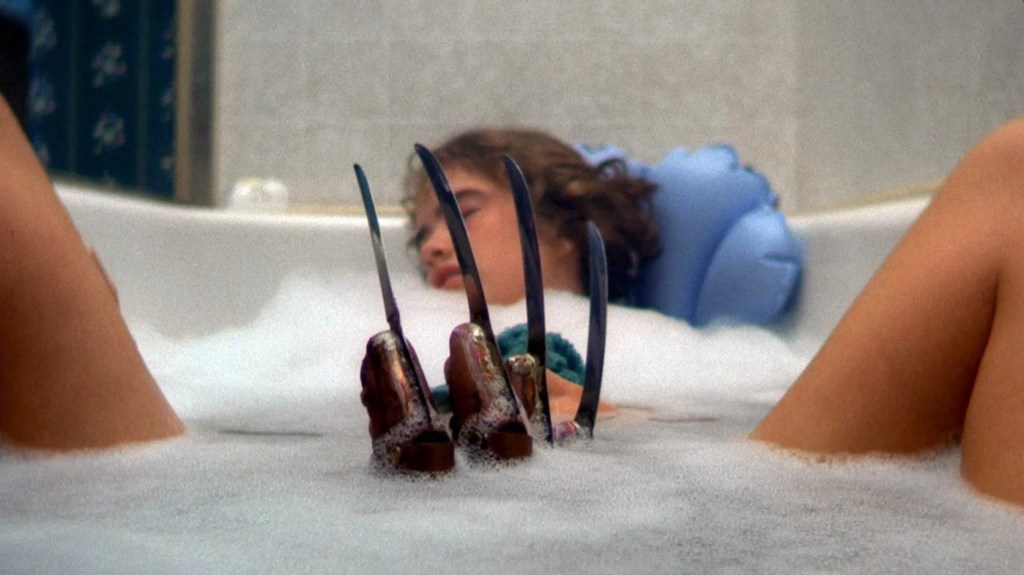
But that’s not all. Craven’s movie extends the parental anxiety relating to their children’s sexual awakening well beyond the idea of satiating carnal desires in conventional means. Krueger invades teenagers’ minds and haunts them in response to the act of thinking about sex with lurid taunts (the tongue-phone), sexually suggestive imagery (the gloved hand in the bathtub is a dead giveaway, also foreshadowed in Deadly Blessing), dirty talk and more. This way, A Nightmare on Elm Street channels these fears both more explicitly and more indirectly. It is no longer a piece of straightforward symbolism of conservative origin stating that if you have sex, a deranged psychopath in a mask who also may or may not be infused with supernatural powers will get you.
By 1984, we have already seen how evil invades the suburbs and disturbs its perceived serenity (Halloween) just as we have seen how the cozy middle-class lifestyle cushioned with outsized wealth can be preyed upon when it meets the roughness of the American outback (The Texas Chain Saw Massacre and The Hills Have Eyes). In A Nightmare on Elm Street evil comes through the back door, unannounced. In fact, it doesn’t need a key to find a way into the house when it utilizes people’s minds as its own personal access hatch. The Craven-esque horror finds very little regard for the implicitly agreed-upon rules of the genre game.
This is also where the filmmaker further elevates the slasher template and complicates matters by referring to the many interesting ways in which the society is stratified. In The Last House on the Left we saw conservative parents effectively taking revenge on the hippie subculture for abusing their kids. Carpenter’s Halloween assumed the parents were never there to begin with as they were busy living their lives and not giving a hoot about their youngsters’ sexual exploits. On the other hand, the story in A Nightmare on Elm Street implies a more involved dynamic between generations—still all within the confines of a wealthy suburban cohort—because while we are primarily concerned with the teenage sexual awakening and the utter vulnerability of the hormone-fueled youth, the assumption is that their parents still cared enough to defend their progeny before having to exact vengeance.
In fact, as the story unfolds and Nancy’s struggle against Freddy who invades her dreamscapes every time she closes her eyes becomes unmanageable, her parents reveal that Freddy Krueger is not a figment or an entirely supernatural construct either. He’s not merely an avatar for that dirty sex-crazed man waiting to abuse our children when we’re not looking, but also something else. In the movie, it is found that the parents, years earlier, had got together and collectively murdered a child murderer (the movie stops short of calling Krueger a molester, but the implication is clear enough), and considered the matter closed. It is as if they thought that by acting, they would be able to stave off the inevitable arrival of adolescence and shield their children from the discomfort of talking to them about sex.
Consequently, the entire film becomes a layer cake of metaphorical social commentary that uses an elevated slasher template to further its ends. It requires its world to blur dream and reality because its core lies in the parental denial of responsibility whose outgrowth manifests indirectly in the characters’ lives. The assignment is no longer as simple as introducing an external threat and having the cast raked through the coals in search of final survivors and their catharsis. It’s about resurrecting sins long forgotten and dealing with uncomfortable truths that parents willfully chose to withhold from their children driven by nothing but best intentions underpinned by embarrassment. Thus, even Freddy—already an elevation of the slasher villain with his maskless visage, a jarring sweater and a fantastical murder weapon—can no longer be seen as just a manifestation of an external threat to conservative serenity. He is both an incarnation of evil and of parental inability to face difficult problems. He’s a thematic stand-in for their philosophy of sticking their fingers in their ears and hoping that nothing bad would ever happen to their kids. That is, at least as long as they lived with them. They probably didn’t think far enough ahead to conceive of just how vulnerable they’d end up being the minute they step into adulthood.
And in a way, the movie makes a comment about it too—in the final scene of the film. When Nancy steps outside of the house, flanked from all sides by that newly restored suburban idyll, the car she gets into traps her inside and drives off screen. Now, this is presumably to be understood as a dream sequence in its own right, but this point nevertheless holds water. It’s all about the perception of having done a good job parenting because these parents succeeded in not letting Nancy lose her innocence while on their watch.
This way, Craven once again skewers the many hypocrisies of traditional conservative upbringing. However, in contrast to his earlier work where the movies commented on parents’ inability to defend their families from the evil on their doorstep, A Nightmare on Elm Street brought horror into their dining rooms and challenged the very fabric of society by suggesting that it’s not only ill-advised but also downright dangerous to pretend that we can defend our kids from harm. We have to equip them with the right tools and emotional awareness to be able to fend for themselves. When they grow up, they’d have to face against their own Freddy Kruegers and they have to be able to do it on their own. That’s the final message Craven leaves us with. And to make it all stick, he had to reinvent the already ossifying slasher template. The creation of one of the most iconic and lasting franchises was merely a byproduct.




 Flasz On Film
Leave a comment