
In a genre space as crowded as modern horror is—between dark fairy tales, elevated horrors, longstanding franchises, nostalgia sequels to 90s slasher revival classics, pornified body horror and everything else—it’s no longer enough to come up with a reasonable slasher villain and just roll with it. I mean, people still do just that, but to stand out and increase their chances of success, horror movies need a gimmick. A USP, as you might call it in professional circles. A Unique Selling Proposition.
James Wan’s Malignant staked its house on its gonzo violence. The Terrifier movies bet on the combination of an iconic villain with extreme gore. However, the most established and effective kinds of horror gimmicks have frequently relied on manipulation of perspective. Maniac assumed the point of view of a slasher villain, later rehashed and refreshed by the likes of Tucker and Dale vs Evil and the more recent genre upside down cake In the Violent Nature. Putting the camera in the hands of protagonists gave rise to the entire field of found footage horror (The Blair Witch Project). We got to see Poltergeist via CCTV in Paranormal Activity and even this year we did so from the point of view of the poltergeist itself in Steven Soderbergh’s Presence. In the early days of the pandemic, we saw a “screenlife” ghost story in The Host.
And let’s be honest: many of such gimmick-first movies do well in the moment and generate some positive word of mouth, but most of them unfortunately fall into obscurity quickly thereafter having failed to establish a sustainable beachhead. Granted, those that spawn entire microtrends tend to persist indefinitely in our collective consciousness as timeless cult classics, but it’s by no means a given. It’s not enough to come to the table with an intriguing what-if elevator pitch and it is equally crucial—if not more so—to use your novel gimmick or a perspective to craft an experience that’s just as novel and unique as well.
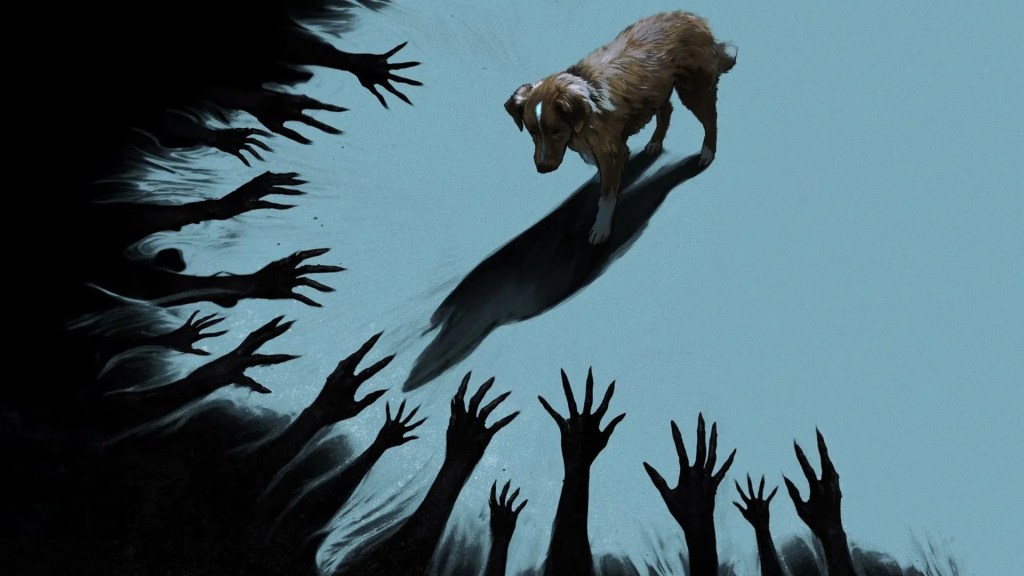
Which brings me to Good Boy, a supernatural horror movie told from the perspective of an adorable dog named Indy. In fact, you don’t need to know anything more about this movie apart from having the central gimmick described to you as the rest is self-explanatory. The camera follows the titular good boy Indy as he moves into an old house with his terminally ill owner (Shane Jensen, whose face we rarely see in focus and up close). But what happens is that Indy begins to notice strange occurrences in the house, from creaking noises downstairs and ominous-looking shadows to full-on hallucinations and encounters with a dark looming presence lurking dangerously close.
Although decidedly novel—I don’t think I’ve ever seen a horror movie told exclusively from a canine point of view and the closest thing I could muster is White God—dogs have always added an interesting angle to horror movies. Between companionship (I Am Legend) offering intriguing foreshadowing thanks to their heightened senses (The Hills Have Eyes, The Babadook and others) and even serving as an inciting force (The Thing), addition of a furry animal companion with a barking disposition can only add value to the experience.
And the case is similar in Good Boy where we are effectively perched on the shoulder of a mid-sized doggo as he grapples with experiences which he does not comprehend himself. At the same time, we can immediately infer that what Indy sees, senses and experiences might be unique to him because of his own heightened sense of sight, smell and sound, but it is us who can interpret what’s going on for him. After all, how is a dog supposed to comprehend that what he’s experiencing is a supernatural event? We’ve seen horror movies before, whereas Indy—despite having to sit through a bunch of classics like Carnival of Souls with his owner—is unlikely to connect the dots. All he knows is that something’s happening in the house, that someone’s lurking in basement and that his owner might be in danger.
To this end, the filmmakers (Ben Leonberg and Alex Cannon) go all in on their central gimmick and stage multiple scenarios in which Indy is woken up or disturbed by weird noises or visions, goes in to investigate and experiences what we, the viewers, interpret as a jump scare. In the background to this, Indy’s owner grapples with what looks like chemotherapy and slowly withers away, which only gives Indy more animus to protect him from whatever it is that clearly ogles them both from the shadows and continues to make gurgling sounds behind the cellar door.
However, as much as I cannot deny Good Boy the ingenuity of its perspective, it doesn’t build up to a lot. In fact, it looks to me as though the guys who put the movie together didn’t have much of a follow-up to their haunted-house-from-dog’s-pov pitch and settled on a string of repetitive episodes and crossed their fingers hoping that the audiences would respond positively to the combined forces of Indy’s dog charisma and canonically effective scares multiple times in a row. The running time says it all: the movie barely qualifies as a feature with its seventy-three minutes of action. Though, even at that, the experience begins to drag at some point because of the repetitive nature of its episodic structure. I suppose, in dog years, this movie probably clocks at just over eight hours. It sure didn’t feel brisk to me.
Maybe this is simply a byproduct of the gimmick itself, this inability to take the story in any meaningful direction. And that’s because the dog, for all his cuteness and bravado—which in a roundabout way is a testament to the filmmakers’ command of the animal on set—never feels like an agent in this story. Indy is merely an observer with a limited grasp of what’s happening and even less of an ability to influence events. All he does is respond to stimuli while we attempt to figure out what’s going on. But what’s going on is essentially more of the same with gradually increasing intensity: something alerts Indy, Indy investigates, the filmmakers tease us with their grasp of the use of negative space and shallow depth of field, and we get scared. Rinse. Repeat.
And even at that, the idea of continually building up to something carries an intrinsic threat to the experience. Once the band of suspense is stretched out, it can only do one of two things: violently contract back or break. After snapping back nicely and converting suspense into scares a handful of times, material fatigue begins to matter and eventually, it ceases to work as intended and this is because (1) there is a ceiling on how many times a viewer will fall for the same shtick and (2) eventually the story will demand a payoff to the cumulative buildup.
The arithmetic governing the fundamental relationship between buildup and payoff is simple: the magnitude of the runup is directly proportional to the expected magnitude of the resolution. However, the catch in it all is that the relationship between what the viewer expects and what is feasible does not follow the same logic and might be almost completely divorced from reality. And that’s because the imagination of the observer is almost always going to outperform what the storyteller can deliver.
This is the perennial “monster behind the door” problem that I remember Stephen King described in Danse Macabre. When you introduce a monster behind closed doors and tease his arrival, eventually you are most likely going to underwhelm the viewer/reader because their imagination is always bolstered by their own personal fears and demons amplifying the perceived power of that invisible presence. Once the monster is revealed, all those additional amplifiers fade into inexistence and what’s left is only what the author/storyteller/filmmaker conjured on their own. The more you build up, the higher the expectations, but the gap between expectations and deliverables grows non-linearly at the same time and eventually it becomes impossible to pay off the runup at all. The band breaks. The point of no return is inevitably crossed.
Therefore, it is unreasonable to perpetually play that tantric edging game that Good Boy engages in because at some point the story crosses that point of no return and regardless of what happens, the result is underwhelming. Once lurking shadows and creepy noises take the form of a mud-covered poltergeist, all tension fizzles out, and we are left with nothing but Indy’s pup charisma to hold the movie together. And that climbdown is nothing but painful to experience.
As a result, although Good Boy has its cool idea to get it going, its bite doesn’t match its bark. The filmmakers, despite having their hearts in the right place, have unfortunately made a handful of unrecoverable rookie mistakes. Between not having much of an idea to shape an intriguing premise into a compelling story, playing fast and loose with the unforgiving diminishing returns of repetitive scare tactics and falling prey to the paradox of the monster behind the door, their work ultimately underwhelms as a whole. Its only saving grace—the only one, I tell you—is Indy’s screen presence, which adds up to the best dog acting this side of Beethoven. Without it, Good Boy would have failed altogether, and the seemingly brisk seventy-three minutes of dog horror would have turned out to be a complete waste of time.
Thank heavens for dogs. Not only are they guardian angels sent to Earth to love us unconditionally, but they are also here to talk horror movies down from the brink of failure with their raw presence alone and generate enough word of mouth for a film that can’t get its ducks in a row to become a cultural phenomenon for at least a short time.

 Flasz On Film
Leave a comment