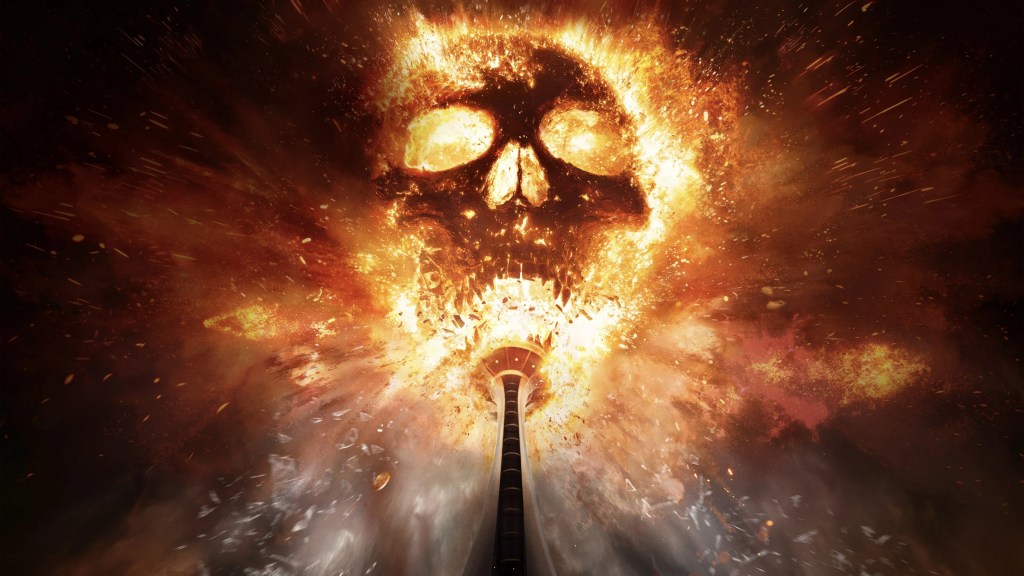

The Final Destination franchise occupies a rather intriguing spot on the timeline of the evolution of horror, as it came into existence at the tail end of the 90s Slasher Revival and fizzled out just before the arrival of the elevated horror era of the 2010s. Meanwhile, it ran alongside the brief J-horror fad and somehow anticipated (perhaps even accelerated) the torture porn of the mid-2000s.
However, as such, it remains broadly unclassifiable as it carries forward some elements of the meta-slasher template reinvigorated by Scream (and its protoplast Wes Craven’s New Nightmare) while banking on an ensemble cast and a variation on a whodunnit where instead of trying to figure out who the killer is (because there isn’t one), a chunk of the fun of these movies would be to predict who would die next and the pattern in which the characters would go. Furthermore, and this is where the series anticipates the arrival of movies like Saw and Hostel, the bulk of the entertainment value of Final Destination movies would reside in relishing in the procedure of the characters being dispatched. It was no longer about an axe, a knife or a chainsaw, but rather the Rube Goldberg-type elaborate contraptions where the characters would die in increasingly esoteric ways. All of which was both refreshing and intriguing, at least in theory.
In practice, though, Final Destination movies ended up completely indistinguishable from one another. In a way, this may be because they gambled on excising the most potent aspects of the meta-slasher—a recognisable villain—while retaining the structural concept of sticking to an ensemble cast of relatively unknown young hot things. They also chose to dispense with the idea of franchise continuity that the Saw movies later embraced almost to a fault and banked on the entertainment value derived from inventive kills. Thus, if you asked me what happened in Final Destination 3, I wouldn’t be able to tell you. I remember broadly that the first one dealt with the aftermath of a plane crash, one had a car pile-up, another a rollercoaster snafu, a bridge calamity or a massacre at a NASCAR event of some sort. But if you put a gun to my temple and asked me what happened in which instalment, or better yet, what happened to any of the characters, my brains would end up painting the wall.
What I do find intriguing about it all, and this is despite the fact that most if not all of the movies in this franchise are uniformly terrible, is that the idea to remove the villain from what otherwise would have been a slasher and replacing it with a cosmic entity of Death that always lurks in the background, cannot be caught, defeated, cheated or killed, gave the series—perhaps completely unwittingly—a plane of fatalistic symmetry reflecting the millennial and the Gen-Z experience. After all, these two cohorts are best placed to identify with the notion that whatever we do, we cannot escape our fate. We can think we can outsmart our destiny but it will come back with a vengeance the minute we lower our guard. In Final Destination movies, you could only cheat death by going to extreme lengths and even then you might fall victim to a last-minute grisly death, just seconds before the credits are about to roll.
So, in a strange way, the entire franchise has always been at odds with itself because it acted as though it wanted to remain episodic while it yearned for continuity and structure. It wanted to bank on the entertainment value of its elaborate kills, none of which were ever memorable enough to survive in your cerebrum for longer than it took to get back home from the cinema, while also trying to anthropomorphise Death without ever turning it into a corporeal entity the characters could face off against and eventually drive a knife through. At the same time, all five movies released between 2000 and 2011 felt as though they belonged to a shared universe as they simply acknowledged, to varying extents, the existence of the series, without ever attempting to find a bigger frame into which the series would fit. The best they could do was to rely on the iconic presence of Tony Todd as a walking and talking exposition machine and the one sustainable piece of connective tissue suitable for organic franchise engineering. It seems Final Destination movies wanted after all to build a legacy despite their anthology origins. But what they needed and didn’t have was… a bloodline.
Thus, after fourteen years of slumber, having been tucked neatly into a corner together with other stale subgenera of horror while the elevated horror ruled the roost, Final Destination has been reawakened. Perhaps driven by the re-emergence of the Scream franchise and what might soon turn into at least a localised nostalgia-driven resurgence of the 90s Slasher Revival trend with such movies as Thanksgiving, Heart Eyes or In a Violent Nature (and related ancillary ilk, too), along comes Final Destination Bloodlines, a movie that attempts to impose a big picture narrative onto the series that desperately wanted one despite doing next to nothing to attain it at the time it was alive and breathing.
Look, I’m not going to tell you exactly what the plot of this movie is because you know it already. You’ve seen one, you’ve seen them all. However, what makes this particular instalment, directed by Zach Lipovsky and Adam Stein, interesting is that it wants to be bigger and more precious than all its predecessors, while also giving the entire series at least a hint of cohesion. And that’s simply because it makes use of a logical rule that has not been deployed in the series before, which states that if you had cheated death and lived a life you were not supposed to have by virtue of having an extended premonition (which is always the prologue to the movie), then all your children and their children—your titular bloodline—will be eventually marked for extermination as well.
Therefore, Final Destination Bloodlines applies this superficially ambitious construct by showing us a young woman (Brec Bassinger) whose premonition spared hundreds of lives way back in the 1960s or something and that Death took decades to work through all of those saved souls and their families before it made its way to the cast of characters we are following in the movie directly. Even more preposterously, we enter this predicament by seeing this premonition second-hand, as a nightmare dreamt by the young woman’s granddaughter Stefani (Kaitlyn Santa Juana). We find out that the grandmother’s conviction that Death was onto her ruined the family, but now might be a good time to reunite because accidents are beginning to happen and family members are dropping like flies. And they do so in staggeringly spectacular and grisly fashion, too. Rube-Goldberg contraptions. You know the drill.
What is more, as Stefani begins investigating the seemingly outlandish idea that Death might be an entity that is after her family, we find out that the disaster her gran stopped from happening was connected to all the calamities we have seen in the previous instalments. And because the very concept of each of these movies was that a group of people would avert their demise temporarily by having their own premonitions, it makes the series look like a nested matryoshka doll of premonitions hidden in premonitions and people avoiding Death while avoiding it already because Death probably had all these calamities planned for them to take them out wholesale. Let’s be honest, it only makes vague sense if you don’t think about it for too long and the minute you do, the logic imposed upon the series by this movie will crumble like a crouton.
Still, it is a valiant attempt because all things considered, Final Destination Bloodlines stands as the second-best in the series, trailing behind the original… and only by a hair. If it hadn’t been for the fact that the entire movie looks underexposed and watching it feels as though someone failed to turn the brightness up a few notches in the projector settings, it would have had a good chance to stand tall as the most entertaining chapter in the series. Though, you have to remember that all four sequels, without exception, are nearly unwatchable, so there’s that. The movie is graded on a curve, so a good pinch of salt is required to process the rating you see at the top of this text.
Nevertheless, it’s a fun enough movie that actually tries to turn this completely fragmented anthology series into a structured franchise by weaving a big picture narrative into the writing and not by only relying on the memetic longevity of its kill sequences to give it cultural shelf life or the threadbare connective elements like the recurring appearances of Tony Todd and other awkward winks.. It’s still just as terminally braindead as all the other five movies in the series and I can assure you that in two weeks’ time I will have no recollection of any kills from this movie—maybe with the small exception of the MRI set piece—but I will remember that Final Destination Bloodlines tried to do something. It’s far from perfect and just about enjoyable in the moment and probably thanks to its own determination to retroactively build a franchise into the pre-existing set of movies it remains the longest in the series.
Sure, it is still a killer-less slasher with a penchant for circus-derived gimmickry, but at least it should count for something that a movie can come out twenty-five years after the original and, through painstaking plotting and some superficially inventive storytelling, retroactively build a legacy for itself and then become nostalgic about it. It honestly is quite an achievement, predictably indulgent as it may be.
 Flasz On Film
Leave a comment