I don’t write about myself directly. And when I do share anything about my life or my emotional states, I do so in riddles. I hide behind metaphors, discorporate otherwise powerful admissions by disguising them as cultural commentary, or if I end up sharing something personal, it will rarely be uncomfortable to me. The stuff that stirs in me or the stuff that I have now spent decades decoding, contextualizing and understanding I often keep to myself.
I have known, or at least instinctively understood, where this reluctance came from for a while, but I think now is the time to break the cycle and consciously and willingly ignore the voices in my head that are trying to stop me from sharing anything about what goes on in my mind right now. In fact, it has taken me weeks to sit down and multiple aborted attempts where I ended up leaning on the backspace button and deleting hundreds of words in acts of last-minute self-betrayal, having given in to the chorus of voices actively persuading me not to let myself be vulnerable. Because why share? What if someone reads it? What if someone takes offence?
I suppose for the same reason I was never able to keep a journal because I could never be completely honest and transparent with a blank page out of fear that someone could find it and read it. So, all of what I ever wrote in attempts at journaling quickly ended up curated, intellectualized and hidden behind half-statements, similes and often complex metaphorical constructs.
But enough is enough and I have Kelly Reichardt to thank for it, at least in part. At this point over a month ago I watched her recent movie Showing Up (now penultimate because her The Mastermind just about premiered at the Cannes Film Festival a few days ago) and it ended up a movie equivalent of an earworm song, stuck in my subconscious, niggling at me like a nasty itch.
Sometimes movies do that to me. Between A Woman Under the Influence, Before Midnight, Boyhood, Minari, Past Lives and even Interstellar, many movies have stayed with me and became synonymous with specific moments in my life or tethered to certain ideas I hold dear to me. How do I show up as a father? What kind of a partner am I to my wife? How has my immigrant experience shaped me as a person? These are all questions I’ve ended up deriving from or attaching to some of those movies, but it would usually take me weeks or even months to realize just how profoundly impactful they were on my existence.
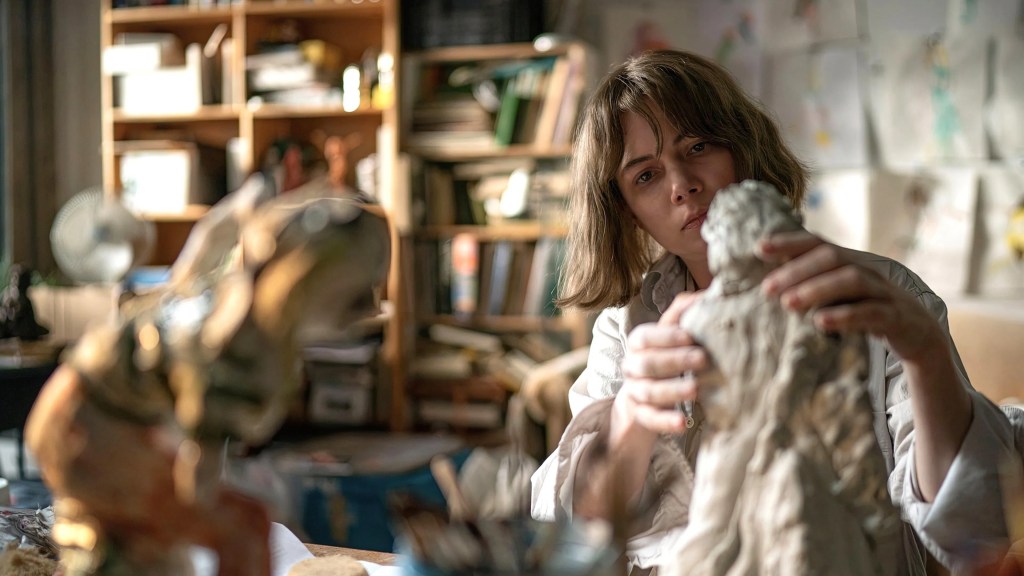
On the other hand, Showing Up hit me like a truck. And it’s not only because I did find it immediately relatable as a hopeful creative trying to juggle minutiae of everyday life that seem to consciously and ceaselessly pour themselves in front of me in an effort to prevent me from expressing myself as a writer. This facet of Reichardt’s movie, which also happens to be the one most critics and viewers (at least those who didn’t find the movie impenetrable and boring because if something doesn’t have a plot and a three-act structure, it is immediately an unwatchable experience antithetical to the generally understood idea of entertainment) latched onto the most. Sure, I saw a little bit of myself in Lizzy Carr (played by the magnificent Michelle Williams) and the trials and tribulations surrounding her attempts at pursuing artistic expression while trying to keep a roof over her head, dealing with her attention-seeking cat, her job and many micro-dramas related to her family life. I get all that and connect with this sentiment fully as someone with a full-time job, more responsibilities that I think I ever thought my shoulders could bear, relationships that need maintenance and nurturing and hopes and dreams vaguely associated with my writing hobby for which I seemingly cannot ever find enough time or energy. I see Lizzy’s frustrations and identify with them. I think I know what it feels like to develop facial muscles from excessive teeth clenching because life is never what you think it is for others and somehow the universe keeps making you walk uphill facing adverse winds while allowing people you see around you to get more done, get away with more and generally enjoy a more pleasant life.
But that’s not the aspect of the movie that shook me so profoundly that I am now seven hundred and fifty words into writing whatever this piece is. What I saw in Lizzy is a person who always suffers in silence, grits her teeth and internalizes all her frustrations. I saw someone who, when she finally cannot hold it in any longer and lashes out at her landlady (Hong Chau) who refused to get her water heater fixed for literal weeks, ends up being “the problem” because she had the audacity to express her emotions and ended up seeing this act weaponized against her in an act of disgustingly narcissistic gaslighting. I saw someone who never talks about herself and rarely receives a call after leaving someone a voice note. I saw someone who serves as a punching bag for other people around her, someone who persists in a state of suspended animation, torn between taking herself outside of her comfort zone and ignoring toxic behavior inflicted upon her by people who should have been in her corner all along, like her parents and friends.
I saw someone who bottles everything up, compartmentalizes her frustrations, makes excuses for people who hurt her, refuses to speak up when time after time they fail to show up for her and—whenever stars align and she can finally sit down and sculpt—she expresses herself through her work. She makes sculptures of girls and women, all frozen in action and emotion, all doing something, all making the world aware of how they feel. I saw… a reflection of things I do, defensive actions I’ve adopted, coping mechanisms I developed, frustrations I internalized, gaslighting I allowed or failed to recognize, other people’s expectations I’ve convinced myself were my own. Kelly Reichardt’s Showing Up became an immediately upsetting experience to me because the movie was about me. Furthermore, because it is after all a Kelly Reichardt movie where the filmmaker is more interested in letting me watch other people without necessarily promising they would undergo change or escape their predicament, she showed me exactly where I am now and where I will continue to be unless something changes. And the only way something ever changes is if and when I decide to do something about it.
It’s not that I had to watch this movie for my eyes to open to the dysfunction that has surrounded me for decades. It’s not like I discovered that I have had a tyrannical, domineering father who then unilaterally decided that everything was OK and he could have a normal relationship with me or my family. It’s not like I didn’t know, although this took me longer to fully appreciate, that I have had a narcissistic, gaslighting mother who manipulated my life forever, expected me to fall in line while clearly favoring my younger sister and who I can’t remember ever asking me how I felt or taking more than two minutes-worth of time to talk to me about me. I knew that nearly all my friendships would only last if I made an effort and I’d never received an unprompted call or a message from anyone while also knowing that the same people expected me to reach out and keep those friendships alive, as though they were my houseplants to maintain. I knew all that but somehow only seeing these exact patterns reflected in a different character knocked over that first domino piece and pushed me to act.
I have spent years now trying to optimize my life, getting on top of my fitness, my diet and my unhealthy habits. I’m well aware of the simple fact that you will only be as healthy as the food you eat and that the same principle applies to other spheres of your life. I’m intelligent enough to be able to draw this correlation. You can’t have a healthy mind if your intellectual diet is composed of dopamine-triggering horseshit you ingest while doom-scrolling through TikTok so if you want to increase your productivity, you need to let your brain ingest smarter things. Listen to better podcasts. Read better books. Watch better films. And I also subconsciously knew that all those efforts had set limits of how much they could have improved my life because I was too afraid to touch the elephant in the room—all the toxic relationships dragging me down like an anchor.
Somehow, I thought that if I fine-tuned everything else, they’d just take care of themselves or that things would just work themselves out. No. They won’t. And in fact, these unresolved issues have eventually encroached on areas I thought I had on lockdown. I proceeded thinking I was optimizing my life while all I was doing was creating a network of fragile coping mechanisms, all of which have eventually begun suffering from punishing diminishing returns. I thought that gym would be like a church to me: a place for me to be in the moment and gain perspective on things. I thought writing would have a therapeutic effect. But Reichardt articulated to me that all I was doing was sculpting little dolls and acting like an NPC in the video game of my own life, navigating progressively choppier waters to avoid the discomfort of expressing that crippling frustration that made me slowly grind down fillings in my molars in my sleep over the course of my entire adult life.
I’m done clenching my teeth. I don’t want to be Lizzy Carr. I’m done pretending not to see how unjust, toxic and manipulative my own parents are and how—even though I live thousands of miles away—they continue to cast a long shadow over my life. Just as a healthy body needs a healthy diet and a healthy mind needs to ingest healthy content, I will never find peace and happiness while carrying a baggage of toxic relationships in tow.
I have spent the first half of my life trying to keep these issues in my blind spot and hoping they wouldn’t matter, but they now obscure my entire field of vision. Seeing in Lizzy Carr what my own impotent frustration looks like in living colour stirred me to take drastic steps because I don’t want for the other four decades of my life to remain defined or influenced by gaslighting, manipulative and insincere people who could never apologize or even acknowledge they hurt me without attempting to flip the script or exercise some kind of control over me. I’m done.
Change has started and even though it’s complex, muddy and emotionally discombobulating to me, I decided I’m done coping, and I’d like to begin healing instead. Therefore, I am no longer on speaking terms with my parents and I probably won’t see them again. In their mind, I’m the villain. I’m the problem. My father sent me a beautifully manipulative letter that looked as though he took responsibility for what he did while also suggesting my problems were fabricated and that his fault was that he didn’t teach me how to fight made-up demons. Meanwhile, my mother decided to cast me out and play the victim.
And I’m fine with that. My healing is worth being a villain in their story. Because I don’t want to be Lizzy Carr and just exist on the periphery of my own story, waiting for people who have spent decades poisoning my life to stop on their own accord. You might not have any idea how painful the process of setting myself free and letting go of these demons is. I had no idea either. It’ll take a while for me to feel normal again. Have I ever felt normal, really? Maybe I need to discover myself anew to find some footing in life. And as I said, I have Kelly Reichardt to thank for this in part because I probably needed to see my life reflected in Lizzy’s character to reach the activation energy needed to begin the journey to reclaim the position of the main character in my own life’s story.
And coincidentally, I managed to prove to myself that writing can actually be therapeutic, not just a coping mechanism or a temporary sedative. These two thousand words took a chunk out of my side, but I suppose this is why I have avoided journaling for so long. Honesty is hard. I cowered in fear of my own thoughts. I still do and probably will for a while. But it’s a start. I decided to show up for myself.




 Flasz On Film
Leave a comment