
What are the limits of authenticity and verisimilitude in cinematic storytelling? The conventional wisdom would dictate that the most authentic and true to life a movie can get is when the camera is pointed at stuff that’s actually happening in the moment, which makes the canonical newsreel the pinnacle of authenticity. Everything else is an approximation of reality. A documentary reliant on reenactment and reconstruction must engage in manufacturing what the camera didn’t get the chance to capture itself, while also the fundamental concept of recounting a real-life story using a combination of archival footage, interviews and reenactments also carries the inherent perspective of the storytellers putting the movie together. In short, unless what you’re watching is a news report, what you engage with is fiction.
However, that’s not a problem because fiction, while not purely fettered to the idea of being a vector for facts, is a potent delivery system for the truth: as people who tell the story saw it, as the characters who may or may not be based on or inspired by real people saw it, as the viewer understood it. Reality is what we perceive and what we perceive might occasionally be misaligned with what objectively transpired, amplified or attenuated by our own response to what’s occurring, modified by our beliefs and convictions. A newsreel or a documentary-like assembly of archival footage will give you facts. But it might not have what it takes to give you reality. Cinema defined as a storytelling modality utilizing moving images, synchronized sound, music and special effects might miss out on facts or offer a perspective while eschewing facts, but it has a great opportunity to serve you a dose of reality of what the characters on the screen went through.
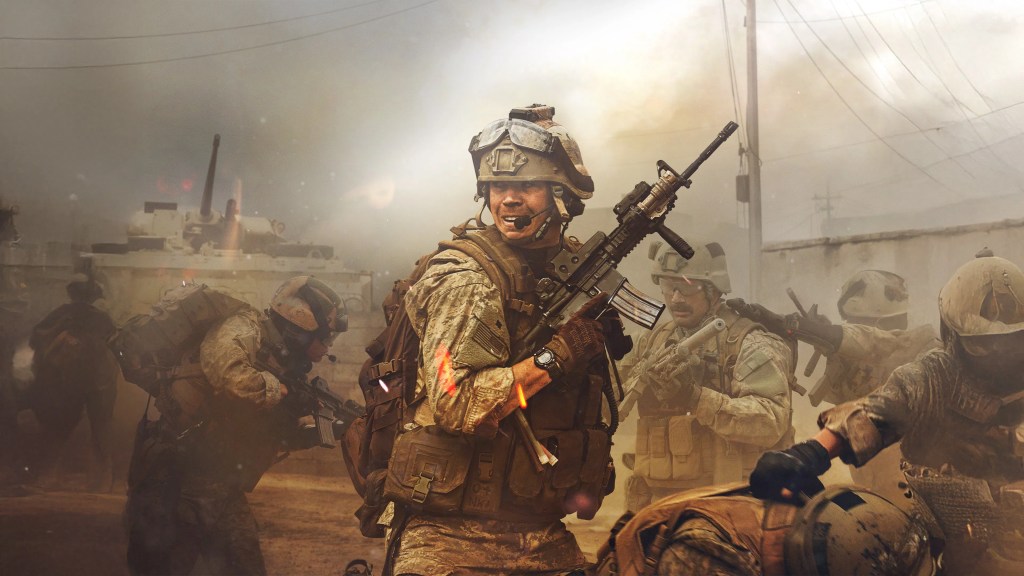
Which is why I think a movie like Warfare exists. I am told that while working on the set of Civil War, director Alex Garland collaborated with a guy named Ray Mendoza, who served on the set as a military consultant responsible for advising the production on realistic portrayal of military operations. This is when they decided to co-direct a movie together and tell a story based on Mendoza’s own recollections of one operation he was a part of while deployed with the Navy SEALs. What they decided they wanted to do—based on collected memories of those who survived what’s known as the Battle of Ramadi—was to recreate using the tools of cinematic expression the experience of what it was like for Mendoza and his comrades when they found themselves trapped in a house, surrounded by a mostly unseen enemy force and trying to fight their way out of the jaws of certain death.
Attention was placed on authenticity of the experience as opposed to conventionally engaging entertainment. None of the soldiers talk about their wives and kids. There’s no time for establishing camaraderie in ways a Peter Berg movie would, even if it would most definitely amplify the viewer immersion. It’s easier to get invested in the story when we have reasons to care about the characters or we have an idea about who they are as people. Warfare is not one of those movies. There’s no time for rapport or chit-chat. There’s no time for exposition either. This isn’t Lone Survivor (which i personally like quite a bit, by the way) where there’s ample time to establish who’s who and what’s what before bullets start whizzing past people’s heads. It’s not Black Hawk Down either where there’s room for large-scale spectacle amidst the potent on-the-ground chaos or time to slow down and indulge in a modicum of rah-rah flag-waving.
The only dialogue you’ll hear in Warfare will pertain to the job at hand. People will speak in code. They’ll adhere to the military radio discipline. They will follow protocol and procedure. With maybe a single instance of acknowledging that the US Marine Corps and the Navy SEALs are a real-life suicide squad that attract the kind of people who feel elated when they are surrounded because they get to shoot in all directions.
What you will also hear will be screams. And lots of them. Because when people get shot, they scream. When their limbs are blown off after an IED explodes while they are attempting to evacuate, they scream continuously. When they get a shot of morphine, they don’t calm down and think it’s all hunky-dory now. They continue screaming. When people try to stop them from bleeding out by stuffing gauze into their open wounds expelling blood from their shredded arteries, they scream even louder. They scream and scream while other people shout orders in the background and radio chatter continues unabated in the soldiers’ headsets and while the air support performs low flybys at high speeds to intimidate the enemy.
What you will see are close-ups of people trying to keep it together while making sure their friends would live a few minutes longer. Not because they care or because we care. After all, we have not seen the pictures of their families. They do it because it’s the job. They follow orders and execute protocols they had practiced a thousand times to the point where they became indistinguishable from muscle memory. They fire at positions where we don’t see anyone. Fire and move. Standard operating procedures. They tap the last guy on the shoulder. It doesn’t matter what the job was, if it was a reconnaissance operation or something else. It’s a job.
Warfare depicts what happens in the combat zone as a job that people do. Which also happens to be a job that is far different to what we tend to think it is based on Hollywood movies. Garland and Mendoza dispel all those notions and steer clear from politicking to concentrate on procedure and immersion to conjure the ultimate act of authenticity and reflect the reality of what it feels like to be stranded in a house where you don’t want to be and where the procedure dictates you must keep the occupiers of the house—people whose only sin is that they had the misfortune to live where you were told to go and establish a position—under arrest. You won’t get that kind of realism from a newsreel or even from the most orthodox documentary movie. You will not find it in a typical Hollywood blockbuster because this thing doesn’t have a typical three-act structure, a hero we are to sit with and care about or a mission we are supposed to invest in. It’s an experience that tells us, as if we needed reminding, that general Sherman was right. War is hell and its glory is all moonshine. It’s chaos incarnate. A swirling vortex of screams, blood, gore, sweat and dust that is not to be romanticized but merely acknowledged as a part of the human experience.
Warfare is a movie about not necessarily what war looks like but what it feels like. Garland and Mendoza thus come close to finding what Werner Herzog has described as “ecstatic truth,” that is something that transcends pure facts and reflects a reality that is experienced, not merely learned. They don’t take political stances with their movie, though it’s hard not to identify with people whose faces we see, as opposed to the unseen force firing from a distance. I think they successfully depict what being in a combat zone must feel like and they use the powers of cinema to their fullest.
To put it bluntly, in a world where cinemas have to look for gimmicks to entice viewers to come out and see movies, Warfare is a perfect example of a film worthy of being called a cinematic experience. It’s not a spectacle like Gravity or Avatar but in order to fully experience the sensory onslaught the filmmakers concocted using nothing but honest camera work, immaculate execution of military procedure and absolutely outstanding sound mixing and editing, you simply must see it in a theatrical setting. And if it’s not possible, watching Warfare on your own at home positioned close enough to the screen that it would envelop your entire field of vision and with good quality headphones on would be an acceptable replacement. It is a great experience and potentially the first great movie of 2025. Because without a shred of commentary and by focusing solely on crafting as true-to-life an experience as possible, Garland and Mendoza managed to put together a movie that decries warfare as a romantic endeavour while saluting the courage and fraternal devotion of those who find themselves in a combat zone, doing a job. In doing so, I think they found that Herzogian ecstatic truth.


 Flasz On Film
Leave a reply to Auto-Catalyzed Perpetuation of Poor Radio Discipline – Flasz On Film Cancel reply