
Nobody really expected The Terminator would make money. In fact, it was a one-off trashy slasher film that nobody wanted to bankroll and even Arnold Schwarzenegger didn’t think much of it. “Some shit movie I’m doing,” he’d call it when asked. Therefore, it’s only reasonable to assume that it was never intended to spawn a sequel, let alone a multimedia franchise and it only became a possibility, or better yet an inevitability, once the box office receipts began flowing in.
And I know this might be controversial in some circles, especially among those who may have been the right age to go watch Aliens and T2 in the cinemas, but the long-awaited follow-up to the 1984 sleeper hit—which was predominantly delayed thanks to a protracted battle over rights, a foreshadowing of sorts in its own right—was not necessarily born out of original thought at all. If we are to trust James Cameron, then T2 was a movie he originally intended to make instead of the original. He wanted the movie to feature two terminators, one of which was liquid metal, but he didn’t have the technology to make it happen. In fact, the technology in question only barely became available in 1991 when ILM got to work on T2 (and they pushed at it until the final bell) and it was ground-breaking enough to earn the movie an Academy Award. But the point stands that the general concept behind Terminator 2: Judgment Day had already existed before The Terminator was made. Granted, the massive hook of seeing who the viewer would immediately have identified as the villain from the first movie show up as a cybernetic guardian angel to young John Connor played by Edward Furlong engineered a grand cultural moment (perhaps not on the scale of the Darth Vader reveal, but close enough, I reckon), but at this point the Terminator formula was set and nobody really knew how to open up the series and use some of the world-building left behind by Cameron in infrequent dream sequences and flashbacks inspired heavily by Roger Corman movies and Mad Max. All they seemed to know was along the lines of more of the same, but with a different flavour.
Thus, Terminator 3: Rise of the Machines tapped into the same formula once more, only with a slight variation of having a female terminator square off against the now ageing Arnie, who was also about to throw in the towel and focus on his political career. And at this point I might as well bring up the fact that once more the subject of rights to the series was an issue delaying the production of the movie too. It is as though different Hollywood factions were vying for their turn at the wheel as many people wanted to, once again, send a pair of terminators from an as-of-yet poorly described cinematic future to thrash things out in the present while looking to protect or eliminate John Connor. At least this movie did get to show the viewers what Judgment Day would actually look like, so there’s that. However, it didn’t make a lot of money, especially when compared to T2 which was an instant cash cow upon release. It was also critically derided, which isn’t surprising either when you realize the movie was trying to recapture almost exactly what T2 did much better and essentially staged the third reenactment of a “Character A comes back from the future to protect Character B from Character C who also came back from the future while wreaking havoc and altering that future from where Characters A and C originated” archetypal recipe.
To be perfectly honest, originality in the Terminator franchise was not to be found in movies, or even in the short-lived TV show Terminator: The Sarah Connor Chronicles, which also relied on the now archetypal time travel formula. Original stuff reliant on world-building and peeking into different facets of the series lore was found in franchise-adjacent works, like novels, fan fiction and comic books. Sure, some of them were just crossovers and featured well-known superheroes facing off against terminators, but this is also where readers could experience what life after Judgment Day could be like and how the world and the lore could be opened for further exploration.
Therefore, I find the 2009 Terminator Salvation to be one of the most (if not the most) intriguing movies in the Terminator series because, again after a long battle over rights and who gets paid how much and what does James Cameron get out of it anyway, it at least attempted to bench the time travel formula and showed us something we haven’t seen before. Now, it has become customary to pour excrement on this movie and to associate its biggest cultural impact with that time Christian Bale was recorded on set as he was verbally abusing the director of photography. Sure, I can take it on the chin. It’s not the best movie ever and in a summer where Transformers: Revenge of the Fallen was setting the bar for special effects (and Bay-esque crass humour) and only months before Avatar would come at Christmas time and show everyone what making money at the box office should look like, a movie like Terminator Salvation looked trashy at best.
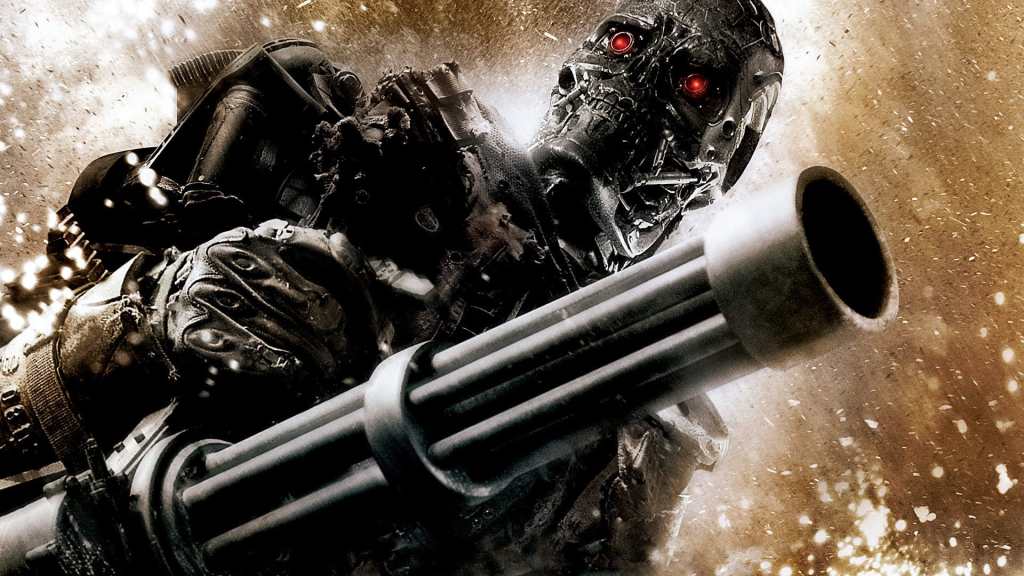
And in fact, it was trashy. Or to be perfectly clear, it is a movie best understood as a piece of B-tier genre trash, as opposed to a spick-and-span “proper” blockbuster with big boy earning potential. The problem was that it cost two hundred big ones to make so it had to bring in some serious revenue to keep its financiers from erupting like Yellowstone geysers and the only thing it had going for it was the iconic visage of the Terminator endoskeleton associating it with the series it was otherwise effectively breaking away from. It didn’t have Schwarzenegger. It didn’t have time travel. It didn’t have the quips, the sunglasses and the hasta la vista babies. For all intents and purposes, Terminator Salvation was attempting a Mad Max-type movie set in a world we have seen in flashbacks, twenty seconds at a time, starring a guy (Sam Worthington, cast at the personal recommendation of James Cameron himself) nobody recognized and where the big-name star, Christian Bale high on his post-The Dark Knight fame, was only there for small portions of the movie. It was conceptually a bad money-making idea.
However, at the same time, Terminator Salvation was a trove of cool storytelling ideas to breathe some new life into the stale series. We got to see terminators who think they’re human, all sorts of new robots and designs and even we got to see the Skynet HQ in San Francisco… which arguably looked from the outside like a Rammstein concert with long-haired and unwashed crowds herded into confined areas surrounded by pyrotechnic installations breathing fire for no apparent reason other than because it’s cool and futuristic in the most 90s sci-fi trash kind of way. In addition, the movie—despite being chronologically a sequel in the series—served as an early prequel to the original because we got to meet young Kyle Reese (Anton Yelchin) and saw how he earned his stripes and became a part of The Resistance (which was also, for the first time, got to inspect up close). Which is interesting and original enough already, thank you very much. And that’s on top of a narrative template that was completely orthogonal to anything we had seen in the series and staged a much grander set of stakes while focusing on an interplay between two main characters, neither of which had come from the future either.
Unfortunately, Terminator Salvation didn’t resonate with audiences at the time despite the fact it wasn’t any stupider than baseline blockbuster fare and it slotted into the post-Matrix wave of post-apocalyptic cinema, which also included titles like The Book of Eli, I Am Legend, or Reign of Fire (also starring Bale, by the way) with relative ease. A sequence or two may also have something in common with Spielberg’s War of the Worlds, so how’s that for winking at prestige?
To be perfectly frank, it was a bit messy, simple and convenient, especially with the way it was harking back to elements of the original movies and the way it borrowed heavily from other genre movies. Its ashen aesthetic and overbearing reliance on post-Bourne shaky cam filmmaking hadn’t been considered stale or overused at the time, even though you’d be within your rights to scoff at them already. But shoot me dead it was a fun movie to watch. Still is. In fact, in 2024, fifteen years after its initial release, which also carried a promise of a trilogy that was immediately nixed on the back of poor box office performance, it remains the only movie in the series courageous enough to think outside the box a little and try something new.
Sure, McG is no James Cameron and the movie clearly looks like a step down when it comes to direction, ideation behind action set pieces and injecting earnest drama into an otherwise schlocky genre husk. You can’t really overlook this problem and therefore Terminator Salvation just doesn’t have what it takes to stand its ground when compared against its predecessors in the series or even direct competitors for box office dollars. But, again, it’s fun enough as a late-night Netflix engagement and I am happy that it exists to provide a bit of respite from the Terminator formula with its post-apocalyptic shenanigans and a brief attempt at bringing back the visage of the original terminator using face replacement CGI and other magic tricks. The fact it isn’t anywhere near as grand and bombastic as the Cameron-directed movies in the series is not a flaw in my books, but a refreshing change of tack and I will happily die on that hill.
The singular originality of Terminator Salvation becomes even more evident when you look at the movies the series spawned after the McG-directed box office fiasco sent its producers into a tailspin. Hollywood folks just had no idea what to do with the series, other than there must have been some dollars to be earned out of this property. So, they forgot about this wild and courageous excursion into the land of tangential lore and post-apocalyptic prequelizations and went right back to what they knew, only with a legacy sequel slant with Terminator Genisys, which was not only messier but also quite frankly incorrigibly unentertaining. What’s more, it was also supposed to spawn a standalone trilogy which was immediately taken behind the shed the minute the box office returns were known. Dark Fate? Same deal. Another bomb in a long string of attempts at doing the same thing all over again while throwing a fresh coat of paint on the formula to make it look shiny and new.
Like that Chanel outfit Marge Simpson refashioned into several dresses that looked original and fresh, the series eventually just fell apart and, as far as movies go, forty years on we only have that unmatched original “Halloween from the future,” a fantastic sequel from 1991… and Salvation, the only movie that tried to break with the formula and did something new. The rest is fodder, a string of clones built recursively on an iteratively decomposing formula. As far as originality is concerned, Terminator Salvation is what you have in the series, in addition to the 2024 anime series Terminator Zero, which utilizes the time travel formula to an extent but equally builds in brand new lore, freshens up the archetypal storytelling found in the franchise and most importantly leans heavily onto its exotic iconography. So, I’m not asking you to choose between them. I’m asking you to think for yourself and give Salvation another look because its trashiness has a quality unto itself, and you will be hard pressed to find another movie in this franchise with a distinctively original feel to it. Even if it’s flawed, imperfect, camp and altogether subservient to the two masterpieces James Cameron concocted, Terminator Salvation is well worth your time.








Leave a comment